Solytics Partners Secures a Trifecta of Wins at the Economic Times Enterprise AI Awards 2026


AI governance best practices help organizations manage artificial intelligence systems through defined controls, accountable decisions, and documented evidence. These practices establish how teams assess risks and approve development. They also guide validation activities and ongoing oversight after deployment.
An AI governance workflow translates these practices into a sequence that connects business teams with risk and technology functions. Without that sequence, enterprises often maintain policies without clear ownership or consistent evidence of how teams enforce them.
The challenge is therefore operational. Organizations need to establish who makes each governance decision and what evidence supports it. They must also determine when an AI system can proceed and when unresolved issues should halt its progress.
This blog focuses on running those decisions across seven governance stages. For a deeper explanation of the technical lifecycle itself, see the Solytics Partners guide to AI model lifecycle management.
What are AI Governance Best Practices?
AI governance best practices establish clear rules for assessing, approving, monitoring, and managing AI systems throughout their lifecycle. They help enterprises apply risk controls consistently while maintaining accountability for decisions involving AI technologies.
AI governance framework establishes responsibilities and risk expectations. A workflow converts those expectations into specific activities supported by defined decision gates. Together, they provide the foundation for effective AI governance. The following practices help organizations turn their governance requirements into repeatable decisions.
- Risk-based oversight: Classify AI systems using their intended purpose, potential impact, autonomy, and exposure to sensitive information. Apply stronger controls where systems can influence consequential business decisions or affect individuals.
- Clear accountability: Assign named owners for system performance and governance decisions. Each owner should understand their approval authority and escalation responsibilities before accepting the assigned role.
- Documented decision-making: Record risk assessments, approvals, validation findings, and exceptions throughout the lifecycle. These records help reviewers understand why teams accepted risks or approved deployment.
- Independent validation: Use reviewers who can challenge development assumptions and evaluate whether testing supports the intended application. Keep validation findings visible until responsible owners resolve or accept them.
- Continuous oversight: Monitor deployed systems for performance changes and policy breaches. Trigger reassessments when operating conditions introduce emerging risks or materially change system behavior.
AI governance best practices become more useful when these requirements connect with recognized frameworks. Three references are particularly relevant for enterprise implementation.
How Do NIST, ISO/IEC 42001 and the EU AI Act Guide Governance?
The NIST AI Risk Management Framework provides voluntary guidance for managing AI risks. Its Govern, Map, Measure, and Manage functions help enterprises structure risk activities. Enterprises can translate these functions into approval criteria and evidence requirements within their existing operating processes.
ISO/IEC 42001:2023 establishes requirements for implementing an AI management system. Organizations can use the standard to define governance processes and support continual improvement. Unlike NIST AI RMF, ISO/IEC 42001 provides a basis for independent management-system certification. See the Solytics Partners guide to ISO/IEC 42001 AI management systems for the practical implementation requirements.
The EU AI Act, amended by Regulation (EU) 2026/1744, establishes binding requirements for applicable AI systems. The Digital Omnibus on AI reached political agreement on 7 May 2026 and entered into force on 27 July 2026.
The amended timeline establishes the following application dates:
- 2 August 2026: Article 50 transparency obligations began applying.
- 2 December 2026: The limited transition ends for machine-readable marking of specified systems already on the market.
- 2 December 2026: New Article 5 prohibitions concerning non-consensual intimate content and child sexual abuse material generation begin applying.
- 2 December 2027: High-risk requirements begin applying to standalone Annex III systems.
- 2 August 2028: High-risk requirements begin applying to relevant Annex I embedded systems.
Enterprises should identify which requirements apply to each system before assigning governance controls. The Solytics Partners EU AI Act guide provides additional regulatory context, while the governing legislation remains the authoritative source for compliance decisions.

What Are the Steps in an AI Governance Workflow?
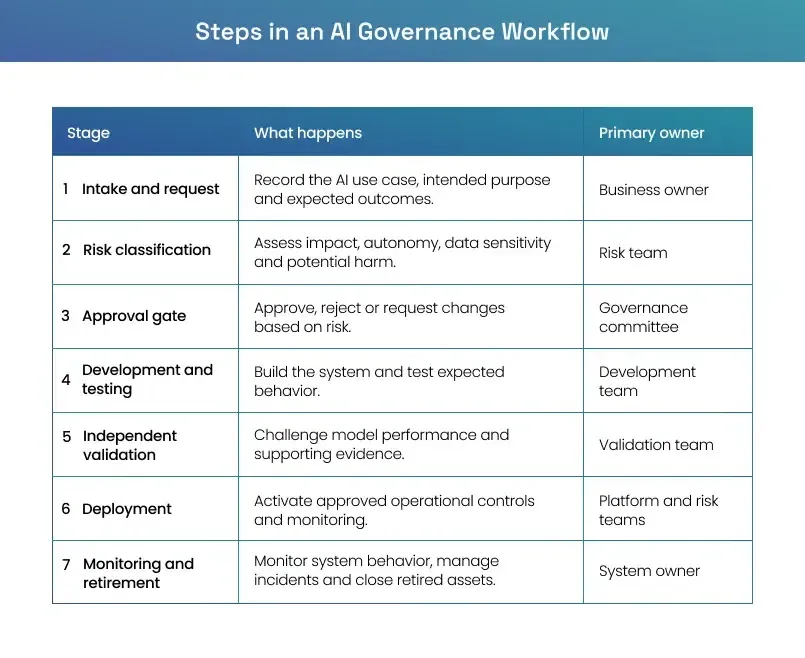
A complete AI governance workflow follows seven stages, starting with use-case intake and ending with system retirement. Each stage should produce evidence that helps the next owner assess readiness and make an informed decision.
The workflow centers on governance decisions rather than technical development activities alone. It identifies who can authorize progression and when a proposal must return for further review.
The following stages support AI governance best practices by connecting individual reviews to a consistent operating sequence.
Stage 1: Intake and Request
The business owner submits a proposal describing the intended AI application and its expected business value. The request should identify intended users and relevant business objectives. It must also explain which decisions the system will influence.
Teams should identify the underlying AI technology, including traditional machine learning or generative AI. Autonomous agents require additional attention because they can execute actions through connected tools.
The intake owner should also record whether the application could affect customers or employees. Where potential harm to stakeholders is relevant, the request should initiate an AI impact assessment before the governance committee makes its initial decision.
Stage 2: Risk Classification
The risk team assesses the proposed system using defined criteria that reflect the organization's risk appetite and operating environment. Classification should consider decision impact, data sensitivity, system autonomy, and potential effects on customers or employees.
Higher-risk applications may require deeper testing and additional approvals. They may also need stronger human oversight. Lower-risk applications can follow a shorter approval route when policy permits.
The classification must determine which governance controls apply. Teams should document the scoring rationale and identify the reviewers required for each tier.
A consistent AI risk-tiering approach helps enterprises apply these requirements proportionately without conflating internal risk classifications with legally defined regulatory categories.
Stage 3: Approval Gate
The governance committee reviews the proposed risk classification and supporting evidence before authorizing further development. Reviewers can approve or reject the request. They can also return it when the available evidence does not support approval.
An effective approval gate records decision ownership and outstanding conditions. It also documents the rationale behind each outcome. This prevents teams from treating informal discussions as documented authorization.
Importantly, this stage authorizes only development and testing. It does not constitute approval to deploy the AI system into production. The committee should record the conditions that development teams must satisfy before requesting final release approval.
Stage 4: Development and Testing
Development teams build the AI system in accordance with approved requirements while documenting relevant design decisions and technical dependencies. Testing should assess performance, data quality, robustness, and behavior under expected operating conditions.
For generative AI, teams may examine hallucination risks and harmful outputs. Prompt manipulation introduces another risk that requires targeted testing. Results should identify limitations that reviewers must consider before deployment.
The development lead should confirm that all required testing has been completed before submitting the system for independent validation. Unresolved defects must remain visible in the governance record rather than disappearing during the handoff.
Stage 5: Independent Validation
Independent reviewers assess whether the testing provides sufficient evidence to support the system's intended purpose and risk classification. They challenge development assumptions and examine documented limitations. Reviewers must also determine whether proposed controls address identified weaknesses.
Validation may include explainability, bias testing, and fairness analysis where relevant. Reviewers should document unresolved findings and recommend conditions before approving deployment.
The validation team should produce a formal recommendation identifying whether the system meets its approved acceptance criteria. The recommendation may support release or require further testing. Material unresolved findings must be escalated to the governance committee.
Validation does not itself authorise production deployment. The committee must consider the findings before granting final approval. A structured AI assurance framework can help reviewers connect testing conclusions with ongoing evidence requirements.
Stage 6: Deployment
Before deployment, the governance committee reviews the independent validation findings and confirms that required controls are in place. It also considers unresolved exceptions and any proposed operating restrictions.
The governance committee gives the final production release approval based on the validation evidence and applicable risk criteria. The decision must identify the approved system version and any conditions attached to deployment.
Only after that approval can platform teams release the system into production. They establish access permissions and monitoring thresholds in accordance with the approved operating requirements. The release record should identify the system owner and responsible operational team.
For agentic systems, runtime safeguards can control whether individual actions proceed, require human review, or stop. Deployment records should identify the responsible system owner and approved operating boundaries.
Stage 7: Monitoring and Retirement
System owners monitor performance, control breaches and material changes throughout production use. They initiate incident response procedures when behavior exceeds approved limits or introduces new risks.
Retirement requires teams to close outstanding issues and remove unnecessary access. They must also preserve records in accordance with applicable retention requirements. This completes the governance lifecycle and provides evidence of responsible system closure.
Monitoring findings should trigger reassessment when they indicate that the approved risk classification may no longer be appropriate. A material incident or significant model change can also require renewed validation.
The governance function should establish who can approve continued operation after such changes. Retirement decisions need similar accountability, especially where a system remains connected to customer-facing processes.
These seven stages create a controlled operating sequence. Each stage has an accountable decision-maker, with evidence that determines whether the system can progress.
How Would This Workflow Differ for a Credit Model and an Internal AI Summarizer?
Consider a bank developing an AI credit assessment model and an internal meeting summariser. Both enter the same governance workflow, but their risk classifications lead to different approval requirements.
The credit model can influence access to financial services. It therefore requires deeper validation and stronger oversight, with the final governance committee approval informed by evidence of model performance. Monitoring must also identify changes that could affect customer outcomes.
The internal summariser may qualify for a lower internal risk tier if its access remains restricted to approved documents. It still needs an accountable owner and basic security controls, but the approval process can be proportionate to its lower potential impact.
The AI governance workflow remains consistent across both applications. The difference lies in the depth of control and the evidence required before approval.
How Do You Build an Effective AI Governance Process?
Organizations build effective AI governance by defining current workflows, assigning responsibility, and establishing risk-based exit criteria. Successful implementation connects governance decisions with evidence while keeping approval requirements proportionate to potential impact.
The following AI governance best practices provide a starting point for implementing the workflow across business units.
- Map the current approval process: Trace how teams propose AI applications and move them through development. Document existing approval steps and deployment requirements. Identify informal decisions or missing checkpoints before introducing additional requirements.
- Assign owners to each governance stage: Assign a responsible owner to each activity and define the authority required to approve its completion. Clarify escalation procedures when reviewers identify unresolved risks or conflicting requirements.
- Establish measurable exit criteria: Specify which documents and control results teams must provide before moving forward. Identify acceptance thresholds where testing evidence supports objective decisions. Reviewers should apply these criteria consistently across comparable applications.
- Apply proportional governance controls: Match review depth to system risk rather than requiring identical procedures for every application. A basic internal summarization tool may need fewer checks than a consequential decision system.
- Maintain connected governance records: Keep intake information and approval decisions linked to the same governed asset. Attach relevant classifications and testing evidence to that record. This reduces manual reconciliation and improves visibility across separate teams.
- Create formal exception procedures: Define how owners request exceptions and identify who can authorize them. Specify when accepted risks require reassessment. Record the rationale and any conditions attached to the decision.
- Include reassessment and retirement requirements: Establish review triggers for material changes in system purpose or operating conditions. Monitoring breaches and unresolved incidents should also prompt reassessment where relevant. Define who can approve retirement and require documented closure of outstanding issues. Remove unnecessary access and preserve records in accordance with applicable retention policies.
These activities connect governance policies with the decisions employees make during daily operations. They also help enterprises maintain consistent controls as their AI portfolios expand.
What are the Most Important AI Governance Best Practices Across the Lifecycle?
The most important AI governance best practices focus on risk classification, accountable approvals, independent validation, continuous monitoring, and reliable evidence. They help enterprises manage risks before deployment while preserving oversight as systems and operating conditions change.
The following controls deserve particular attention because they influence whether governance operates effectively across business functions.
Classify Risk Before Assigning Approval Requirements
Risk classification should determine the level of governance scrutiny each AI application receives. Teams should evaluate business impact and potential harm before defining the required review depth. System autonomy and data sensitivity can further influence that decision.
A consistent classification method helps reviewers compare systems against common criteria. It also prevents low-impact applications from following unnecessarily complex approval processes.
Establish Independent Validation for Higher-Risk Systems
Independent validation gives organizations a structured challenge to development assumptions and testing results. Reviewers should examine whether evidence supports the intended purpose and whether limitations affect acceptable use.
For traditional models, validation may focus on performance and stability. Reviewers should also examine whether model assumptions remain valid. GenAI applications may require additional checks for unreliable responses and unsafe tool behavior.
Maintain Governance Evidence as Work Happens
AI governance best practices require teams to document decisions when they occur rather than reconstruct records during an audit. Each record should identify the responsible owner and decision outcome. Supporting evidence must remain available for subsequent review.
Relevant records include model cards and risk assessments. Approval histories and validation reports provide further context for understanding system decisions. Connected evidence makes it easier to trace how an AI system reached its current governance status.
Continue Monitoring After Deployment
An AI system can meet its original testing requirements and still develop problems under changing operating conditions. New data, evolving user behavior, and modified integrations can affect performance or introduce unexpected risks.
Continuous monitoring helps teams identify these changes and initiate appropriate responses. Enterprises should define thresholds, escalation ownership, and reassessment triggers before production deployment.
Monitoring should also inform governance decisions. A material change may justify additional validation before the organization authorizes continued operation.
Apply Human Oversight Where Decisions Require Intervention
Human oversight should reflect the consequences of an AI system's decisions and the autonomy granted to it. Higher-impact applications may require human approval before executing particular actions.
Reviewers need enough information to understand system behavior and challenge unsafe decisions. Effective oversight also requires authority to override outputs or suspend actions. Teams should define escalation routes for situations that reviewers cannot resolve.
For autonomous agents, these controls should operate at consequential execution points rather than relying on retrospective reviews. The Solytics Partners guide to human oversight controls explains how approval gates and intervention authority support operational oversight.
Connect Ethical Principles With Operational Controls
Ethical principles are most useful when organizations translate them into clear requirements that teams can implement. Fairness should have measurable evaluation criteria, while transparency needs documented explanation requirements. Accountability must identify who approves decisions and who responds when expected controls fail.
For example, a credit model may require fairness testing against approved disparity thresholds. The responsible owner must review the results and determine whether additional mitigation is necessary. Validation reports should preserve the evidence supporting that decision.
Transparency controls can require documented model limitations and explanations appropriate to the intended users. Accountability controls should preserve the approval record and identify who accepted any residual risk.
These mechanisms turn broad ethical commitments into reviewable evidence. They also help enterprises determine whether individual controls continue meeting the requirements established during development.
Define Clear Incident Response and Recovery Procedures
Governance teams should establish how personnel report, classify, investigate, and resolve AI-related incidents. Incident categories can reflect harmful outputs, unauthorized actions, privacy violations, or unexpected model behavior.
Each procedure should identify the responsible owner and relevant escalation authority. Post-incident reviews should capture corrective actions and determine whether the system requires additional validation.
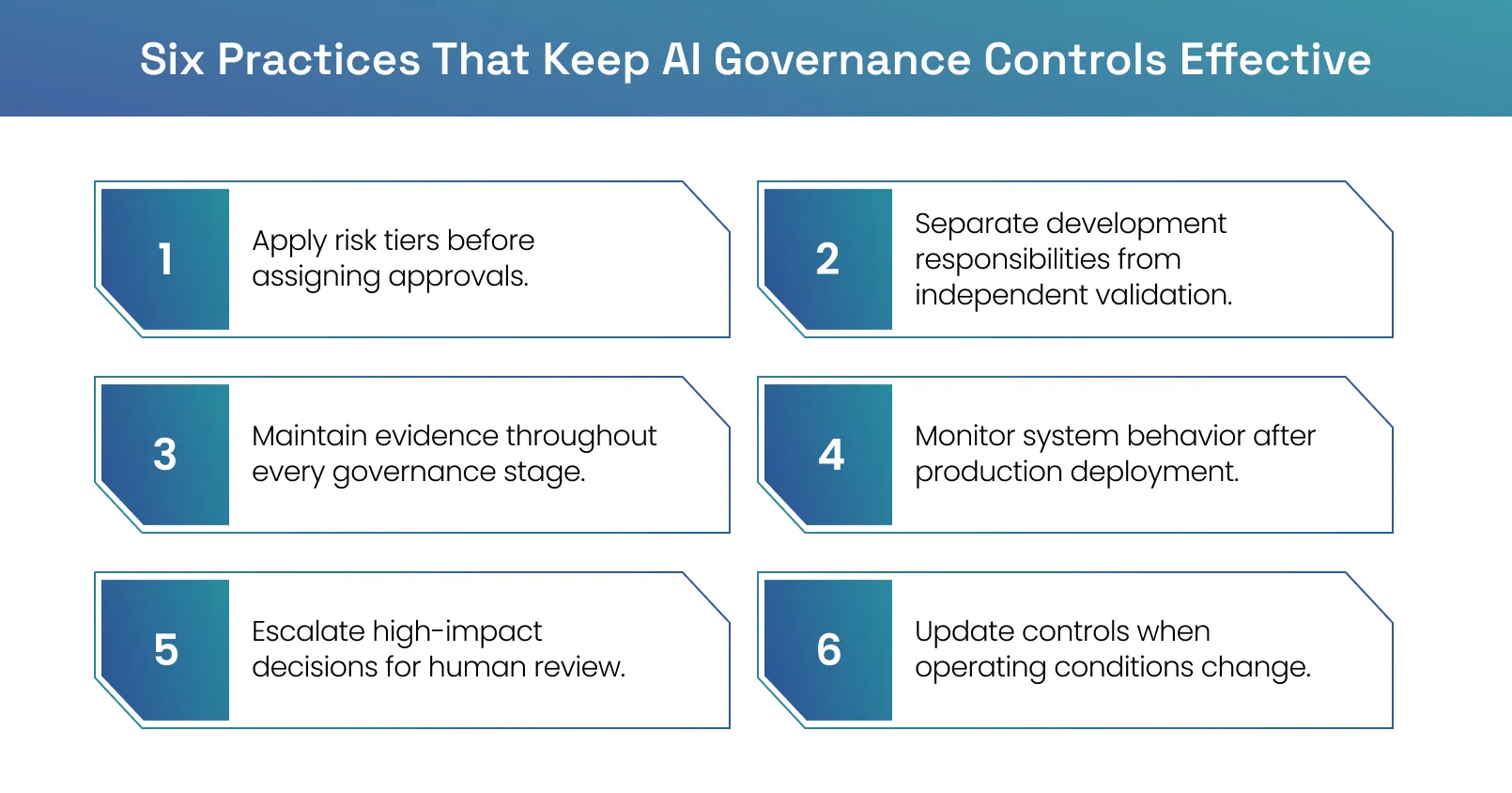
These controls turn AI governance best practices into observable actions. Organizations should review their effectiveness as new systems and risks enter the portfolio.
How Do Organizations Implement AI Governance Best Practices?
Organizations implement AI governance best practices by progressing from informal reviews toward connected governance processes. Each phase should improve ownership, evidence quality, and coordination before introducing additional complexity.
Solytics Partners uses a simple three-phase maturity view to illustrate how organizations can improve governance operations:
Phase 1: Manual and Reactive Governance
Teams manage AI inventories in spreadsheets and exchange approval records through email. Validation evidence often sits in separate documents. Governance activities frequently depend on individual knowledge rather than standard procedures.
This approach can support early adoption, but inconsistent records make portfolio-wide oversight difficult. Companies should establish common intake requirements and ownership before expanding the program.
Phase 2: Structured but Siloed Governance
Teams introduce standardized risk assessments and approval checklists across business functions. Independent validation procedures may also become more consistent. However, departments often maintain separate records and use disconnected governance tools.
The next priority is to connect lifecycle decisions and evidence. Shared identifiers and consistent reporting requirements help reduce discrepancies between governance stages.
Phase 3: Connected and Proactive Governance
Organizations connect AI inventory with risk classification through an integrated governance structure. Approval records and evidence of ongoing monitoring become accessible through shared processes. Teams can track system status and investigate issues using connected records.
Governance committees gain stronger visibility into unresolved findings and material changes. This supports coordinated oversight as enterprises expand AI use cases and operating environments.
A maturity assessment should identify which capabilities need improvement rather than prescribing an identical implementation path for every organization.

What Tools Support AI Governance Best Practices?
AI governance tools help enterprises manage system inventory and risk assessments. Other tools support validation and runtime controls throughout the lifecycle. Enterprises should evaluate whether these capabilities connect governance decisions with operational evidence.
Companies should assess integration capabilities before selecting individual tools. Disconnected systems can increase administrative effort and weaken traceability across the governance process.
AI governance best practices also require a clear distinction between enforcing a control and monitoring its effectiveness. Runtime enforcement tools can prevent prohibited actions, while observability tools detect issues and report supporting evidence.
Both capabilities support governance, but they serve different operational purposes.
Enterprises should evaluate whether these tools connect control evidence with the approved governance record. This makes it easier to review why a system entered production and determine whether operating conditions still support its approved use.
How Does Solytics Partners Support AI Governance Best Practices?
Solytics Partners supports AI governance best practices through AI Vault and NIMBUS Uno, connecting lifecycle governance with evaluation and runtime assurance. The platforms help enterprises coordinate approvals, testing evidence, and operational monitoring through a connected governance model.
AI Vault: Governance and Lifecycle Oversight
AI Vault supports AI asset inventory and ownership records across enterprise AI systems. It also provides materiality scoring and risk-based classification to help teams assess governance requirements.
The platform supports configurable policy workflows and approval processes. Findings and attestations remain connected to supporting evidence trails.
Its control-mapping capabilities help governance teams connect AI assets to applicable policy requirements. This supports the management of approval evidence throughout the governed lifecycle.
NIMBUS Uno: Evaluation, Runtime Assurance and Monitoring
NIMBUS Uno provides evaluation capabilities for model accuracy and robustness. It also supports bias testing, safety evaluation, and hallucination detection.
Its observability capabilities track prompts and responses. Monitoring also covers retrieval activity and tool calls through more than 60 available metrics.
Runtime assurance checks agent actions before execution. The system then allows, escalates, or blocks each action according to applicable policies. Monitoring functions provide alerts and traces that support operational review.
Connected Governance Across the Lifecycle
AI Vault maintains governance records, including risk assessments and approvals, while NIMBUS Uno provides validation, runtime assurance, and monitoring evidence. Together, these platforms help organizations apply AI governance best practices consistently, connect lifecycle decisions to production behavior, and strengthen oversight.
The connection is particularly useful when production findings require another governance decision. Monitoring can reveal behavior that warrants investigation, while the existing approval record provides context for reassessment.
This integrated approach reflects Solytics Partners' expertise in enterprise AI governance. Solytics Partners is a Category Leader in the Chartis RiskTech Quadrant® for AI Governance Solutions, 2025.
Book a demo with Solytics Partners to explore how connected governance, validation, and monitoring can strengthen your AI oversight processes.
FAQs
What Are the Most Important AI Governance Best Practices?
Effective governance requires clear accountability and independent validation throughout the AI lifecycle. Continuous monitoring provides additional oversight after deployment. An AI governance framework connects these controls with organizational goals and ethical considerations. Enterprises should also align governance policies with applicable regulatory requirements and operational risks.
Who Should Own AI Governance in an Enterprise?
Enterprise AI governance should have clear executive accountability, supported by designated business and risk owners. The governance committee establishes approval requirements and reviews material exceptions. System owners remain responsible for operational performance. Compliance teams can provide independent oversight in line with the organization's governance structure.
What Are the Seven Stages of AI Governance?
The seven governance stages cover intake, risk classification, initial approval, development, independent validation, deployment and monitoring through retirement. The governance committee grants final production approval after considering validation findings. Each stage should preserve evidence of the relevant decisions and identify who is accountable for allowing progression.
How Is AI Governance Different From AI Risk Management?
AI governance establishes the policies and decision authority used to oversee AI systems. AI risk management focuses on identifying potential risks and determining appropriate treatment measures. Risk management therefore operates within the broader governance structure. Both disciplines require documented ownership and supporting evidence to remain effective.
What Tools Support AI Governance Across the Lifecycle?
Enterprises use inventory platforms and governance workflow systems to manage AI systems. Evaluation tools support technical review, while observability solutions provide production evidence. These capabilities support data governance and ongoing monitoring of AI applications. Integrated platforms help teams maintain consistent records and improve accountability across governance activities.