Solytics Partners Secures a Trifecta of Wins at the Economic Times Enterprise AI Awards 2026


AI agents now take multi-step actions across enterprise systems without pausing for review at each step. They can call tools and update databases while completing connected tasks within seconds. This speed creates new operational risks when workflows lack meaningful opportunities for human intervention.
Enterprise teams therefore need to shift oversight from manual review habits to controls built into the AI system itself. Manual review cannot scale when agents complete thousands of actions across distributed workflows every hour.
The EU AI Act establishes a baseline in Article 14, which requires effective human oversight of high-risk AI systems within its applicable scope and implementation timelines. The provision describes capabilities overseers must have rather than prescribing specific technical patterns. Enterprises must translate this language into working mechanisms.
This blog explains what human oversight controls are, what Article 14 expects and which six control types enterprises should consider. It also examines agent-specific oversight requirements and presents a five-step implementation sequence.
What Are Human Oversight Controls?
Human oversight controls are technical features and organizational measures that enable people to supervise AI system behavior. They turn the abstract idea of supervision into concrete capabilities built into AI operations and governance processes.
Human oversight controls include approval gates, escalation routes, override paths, and review interfaces that give qualified reviewers meaningful authority. The goal is to make human supervision possible at the point where AI decisions affect outcomes.
These controls differ from automated guardrails and monitoring dashboards in purpose and design. Guardrails enforce defined rules by restricting disallowed actions or outputs. Monitoring detects changes in system behavior and provides information for reviewers to investigate. Human oversight adds the authority to evaluate decisions and intervene when necessary.
These mechanisms work together when organizations establish clear responsibilities for enforcement and human intervention. Automated controls can stop prohibited actions, while monitoring evidence helps reviewers decide when additional intervention is necessary.

What Does EU AI Act Article 14 Require for Human Oversight?
Article 14 of the EU AI Act requires high-risk AI systems to support effective human oversight during their operation. It describes five capabilities that overseers must be able to exercise, as appropriate and proportionate to the system's risk.
The provision applies to natural persons assigned to oversight roles and frames oversight as a working capability rather than a policy commitment.
The distinction between Articles 14(4)(d) and 14(4)(e) matters. The former concerns authority over system outputs, while the latter concerns intervention in the system's operation.
Article 14(5) introduces an additional requirement for remote biometric identification systems covered by Annex III, point 1(a). At least two competent, trained and authorized persons must separately verify the identification before the deployer acts on it.
However, this requirement has a limited exception. It does not apply to specified law enforcement, migration, border control or asylum uses where Union or national law considers dual verification disproportionate.
The amended EU AI Act establishes different application dates for high-risk system requirements:
- December 2, 2027: High-risk systems covered under Annex III.
- August 2, 2028: High-risk systems covered under Annex I and the relevant product legislation.
The Digital Omnibus on AI entered into force on July 27, 2026, following a political agreement reached on May 7, 2026. Organizations should assess their obligations against the amended legislation and the actual classification of each system.
Why Do Human Oversight Controls Matter in 2026?
Human oversight controls are crucial because AI systems can operate without routine human review, while organizations remain accountable for consequential outcomes. Enterprises need documented intervention mechanisms that work during operation rather than relying exclusively on written governance policies.
The amended EU AI Act creates a phased compliance schedule. Article 50 transparency obligations already apply, while the high-risk requirements relevant to Article 14 have later application dates.
Four operational considerations explain why organizations should strengthen oversight before those deadlines.
- Regulatory readiness needs evidence: Article 14 requires oversight mechanisms that people can exercise when necessary. Organizations should maintain approval records and intervention logs that demonstrate how these controls operate.
For specified infringements involving relevant AI Act obligations, Article 99 establishes fines of up to €15 million or 3% of worldwide annual turnover, whichever is higher, subject to the regulation's conditions and exceptions. Organizations should distinguish these penalties from those applicable to prohibited AI practices.
- Agentic AI removes the natural review point: Traditional AI workflows had a human reviewer between recommendation and action. Agents can remove that pause by executing tool calls and database updates through connected workflows. Oversight must therefore be designed into the workflow, not assumed at the output stage.
- Automation bias can weaken human judgment: Reviewers may accept AI recommendations without evaluating their supporting evidence. This creates a risk when an interface encourages approval without presenting system limitations or relevant context.
Organizations can address this through reviewer training and interface design. They should also test whether oversight procedures encourage meaningful challenge rather than routine acceptance.
- Oversight records support defensible governance: Audit trails and approval records document how reviewers exercised their authority. Override decisions provide further evidence for internal audits and incident investigations. Without traceable records, organizations may struggle to reconstruct why a reviewer approved an action or allowed an AI system to continue operating.
For a broader explanation of lifecycle accountability, refer to this detailed guide on AI model governance.
What Are the Six Types of Human Oversight Controls?
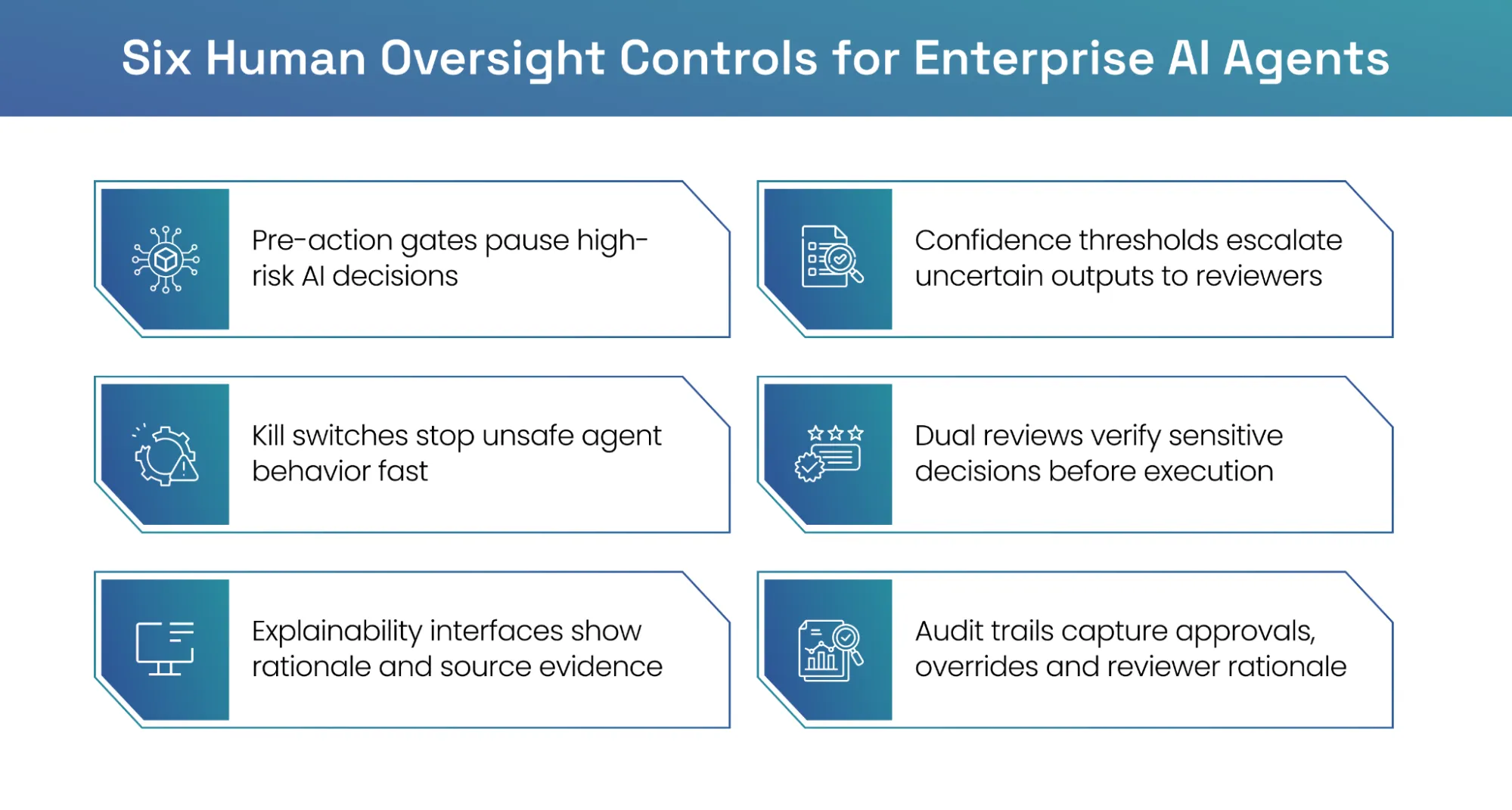
The six core control types are pre-action gates, kill switches, confidence-based escalation, dual review, explainability interfaces, and audit trails. Together, they cover different oversight needs across high-impact AI systems and agentic workflows.
Teams should map each AI system to the controls it requires based on risk level and decision impact.
1. Pre-action approval gates
Pre-action gates require explicit human review and approval before the AI system executes an action. Teams can use these controls for consequential credit decisions or financial transactions. Customer communications and production configuration changes may also require prior authorization, depending on their potential impact.
The system presents the proposed action with relevant context for review. A qualified reviewer can approve or reject it, while the workflow records the decision before execution continues.
2. Kill switches and system deactivation
Operators need a clear way to interrupt unsafe behavior at workflow or system level. Article 14 describes this as a stop button or similar procedure that halts the system in a safe state.
The control should be accessible from operational interfaces rather than buried in administrator settings. Reviewers must know when and how to use it.
Organizations should also define the consequences of stopping an active workflow. This includes handling pending actions and preserving the system state needed for investigation.
3. Confidence-based escalation
Confidence-based escalation routes low-certainty outputs to human reviewers, while routine outputs proceed according to approved operating rules. Teams set thresholds based on model behavior and business risk, using observed performance to inform calibration.
Thresholds need periodic recalibration because confidence distributions can change when input data or operating conditions shift. Confidence scores alone do not prove safety, so this control works alongside other mechanisms.
4. Dual-review requirements
Dual review applies a two-person verification pattern to specific decision types. Article 14(5) applies to the specified remote biometric identification systems, subject to the legal exceptions described above.
Enterprises can voluntarily apply the same pattern to high-impact financial decisions or sensitive compliance actions. This approach can reduce dependence on a single reviewer's judgment when errors could create material harm.
However, organizations should distinguish voluntarily adopted dual-review controls from the obligations imposed by the EU AI Act on systems.
5. Explainability interfaces
Overseers need relevant context and supporting evidence to evaluate AI outputs meaningfully. Explainability interfaces can present model reasoning information alongside the evidence available for a particular decision.
Without this context, the authority to override becomes theoretical because reviewers lack the information needed to disagree. The interface design shapes whether oversight functions as designed.
The appropriate explanation depends on the AI system. Traditional models may expose relevant factors, while generative applications may require source grounding or information about tool execution.
6. Audit trail capture
Organizations should record human reviews and approval decisions as part of operational governance. Escalations and overrides should also leave evidence that reviewers can examine later.
Relevant records include the reviewer identity and decision rationale. Timestamps and associated system outputs help reconstruct what happened during the workflow.
Audit trails support internal assurance reviews and incident reconstruction. They can also help governance teams identify recurring exceptions or gaps in existing controls.
How Do Human Oversight Controls Apply to AI Agents?
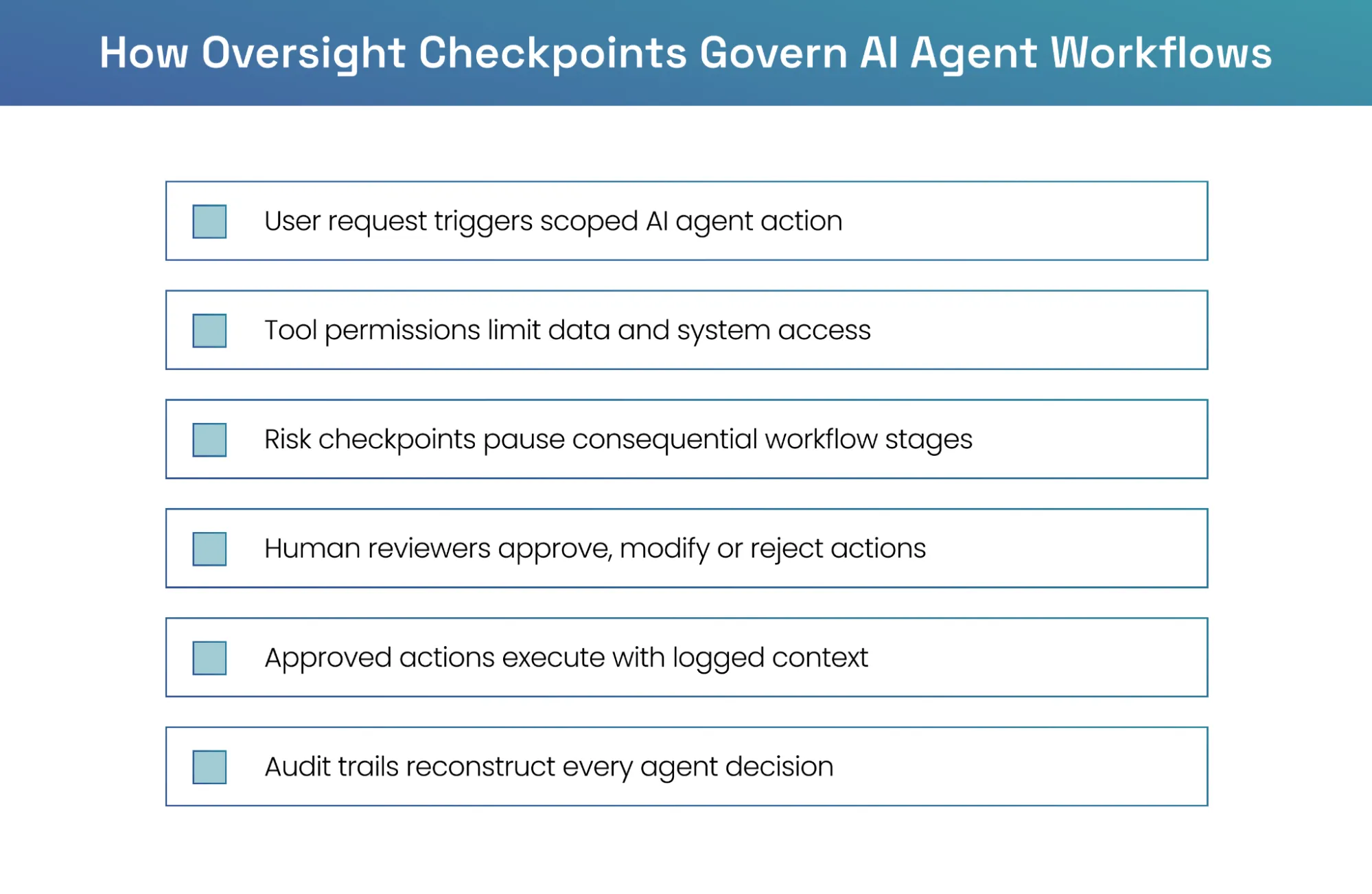
AI agents need scope boundaries, embedded checkpoints, and action-level audit trails because they act autonomously across systems. Traditional review models do not work when an agent completes downstream actions before a human sees the result.
AI agents differ from traditional AI systems because they chain actions across connected tools and external services. A single user request can trigger multiple downstream operations before a person reviews the results.
This changes the point at which oversight must operate. Enterprises need controls that evaluate proposed agent actions before execution rather than relying on final-output review.
The following three architectural elements support this approach.
- Scope boundaries: Teams define what each agent can do before it runs. This includes permitted tools and accessible data. Organizations must also specify which actions require human authorization.
Teams should enforce boundaries through technical permissions and runtime policies rather than relying on prompt instructions. This reduces the likelihood that an agent will perform actions outside its approved authority.
- Checkpoint architecture: Oversight checkpoints sit at specific points in the agent workflow rather than at the final output. Teams can place them before financial transfers or changes to production records. High-impact customer communications may require similar approval gates.
At each checkpoint, runtime controls evaluate the proposed action against applicable policies. The system allows, escalates, or blocks the action before it executes. Escalated actions require review by an authorized person.
- Action-level audit trails: Every agent action should generate a traceable record of the decision. Relevant evidence includes the applicable policy and resulting enforcement outcome.
When incidents occur, teams can reconstruct the sequence of agent actions and identify where intervention occurred. This also helps them determine whether the approved controls operated as intended.
This approach reflects bounded autonomy. Agents can complete permitted tasks while runtime controls restrict actions outside their approved authority. Higher-impact actions receive additional scrutiny through human review.
Learn more about the governance challenges of autonomous systems in this in-depth analysis on agentic AI governance.
How Do You Build Human Oversight Controls for AI Systems?
Enterprises should build human oversight controls into system design and connect them to operational governance. A practical implementation starts with risk classification and ends with evidence that reviewers can inspect.
Here are the steps to create an actionable sequence:
Step 1: Classify every AI system by oversight level
Map each AI system against its applicable risk classification and required level of human involvement. Consider the potential impact on customers or operations, as well as any relevant regulatory exposure.
Organizations can assign internal oversight levels according to their own governance methodology. These classifications should guide control selection without being confused with legally defined EU AI Act risk categories.
High-oversight systems may need pre-action approval gates and detailed audit trails. Certain use cases may also require dual review under applicable law.
Medium-oversight systems may use confidence escalation and periodic review. Low-impact systems can rely on proportionate monitoring where the risk assessment supports that approach.
Step 2: Design oversight mechanisms into the system architecture
Teams should design oversight mechanisms before deployment so the system can support intervention when necessary. Approval gates and escalation routes need appropriate technical integration.
Stop controls and reviewer interfaces must also support the intended decision process. Architectural choices regarding workflow state and action sequencing influence whether personnel can safely interrupt an operation.
Embedding oversight into design also reduces retrofit costs and prevents shadow workflows that bypass controls. This is where engineering and governance teams must collaborate.
Step 3: Assign and train qualified overseers
Effective oversight requires named individuals with appropriate competence and authority to intervene. Organizations should assign specific responsibilities rather than relying on generic team ownership. Training should explain system limitations and known failure modes. Reviewers must also understand escalation procedures and the limits of their authority.
Provide periodic refresher training as the system evolves. Maintain training records to demonstrate that personnel received relevant preparation for their oversight responsibilities.
Step 4: Implement automation bias countermeasures
Interface design shapes how often reviewers accept AI outputs without sufficient scrutiny. Teams can use calibration exercises to evaluate reviewer judgment. Agreement-rate analysis may also identify patterns of excessive reliance on AI recommendations.
Review interfaces can require reviewers to inspect supporting evidence before approving consequential decisions. Enterprises should test whether these prompts improve review quality rather than merely add procedural effort.
Feedback from override decisions can identify gaps in reviewer training and interface design. These findings should inform further adjustments to the oversight process.
Step 5: Connect oversight evidence to governance and audit
Operational systems should transmit approval records and escalation outcomes into central governance processes. Organizations should also retain evidence of overrides and related corrective actions.
Governance teams can map this evidence to internal policies and applicable requirements. The NIST AI Risk Management Framework and ISO/IEC 42001 provide relevant reference points for structuring organizational oversight.
Audit teams should be able to retrieve evidence by AI system or decision type. This gives reviewers a consistent basis for examining how oversight operated during a specific period.

How Solytics Partners Operationalizes Human Oversight Controls
Solytics Partners connects governance decisions with operational assurance through AI Vault and NIMBUS Uno. AI Vault manages governance records, while NIMBUS Uno evaluates system behavior and enforces runtime controls.
Together, they support the operating model of Govern → Validate → Assure at Runtime → Monitor, linking policy decisions with operational evidence.
These capabilities translate human oversight into useful solution layers:
- Governance and approval management through AI Vault: AI Vault maintains AI asset inventories and ownership records. It supports risk tiering and configurable approval workflows, while preserving evidence of governance decisions.
- Runtime enforcement through NIMBUS Uno: NIMBUS Uno checks each proposed agent action before execution. Its runtime controls allow, escalate, or block actions based on policy, with human review for high-impact decisions.
- Continuous observability through NIMBUS Uno: NIMBUS Uno monitors prompts and responses across AI applications. Its observability also covers retrievals and tool calls, with 60+ metrics supporting risk detection and operational investigation.
- Validation and independent review support: NIMBUS Uno supports risk-based evaluation before deployment. MoDeVa complements the broader Solytics Partners ecosystem with explainability, bias testing, and fairness analysis for applicable model validation needs.
AI Vault maintains the governance evidence, while NIMBUS Uno captures runtime decisions through step-level traces. This connection helps risk teams investigate exceptions and demonstrate how approved oversight controls operated.
Solytics Partners is a Category Leader in the Chartis RiskTech Quadrant® for AI Governance Solutions, 2025.
Book a demo with Solytics Partners to explore how connected governance and runtime assurance can strengthen human oversight across AI systems.
Frequently Asked Questions
What is human oversight?
Human oversight is the practice of assigning trained people to monitor AI behavior, review important outputs, and intervene when necessary. It ensures accountability does not sit with dashboards or automated rules alone. For higher-risk systems, oversight should provide meaningful authority to challenge decisions and stop unsafe operations.
Why does AI still need human oversight?
AI still needs human oversight because models can misread context or produce incorrect outputs. Some systems may also take actions outside their intended operating boundaries. Autonomous agents increase this risk because they can complete downstream steps without a natural review point. Human intervention helps organizations control consequential decisions and manage operational risks.
What is human oversight in the AI Act?
Human oversight in the AI Act refers to measures enabling people to supervise high-risk AI systems during operation. Article 14 requires relevant capabilities for understanding system limitations and monitoring operations. Overseers must also be able to interpret outputs, exercise override authority, and intervene or stop the system.
Why are human oversight controls important in AI systems?
Human oversight controls matter because they translate policy statements into operational intervention mechanisms. They help enterprises demonstrate that humans can intervene when AI behavior poses a risk. Evidence of approval and intervention logs support accountability during internal reviews and regulatory examinations.
What best describes the role of human oversight?
The role of human oversight is to give qualified people meaningful authority over consequential AI behavior. Overseers review context and challenge recommendations before approving actions where necessary. Effective oversight requires appropriate training and sufficient information, as well as system controls that enable intervention.
In which context is the implementation of human oversight most important?
Human oversight matters most in high-risk or high-impact AI use cases where automated errors can affect people's rights or safety. Financial decisions and healthcare applications can also require stronger oversight depending on their intended use. Organizations should apply review and intervention controls in accordance with relevant risks and legal requirements.