Solytics Partners Secures a Trifecta of Wins at the Economic Times Enterprise AI Awards 2026

Healthcare AI, Governed End-to-End.
AI Governance & Assurance Ecosystem for Healthcare
A unified, healthcare-focused framework to manage AI/ML and GenAI across the full lifecycle: inventory, validation, monitoring, observability, governance, documentation, and clinical workflows.
Get a 360° view of every healthcare AI system with centralized evidence, lineage, approvals, and runtime oversight – built for patient safety and clinical accountability.
Built-in workflows aligned to FDA, HIPAA, EU AI Act, and Health Canada expectations. Define policy once, enforce everywhere with automated validation, monitoring, approvals, and audit-ready evidence, enterprise speed.
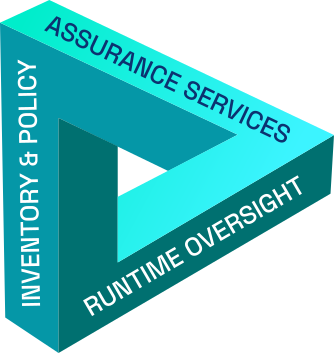
The Healthcare AI Imperative and Challenges
Healthcare is scaling GenAI/LLMs to enhance clinical decision support, diagnostics, research acceleration, and patient engagement – but success requires governance designed for patient safety and multi-regulator scrutiny.
1. Fragmented operating model
Pilot sprawl, duplicated efforts, unclear decision rights, and approvals trapped in email/Excel.
2. Healthcare-specific GenAI risk
Clinical hallucinations, prompt risks, PHI leakage, unsafe outputs, and demographic bias impacting care quality.
3. Assurance gaps from validation to patient care
Non-standard validation, weak observability, and change deployment without clinical sign-off or rollback plans.
4. Regulatory and stakeholder pressure
High expectations for transparency, human oversight, post-market monitoring, and evidence-ready audit trails.
Our Healthcare AI Governance Solution
An Integrated Platform for the Healthcare AI Lifecycle
A connected, clinically-governed approach to manage AI – from research to patient care – combining visibility, control, and assurance across every stage.

Inventory & Workflow Management
Central registry for models, owners, datasets, prompts, lineage, and clinical dependencies; risk tiering and lifecycle approvals.

AI Governance & Policy-as-Code
Healthcare control library mapped to regulations/standards; role-based approvals, segregation of duties, and exception workflows.

Model Wrapping (Runtime Enforcement)
Enforce patient safety limits, output filters, PHI redaction, and clinical content rules across deployed systems.

ML & GenAI
Validation
Accuracy, robustness, stability, and adversarial testing; bias/fairness assessment across patient cohorts.

LLM and RAG Evaluation
Hallucination/faithfulness checks, grounding scores, safety/PHI checks, benchmark testing, clinician feedback loops.

LLM and GenAI Observability
Trace-level logs for prompts/responses/retrievals; latency, throughput, and cost telemetry; change logs and version diffs.

Continous Monitoring
Performance and drift monitors (data/embedding/concept), safety monitors, and progressive rollouts with rollback triggers.

Documentation, Evidence & Incident Management
Auto-generated model cards and evidence packs; tamper-evident audit trails; incident → triage → RCA → CAPA workflows.
Our Healthcare AI Governance Capabilities & Differentiators
A unified ecosystem that embeds healthcare policy into workflows, enforces runtime controls, and continuously monitors safety and performance – so healthcare AI stays transparent, compliant, and deployment-ready.
Governance framework and lifecycle orchestration
Policy-embedded lifecycle gates from intake to retirement.
Control library + Policy-as-Code with Model Wrapping enforcement.
Provenance, lineage, and full version history with impact analysis.
Structured exception and change governance with rollback controls
Patient safety, risk, compliance, and monitoring
Bias/fairness surveillance across cohorts with alerts and mitigations.
Performance and drift monitoring for real-world clinical settings.
LLM/GenAI observability (hallucinations, grounding, safety, PHI checks).
Progressive rollouts (shadow/canary/blue-green) with safety-driven triggers.
Transparency and explainability
Human-readable rationales and clinical attributions
Auto-generated model cards/fact sheets with limitations and safeguards
Role-based stakeholder views (clinical, risk, compliance, leadership)
Evidence, reporting, and collaboration
Audit-ready exports, assessments, and regulator-aligned reports.
Central evidence repository for approvals, validations, incidents, corrective actions.
Tasking, SLAs, and dashboards for clinical governance operations.
Healthcare Business Benefits & Outcomes
Accelerated Time-to-Clinical Value
Standardized workflows reduce cycle time from intake to deployment.
Stronger Patient Safety Controls
Safety limits, PHI safeguards, and governance gates reduce clinical risk.
Reduced Compliance Effort
Automate validation, monitoring, approvals, and evidence generation.
Audit-Ready Evidence On Demand
Centralized documentation and tamper-evident logs support audits & submissions.
Better Clinical Trust and Adoption
Transparent explainability and clear accountability improve clinician confidence.
Adaptable to Changing Mandates
Configurable policies and controls align quickly to new standards and guidance.

MRM Vault
Policy-as-Code & Healthcare Runtime Enforcement
Healthcare control library mapped to FDA guidance, HIPAA/HITECH, EU AI Act, and medical device standards, with specialty overlays.
360° clinical AI inventory with risk classification, templated reviews, role-based clinical sign-offs, version control, and tamper-evident audit trails.
Clinical Model Wrapping for runtime guardrails: patient safety limits, output filtering, clinical content rules, and PHI redaction – supported by exception and change workflows.

NIMBUS Uno
Healthcare Data and Decision Orchestration
Integrated clinical pipelines with built-in patient data quality, lineage tracking, experiment management, and prompt/version control.
GenAI observability for clinical use: hallucination and faithfulness checks, RAG grounding validation, patient safety monitoring, plus latency and cost telemetry.
Automation with enterprise integrations: revalidation workflows, dataset refresh vetting, backfills, and evidence capture via clinical CI/CD and ITSM.
Why AI Governance Matters
Financial institutions face increasing regulatory scrutiny, operational and reputational risk when deploying AI. Making comprehensive and multidisciplinary governance is essential to ensure transparency, accountability, and trust in AI use-case adoption.
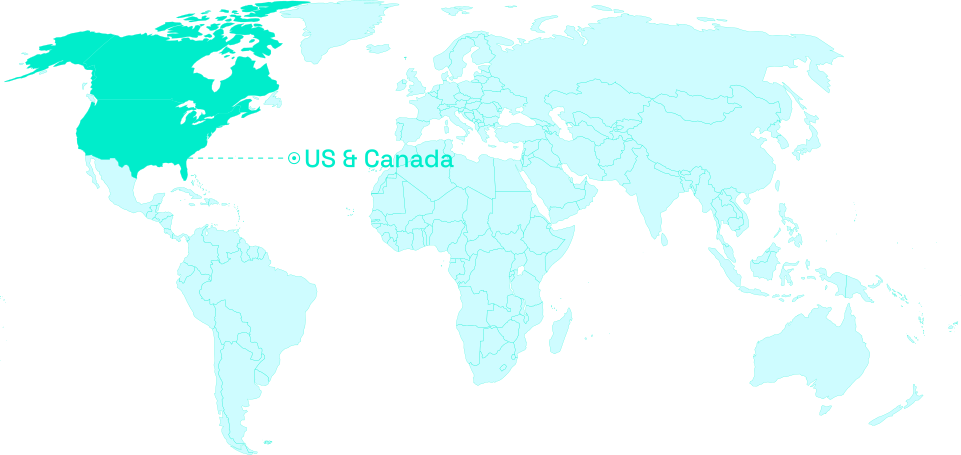
US & Canada
Global Regulations
EU AI Act (Medical AI High-Risk), GDPR, MDR/IVDR, MHRA AIaMD

EU & UK
Global Regulations
FDA AI/ML Medical Device Regulation, HIPAA/HITECH, Health Canada MLMD, PIPEDA

APAC
Global Regulations
EU AI Act (Medical AI High-Risk), GDPR, MDR/IVDR, MHRA AIaMD
Overview of Healthcare Regulatory Drivers
Robust Survey Module
United States
- FDA AI/ML Medical Device Regulation (USA): Establishes comprehensive premarket pathway through 510(k), De Novo classification, or Premarket Approval (PMA) for AI-enabled medical devices, with emphasis on predetermined change control plans and post-market surveillance.
- HIPAA/HITECH Act (USA): Mandatory protection of Protected Health Information (PHI) in AI systems with enhanced enforcement mechanisms and penalties up to $1.5M annually per violation category.
- FDA Draft Guidance on AI-Enabled Device Software Functions (January 2025): First comprehensive lifecycle management guidance covering development through post-market surveillance for medical AI systems.
Canada
- Health Canada Medical Devices Regulations: Class II, III, and IV Machine Learning-enabled Medical Devices (MLMD) requiring comprehensive regulatory approval with predetermined change control plans.
- PIPEDA (Personal Information Protection and Electronic Documents Act): Governs personal health data processing in AI systems with enhanced requirements for medical information protection.
- Pan-Canadian AI for Health (AI4H) Guiding Principles (January 2025): Federal-provincial-territorial framework for responsible AI adoption in healthcare settings.
European Union
- EU AI Act (EU): Medical AI systems automatically classified as high-risk under Article 6(1)(b), requiring comprehensive risk management, transparency, human oversight, and post-market monitoring with implementation by August 2026-2027.
- Medical Device Regulation (MDR) & IVDR (EU): Intersection of existing medical device compliance with new AI Act requirements for comprehensive dual regulatory oversight.
- GDPR (EU): Special category health data processing requirements with enhanced safeguards for AI-driven medical decisions and automated decision-making restrictions.
United Kingdom
- MHRA AI Strategy (UK): Software as Medical Device (SaMD) and AI as Medical Device (AIaMD) regulatory pathway with emphasis on safety, transparency, fairness, accountability, and contestability principles.
- MHRA Transparency Guiding Principles for MLMDs (June 2024): Human-centered design requirements, performance monitoring, and risk communication for healthcare AI systems.
Asia-Pacific
- TGA Software as Medical Device (Australia): Comprehensive regulatory framework for AI-enabled medical devices with risk-based classification and post-market surveillance requirements.
- PMDA AI Guidelines (Japan): Regulatory guidance for AI/ML-based medical devices with emphasis on clinical validation and real-world performance monitoring.
- Singapore PDPA Healthcare AI: Personal data protection framework for AI systems processing health data with requirements for consent, transparency, and risk-based management.
United States
Canada
European Union
United Kingdom
Asia-Pacific
.svg)
Transform AI Governance into a competitive advantage

Centralize your Healthcare AI inventory with 360° visibility across models, datasets, prompts, lineage, and patient safety controls.

Reduce compliance burden by 40-50% through automated validation, monitoring, and audit-ready evidence generation aligned to FDA, HIPAA, EU AI Act, and Health Canada mandates.

Deploy safer AI faster with policy-as-code enforcement, runtime guardrails, bias surveillance, and progressive rollouts with safety-driven rollback triggers.
Book a Healthcare
AI Demo Today
AI Demo Today
Oops! Something went wrong while submitting the form.