Solytics Partners Secures a Trifecta of Wins at the Economic Times Enterprise AI Awards 2026


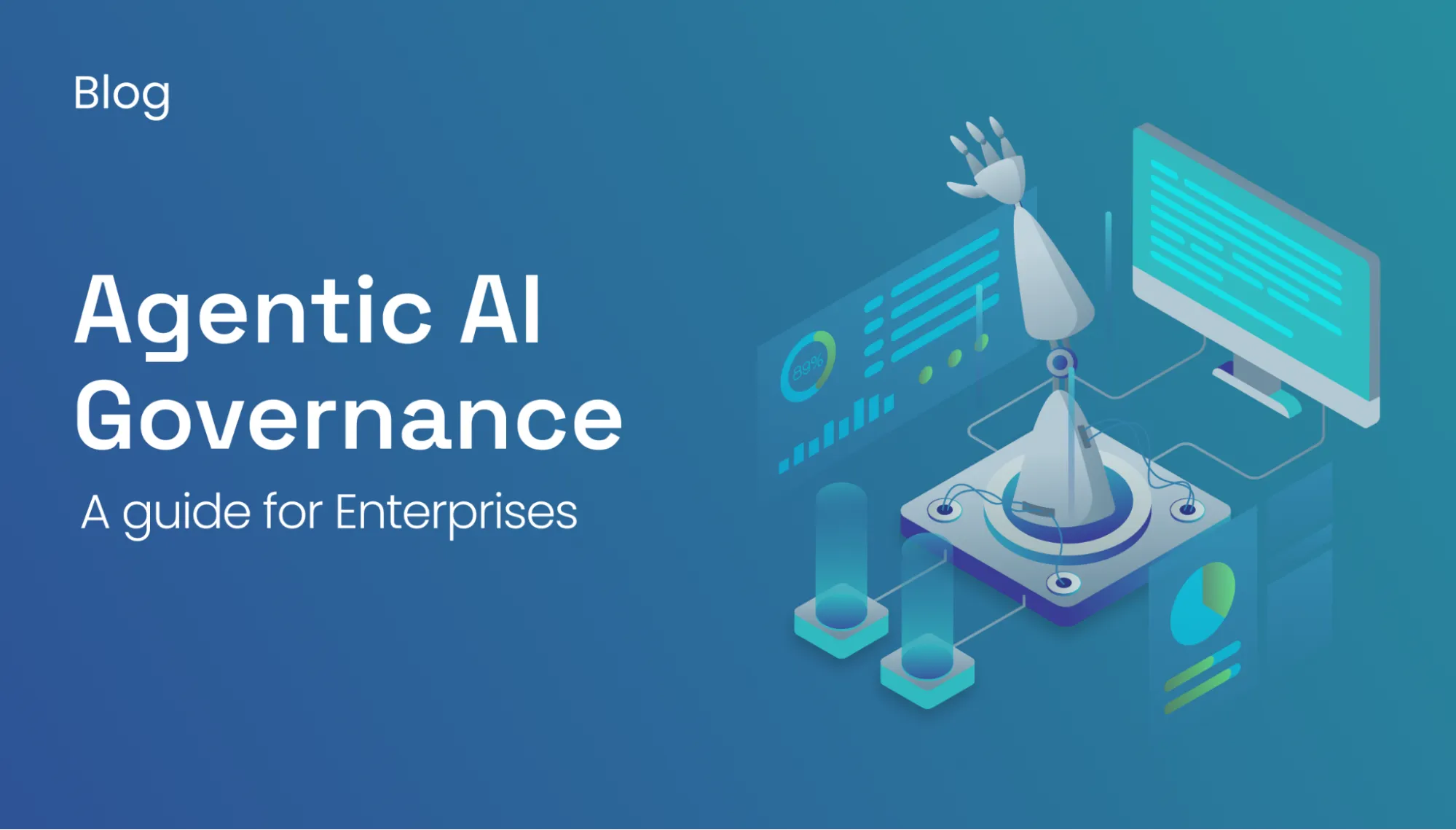
In August 2025, Gartner predicted that 40% of enterprise applications would feature task-specific AI agents by the end of 2026. The forecast compared that figure with less than 5% in 2025. These agents can retrieve customer records and call internal APIs before executing tasks across connected enterprise systems.
That autonomy changes how enterprises govern artificial intelligence. A model can produce an incorrect recommendation, while an agent can act and delegate before review. Traditional governance models built for static models do not inspect tool permissions or action chains. These new challenges show why governance matters before production.
Agentic AI governance sets boundaries for those actions, assigns accountable owners, and preserves evidence across every decision. This guide explains seven priority risks, five production controls, implementation steps, and the frameworks that shape enterprise practice.

What Is Agentic AI Governance?
Agentic AI governance combines policies, technical controls, and oversight for autonomous planning, delegation, and execution. It defines what agents may do, which systems they may access and when people must intervene. The discipline also records every consequential action so teams can investigate incidents, demonstrate accountability and improve controls over time.
It extends an enterprise AI governance framework across identities, memory, tools and delegated decisions. Existing traditional AI governance still covers model quality and lifecycle evidence. The agent layer adds execution boundaries. Teams must govern approvals, external tools and agents' access to data.
Prompt governance controls approved instructions, versions, and changes to agent goals. However, prompts cannot enforce every boundary inside a complex agentic AI architecture. An effective agentic AI governance framework combines prompt controls with identity, runtime policy, and action-level evidence.
This means an agent must pass operational checks before taking any action that affects enterprise systems. Human reviewers should also retain authority over consequential decisions when policies require intervention
How Does Agentic AI Governance Differ From Model Governance?
Model governance evaluates model design, performance and documented limitations across its lifecycle. Agentic AI governance adds control over identities, permissions, tool calls and delegated actions. Enterprises need both disciplines because an autonomous agent still depends on governed models while creating operational risks that output-focused reviews cannot fully address in production.
Model governance remains necessary because autonomous agents depend on models, retrieval components, and business rules. AI agent governance adds governance controls around that foundation. For a broader view of the underlying model controls, see the Solytics Partners guide to AI model governance.
Why Do AI Agents Require Different Governance Controls?
AI agents require different controls because autonomy turns model errors into actions across connected systems. Tool access, delegated identities, and persistent memory pose risks that traditional reviews do not capture. Agentic AI governance must therefore operate during execution, when policies can restrict permissions, pause actions, and preserve evidence for investigation and audits.
- Autonomy expands the range of consequences: Agentic systems can plan complex tasks and execute multiple steps without waiting for manual oversight. An incorrect assumption may trigger further actions across payment systems or customer workflows before a reviewer identifies the problem.
- Tool access expands the attack surface: Agents can query databases, write files, or send communications via connected interfaces. Each connection can introduce unsafe tool arguments or dependency risks. These weaknesses may also expose sensitive information through unauthorized access.
- Identity affects accountability: Agents may act through user credentials or shared service accounts. Distinct identities support data protection, data privacy, and task-specific authorization, especially when agents interact with third-party providers.
- Delegation obscures responsibility: Multi-agent workflows can pass goals between specialized components. Standard model logs cannot reconstruct these chains, so GenAI observability must connect plans, tool calls, memory, and handoffs.
These differences explain why governance must act before an autonomous agent executes a consequential step. Post-event reviews can identify failures, but they cannot prevent an unauthorized action that has already been completed.
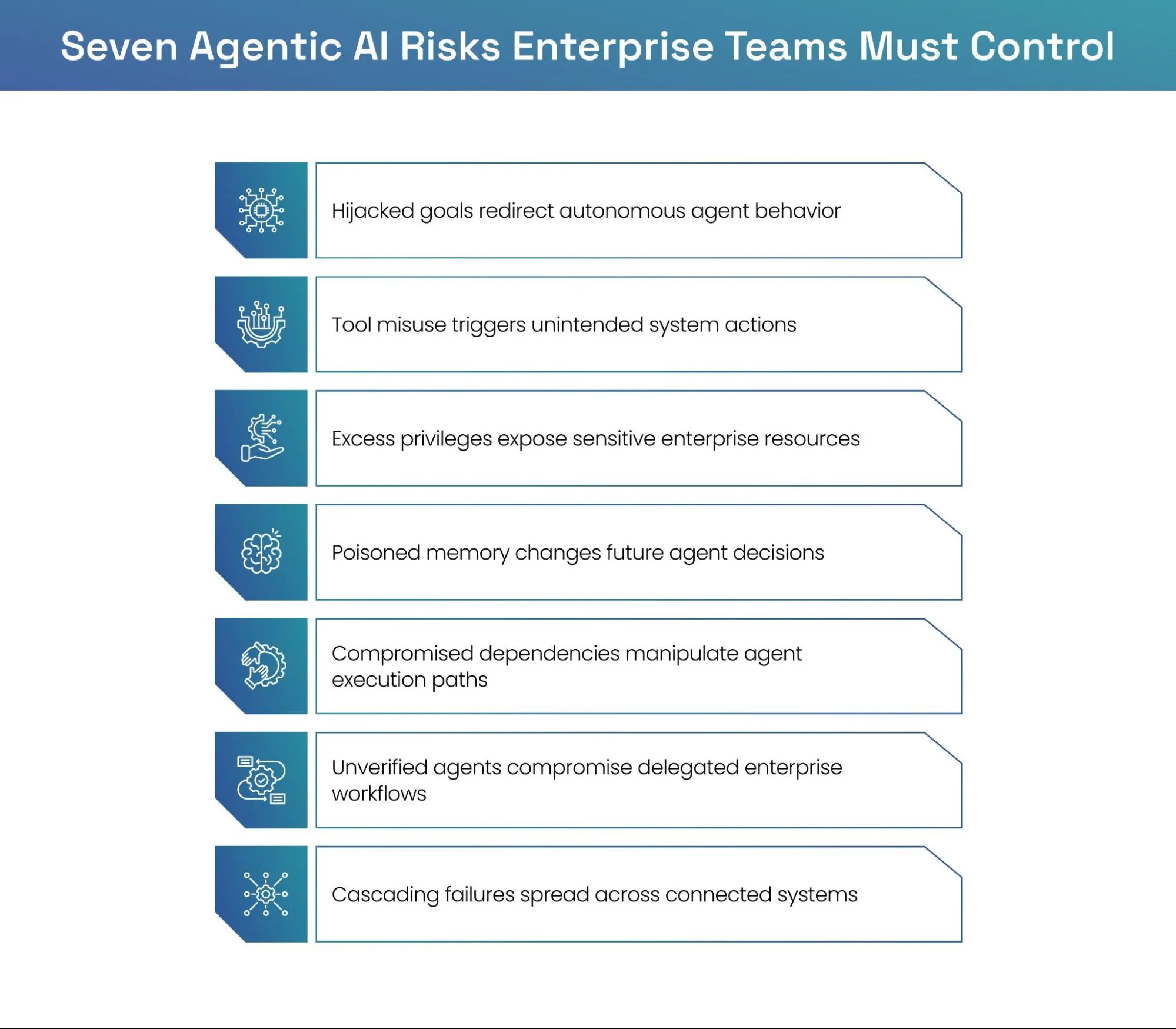
Which Seven Agentic AI Risks Should Enterprises Prioritize?
OWASP publishes ten risks for agentic applications, covering goal manipulation, unsafe tools, identity abuse, and related failures. The following seven risks are relevant to enterprise governance because they can affect execution authority or connected business systems. Each requires targeted controls that operate during planning or execution.
Observability gaps increase every listed risk, although OWASP does not list observability as a separate category. GenAI guardrails should protect data sources, sensitive information, and action pathways.
Weak data quality can also produce unsafe plans. Teams should connect violations with incident response workflows and named owners.
What Are the Five Core Controls for Agentic AI Governance?
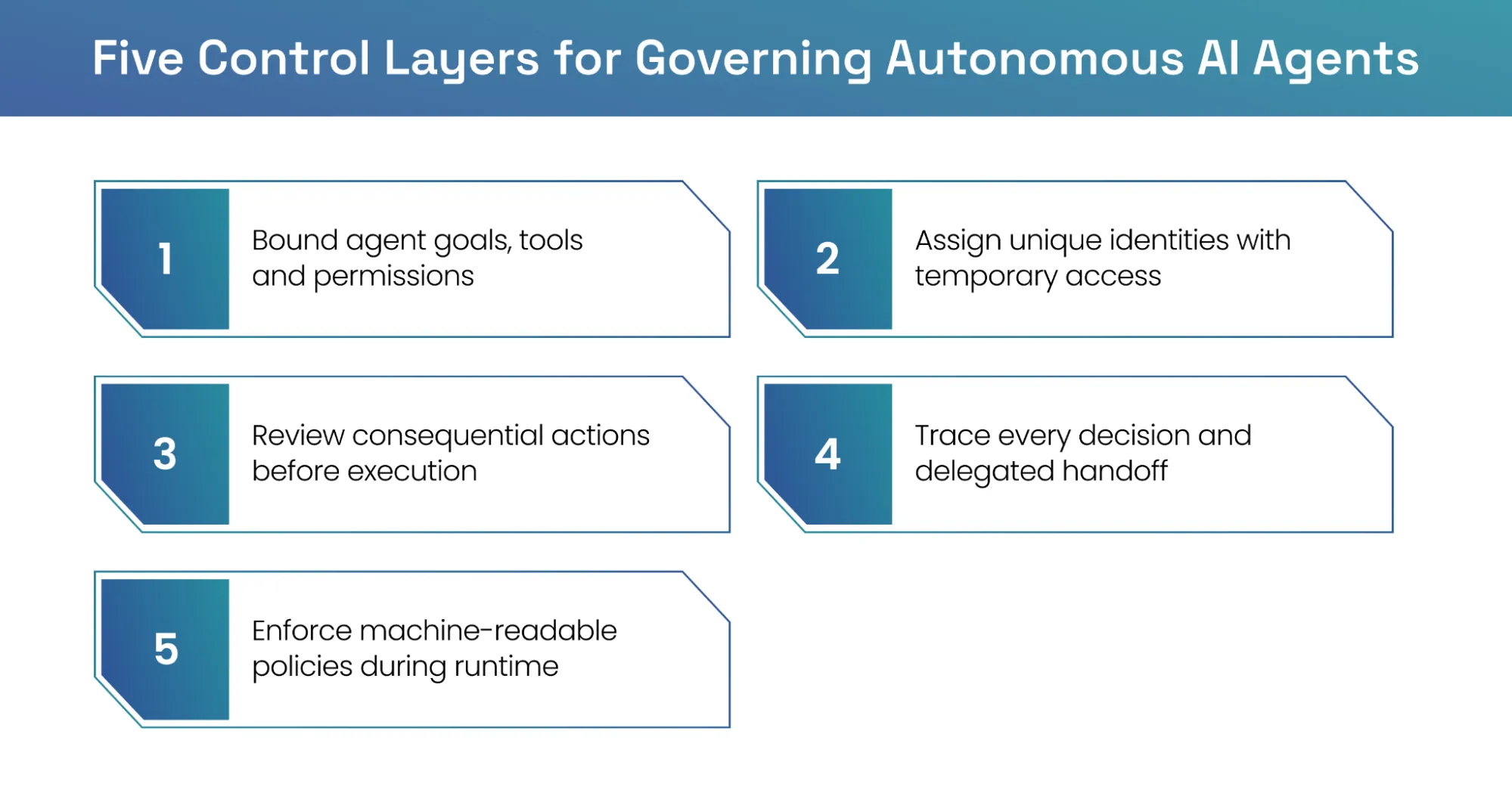
Enterprises need layered controls across design, identity, execution, oversight, and evidence. No single control addresses every risk. Effective agentic AI governance implementations combine deterministic restrictions with runtime enforcement and continuous monitoring across the agent lifecycle.
1. Bound Agent Autonomy Before Deployment
Teams should define clear boundaries around goals, tools, data, time, and spending before deployment. Deterministic restrictions should control high-impact actions because prompts can drift.
Consider a website operations agent that evaluates website performance and proposes updates to approved content. Its permissions should restrict changes to authorized pages while preventing access to unrelated production settings.
Risk classification should determine which actions require approval and when automated execution must stop. Teams should document these boundaries before granting operational access.
2. Assign Distinct Identities and Least Privilege
Every agent needs a traceable identity separate from its creator or triggering user. Credentials should grant the minimum permissions required for the current task. Temporary authorization reduces exposure after completion.
It also prevents orphaned agents from retaining access when owners leave or service accounts change. Identity controls should cover recursive delegation and shared tools.
Organizations should review agent privileges when responsibilities change or integrations expand. This supports access accountability without applying every compliance requirement to every agent.
3. Insert Human Oversight at Consequential Actions
Teams should place review checkpoints before transfers, deletions, external communications or production changes. Routine actions can continue under policy controls and logging. Mandatory approval differs from exception review. The first pauses execution, while the second routes uncertain or policy-sensitive cases for human review.
Organizations can use their existing lines-of-defense structure to assign responsibility for review and independent challenge. Each checkpoint should identify who can approve the proposed action and who can intervene when risks exceed approved limits. Effective checkpoints protect people without forcing every low-risk action through the same queue.
4. Capture End-to-End Trace Evidence
Trace records should cover goals, planning steps, tool calls, memory access, handoffs, and policy decisions. They must show what happened and whose authority supported the action.
TraceIQ, a NIMBUS Uno capability, provides observability across generative AI interactions and associated workflow traces. It helps teams examine prompts, retrieved context, and responses generated during execution.
Agent-level traces should connect these observations with tool actions and delegation events. Records must preserve the applicable enforcement outcome so reviewers can reconstruct why execution continued or stopped. Retention rules should reflect policy and jurisdiction while supporting regulatory compliance and investigation.
5. Enforce Policies Before Runtime Actions
Runtime policy enforcement evaluates each proposed agent action before execution. It checks whether the requested operation falls within approved authority and relevant policy boundaries.
The enforcement layer then produces one of three outcomes: allow, escalate or block. Permitted actions proceed, while prohibited actions stop before execution. Higher-impact actions can require review by an authorized person.
This is the central distinction between runtime assurance and observability. Monitoring identifies behavior and reports findings, while enforcement controls whether a proposed action can proceed.
Bounded autonomy keeps agents within approved permissions during execution. Human intervention and stop controls provide additional safeguards when an agent encounters situations that exceed its authority.
The Solytics Partners AI governance platform explains how NIMBUS Uno applies these pre-execution decisions and maintains step-level evidence.
How Do Enterprises Build an Agentic AI Governance Program?
A working agentic AI governance program follows six sequential steps that move governance from policy statement to operational practice. Each step produces documented output that the next step consumes. Organizations should connect these steps to existing risk management responsibilities rather than create an isolated agent approval process.
- Inventory every enterprise agent: Record vendor agents, embedded copilots, custom assistants and multi-agent workflows. Capture each agent’s purpose, owner, framework, connected tools and current lifecycle status.
- Assign ownership and purpose: Name business and technical owners for every agent. Record approved goals, affected business processes and accountability for failures or policy breaches.
- Classify autonomy and impact: Score tool access, data sensitivity, reversibility and customer consequences. Include machine learning components, generative AI services and agents created by third-party providers.
- Map controls to risk: Assign permissions, approvals, testing and monitoring in proportion to agent risk. Higher tiers need pre-action approval gates, while lower tiers can proceed with logging and periodic review.
- Test adversarial behavior: Challenge agents with adversarial prompts and edge cases before production deployment. Include policy-violation tests that attempt unauthorized tool calls or actions beyond approved permissions. Testing should also cover goal hijacking and memory poisoning scenarios. Teams must examine whether runtime safeguards block prohibited behavior before connected systems execute harmful actions.
- Monitor and reassess: Review traces, overrides, incidents and permission changes after deployment. Material changes should trigger reassessment under the organization’s governance model.
An effective program connects AI risk management tools with inventory, runtime evidence and approvals. Separate spreadsheets create gaps between traditional governance records and active agent behavior.

Which Standards and Frameworks Guide Agentic AI Governance?
Agentic AI governance draws on several emerging frameworks rather than a single binding global standard. OWASP addresses security risks, while NIST and IMDA focus on standards and responsible deployment.
The EU AI Act can also apply to agentic systems, depending on their intended use and the organization's regulatory role. US model risk guidance requires separate consideration because it does not cover all categories of AI systems.
- OWASP Agentic Top 10: The framework identifies ten major threats affecting agentic AI systems. It provides operational best practices for builders, security teams, and governance leaders.
- NIST AI Agent Standards Initiative: NIST announced the initiative on February 17, 2026. Its activities focus on industry-led standards and open-source protocols, supported by research into agent identity and security.
- IMDA Model AI Governance Framework: Singapore's IMDA introduced the Model AI Governance Framework for Agentic AI on January 22, 2026. The voluntary framework addresses risk boundaries and human accountability, as well as technical controls and end-user responsibilities.
- EU AI Act: The Act applies to AI systems and regulated entities according to their roles and intended purposes. An agent does not automatically become high risk just because it operates autonomously. Under Regulation (EU) 2026/1744, Annex III high-risk requirements apply from December 2, 2027. Annex I embedded high-risk systems have an application date of August 2, 2028.
- US SR 26-2: The Federal Reserve, OCC, and FDIC issued SR 26-2 on April 17, 2026, replacing SR 11-7 and SR 21-8. The guidance addresses model risk management using a tailored approach. Footnote 3 expressly excludes generative and agentic AI models from its scope. Banking organizations should still determine appropriate controls for excluded systems through broader governance and risk management practices.
Organizations should map these governance frameworks against sector rules and internal compliance frameworks. No single framework replaces enterprise risk management or jurisdiction-specific legal review
How Does Solytics Partners Operationalize Agentic AI Governance?
For autonomous agents, the most consequential governance decision occurs before execution. An agent may propose a seemingly valid action that exceeds its authority, making preventive controls essential for safe operation.
Solytics Partners connects agent registration with pre-execution enforcement through AI Vault and NIMBUS Uno. The platforms support a governed sequence, from the approval of an agent's purpose to runtime monitoring.
Establish Ownership Before Granting Autonomy
AI Vault maintains the inventory of enterprise AI agents and their assigned owners. It supports risk classification and approval workflows, giving governance teams a record of an agent's intended purpose and applicable controls.
This provides the governance foundation for determining which agents can operate and what conditions apply to their use.
Check Actions Before Execution
NIMBUS Uno applies runtime assurance to proposed agent actions. It evaluates each action against approved boundaries before allowing, escalating or blocking execution.
Bounded autonomy restricts activity outside the agent's permitted scope. High-impact actions may require human review, while intervention controls help contain unsafe behavior when it emerges.
This enforcement capability addresses the operational gap between approving an AI agent and controlling its actions after deployment.
Maintain Evidence Across the Execution Chain
NIMBUS Uno provides observability across prompts and responses, including retrieval activity and tool calls. TraceIQ supports investigation of individual interactions, while step-level traces document runtime enforcement decisions.
These records help reviewers determine which action an agent attempted and how the applicable controls responded. AI Vault maintains the corresponding governance information and connects operational findings to the approved asset record.
Together, these capabilities support the Solytics Partners approach of Govern → Validate → Assure at Runtime → Monitor.
The operating model connects governance approvals with technical evaluation before agents enter production. Runtime enforcement keeps agent actions within approved boundaries, while monitoring provides evidence for ongoing oversight and reassessment.
By bringing these capabilities together, Solytics Partners helps enterprises maintain control over autonomous AI operations, an area reflected in its industry recognition. Solytics Partners is a Category Leader in the Chartis RiskTech Quadrant® for AI Governance Solutions, 2025.
Book a demo with Solytics Partners to explore how runtime assurance and connected governance can strengthen control over autonomous AI agents.
Frequently Asked Questions
What Is Governance in Agentic AI?
Governance in agentic AI covers the policies and technical controls that direct autonomous agent behavior. It defines which actions agents may perform and when people must intervene. The discipline extends AI governance principles to cover tool use, delegation, and execution boundaries.
What Is Model AI Governance for Agentic AI?
Singapore's IMDA published the Model AI Governance Framework for Agentic AI on January 22, 2026. It covers four dimensions: bounded risk, accountability, technical controls, and end-user responsibility. The framework provides voluntary guidance for responsible agent deployment rather than establishing binding legal obligations.
What Is Included in the NIST AI RMF?
The NIST AI Risk Management Framework organizes guidance into four functions: Govern, Map, Measure, and Manage. These cover risk identification, measurement, treatment, and organizational oversight. The AI Agent Standards Initiative, announced on February 17, 2026, is a separate NIST effort focused on agent interoperability and security.
How Does the NIST AI RMF Work?
Organizations use the framework to identify their AI context, map risks across the system lifecycle, measure trustworthy AI characteristics, and manage risks through controls. The four functions run continuously rather than as sequential stages. Enterprises document evidence for each function to support internal governance reviews and applicable assurance requirements.
What Are the Pillars of Agentic AI Governance?
Five practical control areas support agentic AI governance: bounded autonomy, scoped identity, human oversight, runtime enforcement, and traceable evidence. Each area addresses a different risk created by autonomous execution. Together, these controls help organizations prevent unsafe actions and maintain accountability across delegated-agent workflows.