We have been recognized in RegTech100 2026 - Strengthening leadership across AI governance, MRM and FCC

.webp)
.webp)
The EU AI Act is the world's first comprehensive law governing Artificial Intelligence (AI). It entered into force on 1 August 2024, and the most consequential obligations for enterprises kick in on 2 December 2027. Penalties reach up to EUR 35 million or 7% of worldwide annual turnover, putting the AI Act well above GDPR in financial exposure.
For risk and compliance leaders, the question is no longer whether the EU AI Act applies to their operations. The harder question is whether the existing governance stack can produce the inventory, documentation and audit trails that national competent authorities will request. Most enterprises discover their current setup falls short.
This blog elaborates on what the Act covers, who falls within its scope, and what enterprises should be doing right now. We will pay special attention to financial services and healthcare sectors, where the level of risk is highest and the regulatory exposure is most severe.

Brief History of The EU AI Act: From Proposal to Enforcement
The EU AI Act took six years to move from concept to law. Each milestone shaped how the final regulation treats different uses of AI today.
- 2018: The European Commission kicks off ethics work through the High-Level Expert Group on AI.
- 2021: The Commission publishes the first proposal for a horizontal legal framework governing AI systems.
- 2023: The European Parliament approves its negotiating position covering generative models and biometric rules.
- 2024: The Act enters into force on 1 August after publication in the Official Journal of the European Union.
- 2025: EU lawmakers agree to streamline AI Act implementation under the Omnibus VII simplification package focused on reducing compliance burdens.
- 2026: Transparency obligations for AI-generated content providers begin applying from 2 December 2026 under the revised implementation timeline.
- 2027: Standalone high-risk AI systems become subject to compliance obligations from 2 December 2027 under the updated proposal.
- 2028: High-risk AI systems embedded within regulated products become subject to AI Act obligations from 2 August 2028.
- 2030: Full implementation of the EU AI Act across industries and member states is expected to continue through 2030
Disclaimer: These timelines reflect the latest publicly available EU AI Act updates and provisional agreements as of May 2026. Implementation dates and compliance requirements may change based on future amendments, approvals, or regulatory guidance.
What is the EU AI Act?
The EU AI Act, formally Regulation (EU) 2024/1689, is the first comprehensive legal framework dedicated to Artificial Intelligence (AI).
Adopted in 2024 after extended negotiations around generative AI, the Act establishes a common regulatory approach across all EU member states. Its framework is designed to influence global AI governance standards.
The Act follows a risk-based model, regulating AI systems according to their potential societal and business impact. High-risk applications in sectors like finance, healthcare, and HR face stricter compliance obligations. The law also applies extraterritorially, meaning non-EU companies serving European users must comply, similar to GDPR requirements.
What are the Four Risk Tiers of the EU AI Act?
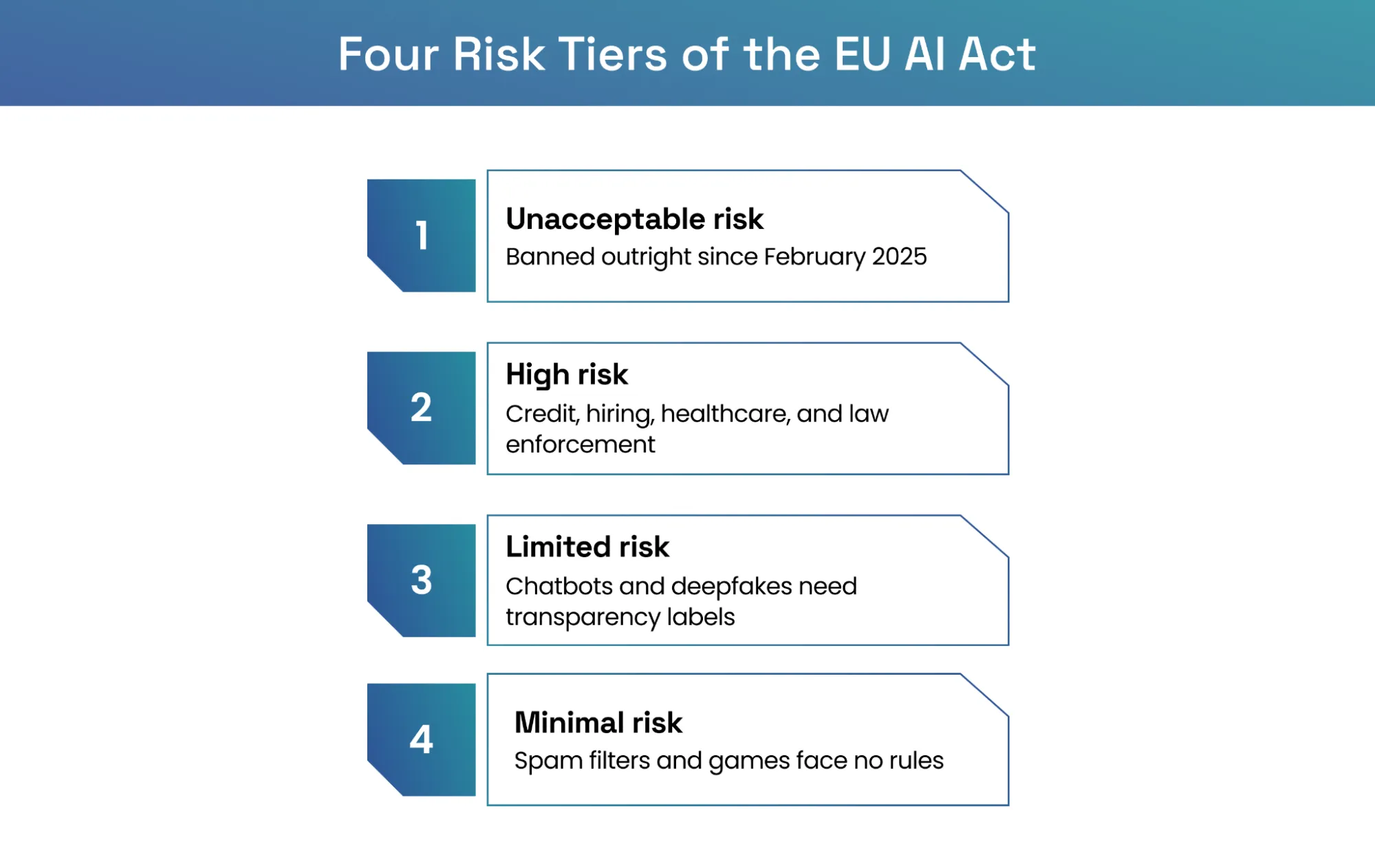
The EU AI Act classifies AI systems into four tiers, with obligations increasing as risks to fundamental rights grow.
- Unacceptable risk (banned): AI practices that manipulate behavior, enable government social scoring, scrape facial images for recognition databases or perform real-time remote biometric identification in publicly accessible spaces. These have been prohibited since 2 February 2025. Such systems cannot be placed on the EU market under any circumstances.
- High-risk (heavily regulated): AI used in credit scoring, insurance pricing, medical devices, recruitment, education, law enforcement and migration control. This is where most enterprise AI sits, and where the 2 December 2027 deadline applies. Providers must complete conformity assessment and register their systems in the EU database before deployment.
- Limited risk (transparency required): Chatbots, deepfakes, and AI-generated content. Users must be informed that they are interacting with AI under Article 50 transparency obligations. Synthetic content must carry machine-readable labels so downstream platforms can detect it. Transparency requirements apply regardless of who deploys the system.
- Minimal risk (unregulated): Spam filters, AI-enabled video games, and similar low-impact systems. No mandatory obligations apply, though voluntary codes of practice are encouraged. Most consumer applications fall into this minimal risk tier and face no specific obligations under the Act.
What AI Practices Are Banned Under the EU AI Act?
Article 5 of the EU AI Act lists eight prohibited AI practices that no provider or deployer can legally place on the EU market.
- Harmful manipulation and deception techniques that distort behavior in ways that cause significant harm.
- Exploitation of vulnerabilities tied to age, disability or socio-economic situation.
- Social scoring systems that rank individuals based on social behavior or personal characteristics.
- Predictive policing based solely on profiling or assessment of personality traits.
- Untargeted facial recognition scraping from the internet or CCTV feeds for database building.
- Emotion recognition in workplaces and educational institutions outside narrow medical use.
- Biometric categorization that infers race, political opinions or sexual orientation.
- Real-time biometric identification systems in public spaces for law enforcement purposes with limited exceptions.
What is the Conformity Assessment Process for High-Risk AI?
Conformity assessment is the formal process where high-risk AI providers prove their systems meet Articles 8 through 17 obligations.
Self-assessment vs third-party assessment
Most high-risk systems under Annex III follow internal control self-assessment by the provider. Annex I systems embedded in regulated products, such as medical devices, require a notified body audit. The choice depends on the use case and applicable sectoral law.
CE marking requirements
Providers affix CE marking to high-risk AI systems before placing them on the EU market. The marking signals that the system has passed conformity assessment and meets all applicable requirements. Importers and distributors verify CE presence before downstream sale.
Technical documentation (Annex IV)
Providers maintain documentation covering system architecture, training methodology, validation results, performance metrics, known limitations and human oversight measures. The competent authority can request this file at any point during a market surveillance inspection.
6-12 month timeline
Conformity assessment typically takes 6-12 months for a single high-risk system. Documentation preparation, testing and notified body engagement drive most of that timeline. Enterprises with multiple high-risk systems should sequence assessments to avoid resource collisions.
What are Key EU AI Act Deadlines Every Enterprise Should Track?
The Act phases obligations across multiple dates, and enterprises should plan against the operative deadlines below.
The European Commission proposed a Digital Omnibus Regulation Proposal in late 2025 that may shift some high-risk deadlines if harmonized standards are not ready. Enterprises should treat December 2027 as the binding date and avoid planning around an extension that has not been enacted.
Who Does the EU AI Act Apply To?
The EU AI Act regulates four operator roles across the AI value chain, each carrying different obligations.
- Providers: Businesses that develop AI systems and place them on the EU market under their own brand. This category also includes companies substantially modifying third-party AI systems under Article 25.
- Deployers: Enterprises, banks, hospitals, and HR teams using AI systems professionally rather than for personal use. Common examples include recruitment screening tools, diagnostic AI systems, and credit-scoring models.
- Importers and distributors: Companies bringing AI systems into the EU market or supplying them through distribution channels. This role commonly applies to resellers, technology suppliers, and channel partners handling regulated AI products.
- Authorized representatives: EU-based legal entities representing non-EU AI providers for regulatory purposes. This role applies where overseas providers place certain high-risk AI systems within the European Union.
How Does the EU AI Act Regulate General-Purpose AI Models?
Articles 51 through 55 of the EU AI Act govern general-purpose AI models, including the most advanced foundation systems on the EU market.
- GPAI with systemic risks like GPT-4 and Claude face additional obligations, including model evaluation and adversarial testing.
- GPAI obligations entered into force on 2 August 2025 with the European AI Office managing oversight at the EU level.
- Providers of GPAI models notify the European Commission within two weeks of meeting the systemic risk threshold.
- The scientific panel of independent experts advises the AI Office on systemic risks posed by foundation models.
- Compliance timelines for GPAI providers follow a separate track from high-risk system rules under Annex III.
How the EU AI Act Impacts Enterprises?
The operational impact of the EU AI Act covers inventory, documentation, monitoring and incident reporting across every enterprise running AI in the EU, making enterprise AI governance a core operational requirement rather than a compliance exercise.
- Inventory and classification become mandatory: Every AI system in production needs a documented owner, a risk classification and a record of use cases. Most enterprises start from scratch when building this AI inventory. Shadow AI deployments multiply the discovery effort across business units.
- Technical documentation expands beyond traditional model docs: The Act requires risk management records, data governance evidence, accuracy testing, cybersecurity measures and human oversight mechanisms for every high-risk system. Documentation must remain current as systems evolve. Static one-time records do not satisfy the obligation.
- Continuous monitoring replaces point-in-time audits: Article 72 requires post-market monitoring for high-risk systems running on the EU market. Drift, performance and incident data must flow into regulator-ready reports on demand. This shift makes observability infrastructure a compliance requirement.
- Fundamental Rights Impact Assessments (FRIAs) become routine: Public authorities and financial institutions deploying high-risk AI in credit or insurance must complete fundamental rights impact assessments before deployment. These document potential impacts on individual rights. They must be filed with the competent authority.
- Penalties stack on top of GDPR and DORA: Non-compliance carries fines up to EUR 35 million or 7% of global revenue. Financial institutions also face exposure under DORA and GDPR for overlapping failures. Personal data processing inside AI systems often triggers both regimes simultaneously.
How Does the EU AI Act Interact with GDPR, DORA and NIS 2?
The EU AI Act adds a layer that interacts with GDPR, DORA and NIS 2 in ways enterprises must manage actively.
EU AI Act and GDPR overlaps
AI systems processing personal data trigger GDPR obligations alongside AI Act rules. Article 27 FRIAs overlap with GDPR data protection impact assessments. Enterprises can combine assessment workflows, but must maintain distinct records that satisfy both regulators inspecting from different angles.
EU AI Act and DORA (financial institutions)
Banks and insurers deploying AI for risk management or fraud detection face simultaneous obligations under DORA digital operational resilience rules. Incident reporting timelines, third-party risk management and ICT contract controls overlap. Coordinated reporting reduces duplicate work without compromising either regime.
EU AI Act and NIS 2 (critical infrastructure)
Operators of essential services running AI in healthcare, energy or transport face NIS 2 cybersecurity obligations layered on top of AI Act Article 15. Adversarial robustness testing satisfies both regimes when documented properly. Operators avoid duplicate audits through unified evidence packages.
Dual compliance burden management
Compliance teams should map every AI system to all applicable regimes during initial risk classification. A unified governance platform reduces cost compared to running parallel programs. Cross-framework controls produce one evidence pack that satisfies multiple regulators during inspection.

What Are the Penalties for EU AI Act Non-Compliance?
The EU AI Act establishes a tiered penalty structure that scales with the severity of the violation.
- EUR 35 million or 7% of global revenue applies to prohibited AI practices under Article 5.
- EUR 15 million or 3% of global revenue applies to high-risk obligations and transparency requirements failures.
- EUR 7.5 million or 1.5% of global revenue applies to documentation and information disclosure failures.
- SMEs and startups face the lower of the two amounts rather than the higher figure.
- Member states retain authority to impose additional administrative penalties under their national implementing law.
How Enterprises Should Prepare for the EU AI Act?
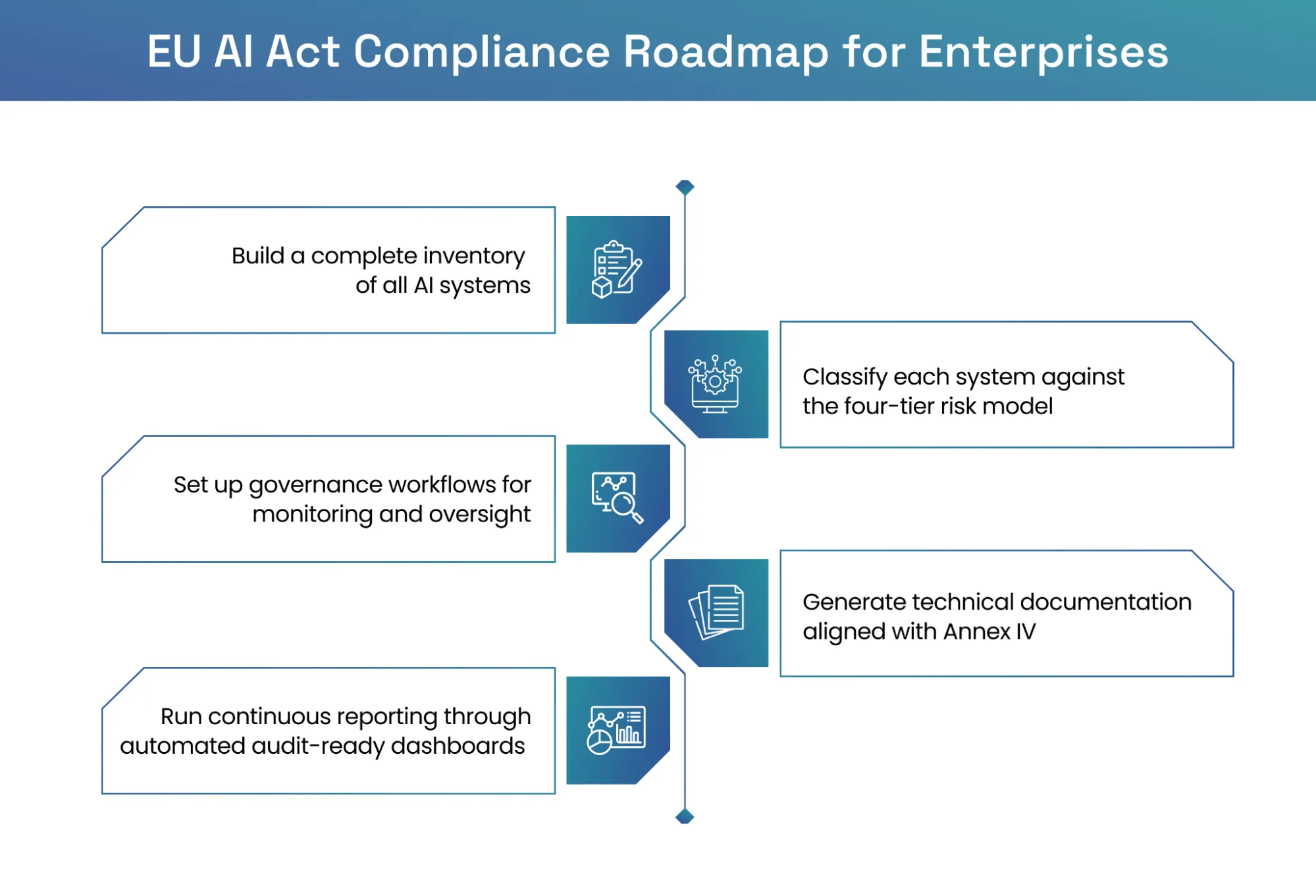
- Build a complete AI inventory covering every model, generative AI tool, and agent currently deployed or in development.
- Classify each system against the four-tier risk model and flag every high-risk use case under Annex III.
- Establish governance workflows for risk assessment, validation, human oversight, and post-market monitoring.
- Generate technical documentation aligned to Annex IV templates and conformity assessment requirements.
- Set up ongoing reporting infrastructure that feeds drift, incident, and performance data into audit-ready outputs.
How Solytics Partners Helps Enterprises Meet the EU AI Act?
The EU AI Act has shifted AI governance from a voluntary discipline to an enforceable obligation. December 2027 is the binding deadline for high-risk systems, and the operational lift involved (inventory, classification, documentation, oversight, monitoring) takes far longer than most enterprises assume. Conformity assessments alone consume 6 to 12 months of dedicated work.
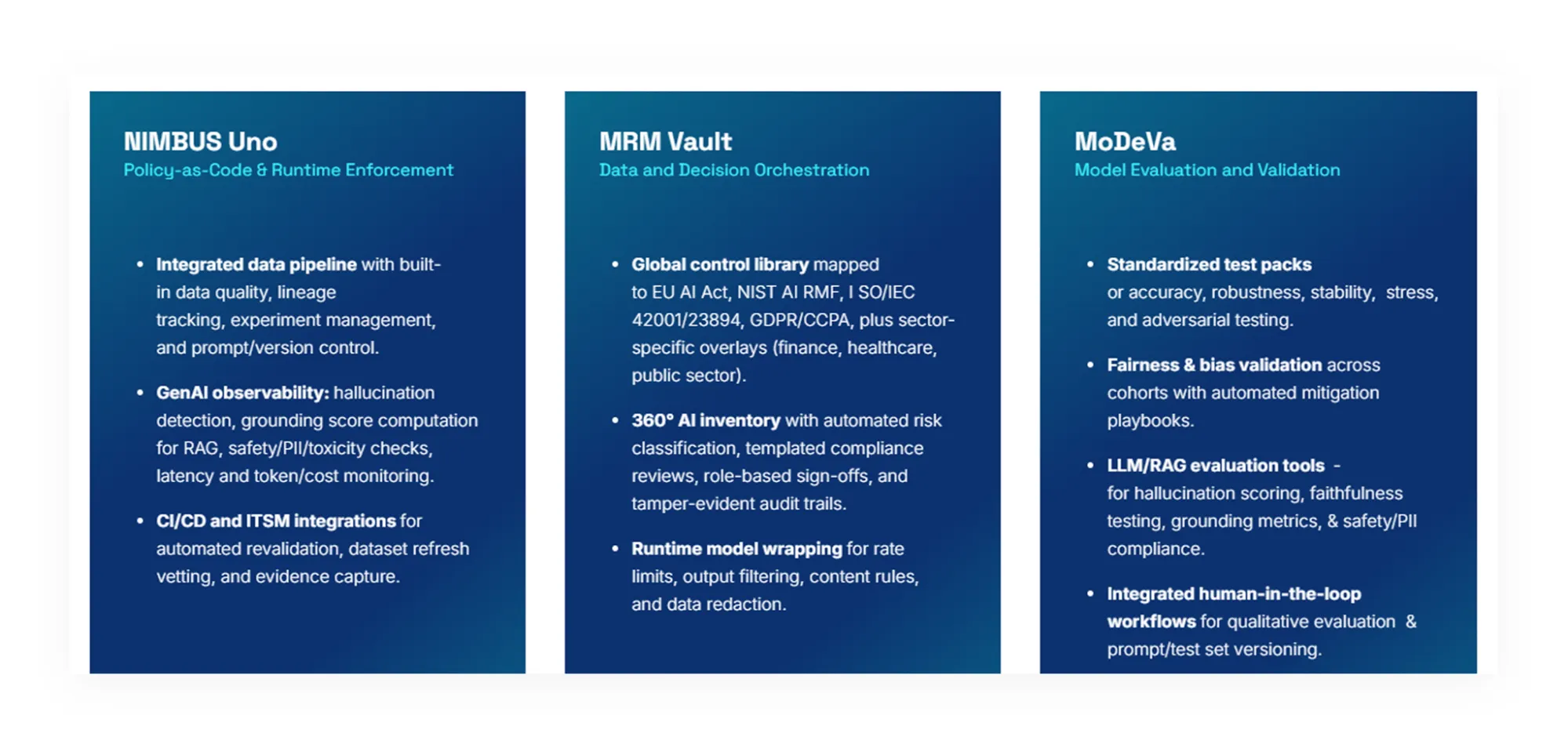
Solytics Partners delivers the unified ecosystem that the EU AI Act compliance demands across regulated industries.
- MRM Vault centralizes the AI inventory and automates regulatory documentation aligned with Annex IV templates.
- NIMBUS Uno monitors traditional models, ML systems, generative AI and agents continuously across the full lifecycle.
- The platform captures drift, hallucinations and serious incidents without manual intervention from compliance teams.
- MoDeVa libraries handle bias testing, fairness scoring and explainability for every high-risk system in production.
- Pre-built regulatory mapping covers EU AI Act, NIST AI RMF and SR 20-02 inside one ecosystem.
Enterprises avoid the typical four-tool stack of inventory, monitoring, validation and documentation systems, and the integration debt that comes with stitching them together.
Book a demo and see how unified inventory, automated documentation and continuous monitoring shift your team from chasing deadlines to running ahead of every audit cycle.
Frequently Asked Questions
Does the EU AI Act apply to companies in the US?
Yes, the Act applies extraterritorially when AI systems are used in the European Union. A US provider placing AI on the EU market faces full obligations. US deployers serving EU customers face the same scope.
What happens if an enterprise misses the 2 December 2027 high-risk deadline?
Missing the deadline triggers fines up to EUR 15 million or 3% of global revenue. Member states also have authority to order withdrawal of non-compliant systems. Repeat violations attract higher penalty multiples in some jurisdictions.
How does the EU AI Act interact with GDPR and DORA for financial institutions?
The three regulations layer rather than replace each other. Financial institutions running AI face overlapping obligations on documentation, incident reporting and third-party risk. Coordinated compliance programs reduce cost without compromising any individual regime.
What is the difference between a provider and a deployer under the EU AI Act?
Providers develop and place AI on the market under their own brand. Deployers use AI systems in a professional capacity. Substantially modifying a third-party system or rebranding it converts a deployer into a provider under Article 25.
Are general-purpose AI models like GPT-4 and Claude regulated separately?
Yes, GPAI models follow Articles 51 through 55 with obligations distinct from high-risk system rules. Models posing systemic risks face additional evaluation and transparency obligations. The AI Office manages oversight at the EU level.
Are chatbots like ChatGPT considered high-risk under the EU AI Act?
Most chatbots fall into the limited-risk tier requiring transparency disclosures rather than the high-risk tier. The classification depends on the use case rather than the underlying technology. Chatbots used for credit decisions become high-risk by association.
How long does conformity assessment take for high-risk AI systems?
Conformity assessment runs six to twelve months for a single high-risk system. Documentation preparation, testing and notified body engagement drive most of the timeline. Enterprises managing multiple systems should sequence assessments across quarters.
What is the difference between the EU AI Act and GDPR?
GDPR governs personal data processing across all technologies. The EU AI Act governs AI systems regardless of whether they process personal data. AI systems processing personal data trigger both regimes simultaneously through overlapping obligations.
.webp)
.svg)


