Solytics Partners Secures a Trifecta of Wins at the Economic Times Enterprise AI Awards 2026

.png)
AI adoption has moved from experiments into everyday enterprise workflows. Banks use AI for fraud reviews, credit decisions, service workflows and compliance alerts. Healthcare, hiring and insurance teams also use AI systems to support decisions that affect people.
This wider use creates risk when teams cannot clearly show ownership, controls, monitoring or evidence. IBM reported in 2026 that only 18% of organizations maintain a current and complete AI inventory. This gap shows why enterprises need stronger oversight mechanisms before AI expands further across business functions.
This blog explains what is AI governance, why it matters, and how enterprises build a working program. It covers pillars, frameworks, examples, ownership, GenAI, agentic AI, and Solytics Partners’ operating view.

What Is AI Governance?
AI governance is the set of policies, roles and controls that guide enterprise AI use. It covers development, deployment, monitoring and retirement. It makes AI systems accountable, controlled and reviewable.
Here is another simple AI governance definition: it gives teams a clear way to decide who owns an AI system, which risks it carries, and how controls work. It also defines what evidence teams must preserve. This makes effective AI governance measurable during audits and internal reviews.
The AI governance meaning becomes clearer through four operating questions. Who owns the system? What risks can it create? Which governance controls reduce those risks? Which records prove the controls work over time?
AI governance applies across traditional models, machine learning systems, generative AI applications, and autonomous agents. The control design may change by system type. The governance questions stay consistent across the AI lifecycle.
As organizations mature, they move from broad principles to repeatable operating discipline. The next section explains that maturity path.
Three Levels of AI Governance
AI Governance maturity shows how consistently teams apply ownership, controls, monitoring, and evidence across AI portfolios. Most organizations move from informal guidance to formal enterprise programs.
- Informal governance: Teams discuss ethical considerations through broad principles or review groups. Ownership, monitoring, escalation, and evidence remain unclear across most business functions.
- Ad hoc governance: Some teams add review steps for selected use cases. These governance practices help local teams, yet evidence still depends on manual follow-ups and scattered records.
- Formal governance: Enterprises define portfolio-wide ownership, control standards, escalation paths, and audit evidence. Formal governance structures help ensure every AI workflow remains reviewable throughout development and production.
These levels show why principles alone do limited work. Enterprises also need values that guide decisions and operating controls that prove those values work.
How Is AI Governance Different From Responsible AI?
Responsible AI and AI governance work together, yet they solve different enterprise problems. Responsible AI defines expected behavior, while governance turns those expectations into controls, owners, and reviewable evidence over time.
Here is a comparison highlighting how both disciplines differ across enterprise AI programs:
Why Does AI Governance Matter in 2026?
AI governance is essential for enterprises as artificial intelligence now influences regulated decisions, customer outcomes, operational exposure and board-level risk. Strong governance helps teams identify exposure early, assign ownership and preserve evidence before incidents escalate.
The following forces explain why enterprises need stronger governance as AI use expands:
- Regulation now shapes AI decisions: The EU AI Act creates risk-based obligations across the region. Penalties for prohibited practices can reach EUR 35 million or 7% of global annual turnover.
- Timelines require evidence planning: Transparency obligations apply from 2 August 2026, while Annex III high-risk rules apply later. Enterprises still need governance evidence before regulatory requirements become examination pressure.
- Privacy risk needs stronger review: AI systems can process sensitive data and personal records at scale. The General Data Protection Regulation requires DPIAs for processing likely to create high rights risks.
- Operational incidents can spread fast: Hallucinations, weak prompts, poor retrieval, and poor controls can create customer errors or compliance issues. Strong incident response helps teams detect issues early and preserve clear ownership records.
- Shadow AI creates hidden exposure: Employees may use AI tools without approval or review. Governance helps teams identify unapproved systems and control data privacy risks before workflows expand.
This is where AI risk management becomes a practical governance discipline. Teams need controls that reduce exposure and improve daily AI operations.
What Are the Business Benefits of AI Governance?
AI governance helps enterprises deploy AI with clearer ownership and stronger evidence during review cycles. It also improves how teams monitor performance and act after deployment. These benefits become clearer when governance steps guide decisions before release and after deployment.
- Faster controlled deployment: Teams move faster when governance steps already exist. Clear intake and tier-aware approval routes reduce repeated discussions across new workflows.
- Lower incident exposure: Continuous monitoring helps teams detect drift, unsafe responses, weak outputs, and control failures after release. This gives teams earlier signals of issues before they reach customers or regulators.
- Stronger procurement posture: Buyers increasingly request evidence of governance before approving AI vendors. Documented controls, evidence of data security, monitoring records, and ownership records help answer those questions more quickly.
- Clearer business alignment: Governance links AI use with business objectives and approved purpose. This helps teams protect business value while keeping risks visible.
- Better performance review: Governance programs define key performance indicators for models and GenAI workflows. These indicators help owners review performance in safety, fairness, reliability, and compliance.
These benefits depend on the program's operating model. Accountability, trustworthiness, compliance alignment, and monitoring discipline create that foundation.
What Are the Three Pillars of AI Governance?
Al governance needs defined pillars because policies alone do not show how teams control Al systems. Each pillar creates a different kind of review evidence, from ownership records to testing outputs and compliance mappings.
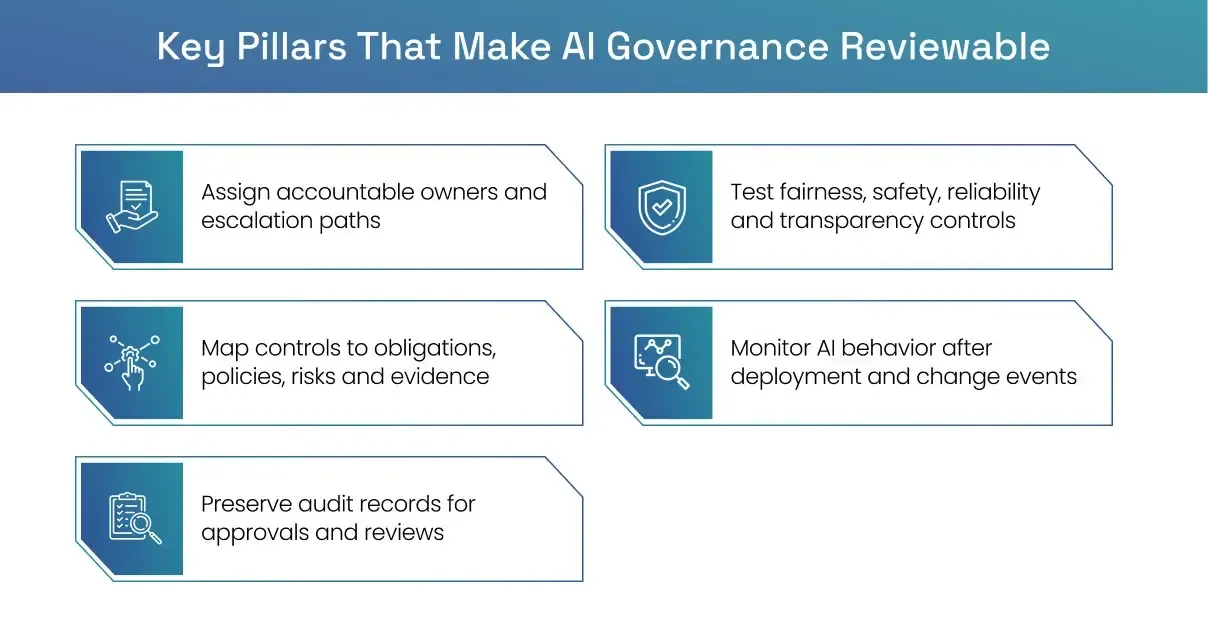
The following analysis shows how accountability, trustworthiness, compliance alignment, and monitoring discipline support reviewable governance.
Accountability ensures that people own decisions and follow-up actions. Trustworthiness checks whether the AI system behaves within approved limits. Compliance encompasses regulatory compliance, internal compliance requirements, audit readiness, and review expectations.
Trustworthiness also depends on technical evidence across the model lifecycle. Teams need data governance, data quality, data integrity, and explainable AI outputs. Higher-risk decisions also require human oversight, access controls, approval records, and clear control ownership.
What Are Examples of AI Governance in Enterprises?
AI governance becomes easier to understand through operating examples. These examples show how policies become controls. They also show how teams create evidence for review.
- Model inventory: Enterprises maintain one record for every AI model, workflow and approved tool. The inventory captures owner, purpose, risk tier, data sources, deployment status and approval history.
- Risk tiering: Teams classify systems by impact, reversibility and regulatory exposure. The assigned risk profile guides validation depth, approval level and ongoing monitoring frequency.
- Bias testing: Governance teams test outputs across customer segments and, where relevant, protected attributes. This helps teams identify unfair outcomes before systems affect credit, employment or service decisions.
- Human oversight: High-impact decisions move through human review before final action. Reviewers need authority and context along with adequate time to properly challenge outputs.
- Prompt governance: GenAI workflows require approved prompts, prompt-change records, and output checks. This detailed prompt governance guide explains how prompt controls support safer GenAI operations.
- Guardrails and monitoring: Teams use input checks, output review, retrieval controls, and system logs. These controls help reduce prompt injection and unsafe responses.
These examples show what governance looks like during daily work. Frameworks help teams connect that work with recognized control language.
What Are the Major AI Governance Frameworks?
Major AI governance frameworks help teams organize controls, evidence, and audit language across AI programs. Each framework serves a different purpose, so enterprises should avoid treating them as interchangeable. Most regulated organizations combine legal obligations, audit expectations, internal policies, and sector rules.
- EU AI Act: The AI Act is a binding law that classifies AI systems by risk. Its high-risk system rules use Article 6 and Annex III classification logic.
- NIST AI RMF: NIST AI RMF works as a voluntary AI risk management framework for managing AI risks. It uses Govern, Map, Measure, and Manage functions across AI risk work.
- ISO/IEC 42001: This standard defines requirements for establishing and improving an AI management system. ISO describes it as an international standard for responsible AI development and use.
- ISO/IEC 23894: It offers guidance for managing risks linked to artificial intelligence systems. ISO says it supports organizations that develop, produce, deploy, or use AI-enabled products.
- SR 11-7 and SR 26-2: These model risk references guide US banking model governance. They help financial institutions manage validation, monitoring, documentation, and effective challenge.
These governance frameworks give teams a shared language for controls and evidence. No single risk management framework covers all AI obligations, making framework mapping a practical governance step.
How Do You Build an AI Governance Program?
Enterprises build AI governance through inventory, tiering, assessment, ownership, controls, and monitoring. Each step should create evidence, and the program should follow the system after deployment.
Step 1: Inventory Every AI System
Teams cannot govern AI they cannot see. The inventory is therefore a foundational component of AI model governance, covering approved models and unapproved tools. It should also include ML workflows, GenAI applications, and agents.
Each record should show the owner and approved purpose. It should capture training data and data sources in clear fields. Approval history and deployment status should also stay attached to the same record.
This creates visibility before teams apply controls. It also supports proper oversight during audits and internal reviews.
Step 2: Apply Risk Tiering
Risk tiering decides the control depth for each system. Teams should first review business impact and reversibility. They should then examine data sensitivity and regulatory exposure.
Higher-risk systems need stronger validation and approval paths. Lower-risk systems still need ownership records and basic controls. This keeps AI governance proportionate to actual exposure.
Step 3: Run AI Risk Assessments
Risk assessments give each system a documented risk view after tiering. Teams should examine performance and bias first. Privacy exposure, security concerns, and operational impact need separate review.
This step supports risk management by enabling teams to identify risks before deployment. Solytics’ AI risk management tools guide explains how platforms support assessments and control evidence.
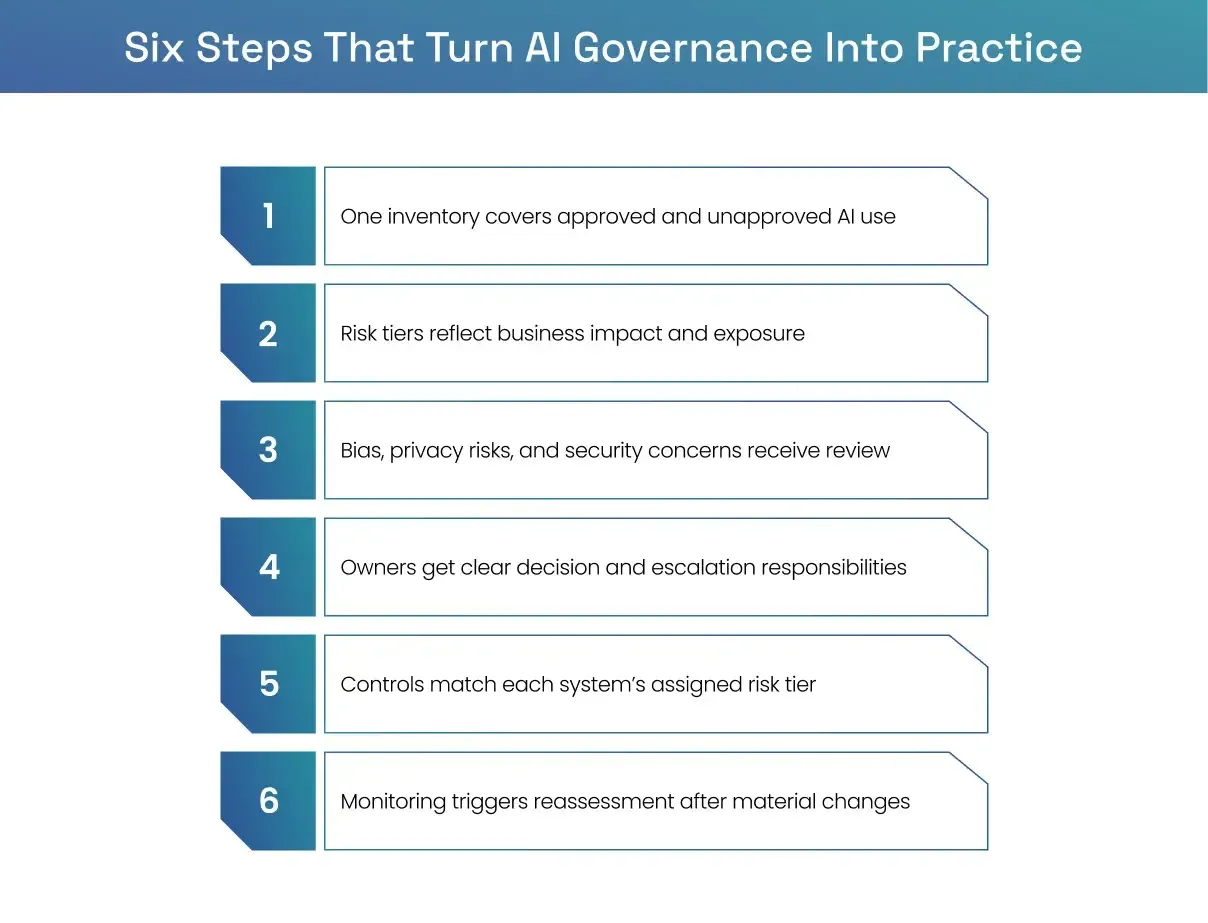
Step 4: Assign Accountability
Every system needs named owners and documented decision rights. Teams should clearly define the business owner and the model owner. The data steward and escalation route should also appear in governance records.
This gives executive leadership a clear view of responsibility across the portfolio. It also reduces accountability gaps when incidents occur, model changes are made, or regulatory questions arise.
Step 5: Implement Controls Proportionate to Risk
Controls should match the system’s tier and approved use. Higher-risk systems may need bias testing and human oversight. They may also need access controls and audit trails.
Teams should align controls with organizational goals before deployment. A low-risk internal assistant and a credit decision model should follow different workflows.
Step 6: Monitor Continuously and Reassess
Governance continues after deployment. Teams should track model drift and performance changes. Incidents, user feedback, and regulatory updates should trigger reassessment when they affect system risk.
Monitoring keeps controls aligned with current behavior. It also supports continuous improvement because teams can update thresholds and owners after findings.
This structured approach keeps governance connected to daily AI use through an AI governance platform. It gives teams best practices without turning AI governance into a static policy exercise.
Who Owns AI Governance in an Enterprise?
AI governance works when every decision has a clear owner and escalation path. Shared accountability can support the program, but each role still needs defined responsibility. This structure helps teams move reviews, incidents, and approvals without confusion.
- AI Governance Council: This group approves governance policies and reviews higher-risk AI use cases. It also tracks program-level metrics through a single forum for risk, legal, technology, and business leaders.
- Chief AI Officer or Chief Risk Officer: The executive owner connects AI governance priorities with board reporting and investment decisions. This role helps leadership decide where funding, controls, and accountability should sit.
- Model Risk Owner: This owner manages performance, validation evidence, limitations, and control follow-up for a specific system. The role works with data science teams when model behavior or assumptions need review.
- Data Steward: The data steward manages definitions, lineage, quality rules, and permitted use. This role helps protect privacy when AI systems use customer data or employee records.
- Business Owner: The business owner confirms the use case and expected business benefit. This role checks whether AI outputs still support approved business objectives and customer impact expectations.
Role clarity becomes more important when systems produce open-ended responses or take actions across connected tools. GenAI and agentic AI need extra controls because ownership, permissions, and review points can blur quickly.

How Should Enterprises Govern GenAI and Agentic AI?
GenAI and agentic AI require additional controls because their outputs vary and their actions can affect connected systems. Governance should define prompt behavior and tool permissions before these systems enter production. It should also set review points for potential risks that appear after deployment.
GenAI Governance
GenAI governance starts with approved use cases and prompt controls. Retrieval boundaries should define which sources the system can use and cite. Teams should monitor hallucinations, unsafe outputs, data protection issues, and grounding failures.
Solytics’ GenAI observability analysis explains why production traces matter after deployment. Reviewable logs help teams see how context, prompts, retrieved documents, and system settings shaped each answer.
Agentic AI Governance
Agentic AI systems can plan steps and call tools across connected systems. Teams should define scope boundaries and agent identities before granting access. Tool permissions and action logs should then show what the agent did.
These controls help teams manage AI technologies that operate beyond single-output prediction. They also support safer use of AI when agents trigger workflows. Clear permissions reduce access, data, operational, and compliance risks.
The control model should remain easy to inspect. Teams should know what the system can do and where it can act. They should also know who reviews exceptions when behavior moves outside approved limits.
How Does Solytics Partners Enable AI Governance?
AI governance is harder to sustain when inventory, controls, approvals and monitoring records sit across separate systems. Solytics Partners brings these governance layers together for models, GenAI applications and agentic AI.
The platform helps teams govern AI from a central inventory, with ownership, risk tiering and approval workflows tied to each asset. It also maps controls to policies, regulations and internal standards, so governance evidence stays connected to daily decisions.
Validation adds the next layer of assurance before systems move into production. Teams can test accuracy, bias, safety, robustness and hallucination risk across models, RAG systems and agents, while comparing outputs against business and policy thresholds.
After deployment, NIMBUS Uno helps teams monitor prompts, responses, retrievals, tool calls, drift, bias and hallucination signals. Runtime assurance adds policy enforcement for agent permissions and actions, helping teams allow, escalate or block high-risk behavior before execution.
Book a 1:1 demo to see how Solytics connects AI inventory, validation, runtime assurance and monitoring evidence across enterprise governance workflows.
Frequently Asked Questions
What is an example of AI governance?
An example of AI governance is a central AI inventory with owners, risk tiers, and approval records. Teams use it to see which systems operate across the business. They then connect each system with controls, monitoring, and evidence review.
What is the main goal of AI governance?
The main goal of AI governance is to make AI systems accountable, controlled, and reviewable. It helps teams manage risk, compliance, performance and stakeholder impact. Strong governance gives leaders evidence that systems operate within approved boundaries.
How is AI used in governance?
AI can support governance tasks such as monitoring, documentation review and risk detection. This differs from AI governance, which controls AI systems themselves. Enterprises should use AI tools carefully when governance decisions need evidence, accountability and review.
What is the difference between AI governance and responsible AI?
Responsible AI defines values such as fairness, transparency, accountability and privacy. AI governance turns those values into controls, owners, tests and evidence. A fairness principle becomes operational when teams run bias tests and record outcomes.
How do enterprises implement AI governance?
Enterprises implement AI governance by creating inventory, risk tiering, assessments, ownership, controls, and monitoring. Each step should create evidence that reviewers can inspect. The program should stay current as models, data, rules, and business conditions change.
.svg)


