We have been recognized in RegTech100 2026 - Strengthening leadership across AI governance, MRM and FCC


Most enterprises managing Artificial Intelligence (AI) today juggle three or four disconnected systems. Model inventory sits on one platform. Monitoring runs on another. Validation libraries live in notebooks, while regulatory documentation is scattered across SharePoint folders.
That fragmentation is now a compliance liability.
Regulators have tightened expectations under the EU AI Act, NIST AI Risk Management Framework, and SR 26-02, and disconnected systems can't produce the audit-ready evidence they demand. AI risk management software now sits on the board agenda for most large enterprises.
This article compares the strongest AI risk management platforms available in 2026. Each section covers what the platform does well, where it leaves gaps, and which buyers should shortlist which tool.

Why AI Risk Management Software Matters in 2026
AI failures now sit on the same risk register as fraud and operational outages. The shift makes documented governance a board-level requirement across regulated industries.
- Regulators have moved from voluntary to enforceable frameworks: The EU AI Act became fully enforceable in August 2026, classifying medical AI and credit scoring as high-risk systems. Non-compliance carries fines of up to 7% of global revenue. Documented governance is no longer optional for any enterprise placing AI on the European market.
- Shadow AI has scaled inside enterprises: Employees deploy generative AI tools without IT awareness, creating ungoverned model sprawl across the AI lifecycle. Without a centralized inventory, risk teams cannot identify which models touch sensitive data or feed customer decisions. Governance gaps multiply faster than the controls designed to close them.
- GenAI introduces risks that legacy tools cannot detect: Hallucinations, prompt injection, data leakage and model drift behave differently from traditional model failures. Risk frameworks built for credit scoring models fail when applied to LLM-driven workflows. Enterprises need controls such as LLM guardrails and continuous monitoring designed for non-deterministic outputs and adversarial attacks specific to machine learning systems.
- Manual documentation drains compliance teams: Validation reports, model cards and audit trails consume weeks of analyst time per model. Automated documentation has shifted from a productivity gain to an operational necessity at scale. Regulatory requirements demand audit-ready evidence on demand rather than weeks-long preparation cycles.
- Real-world failures have hit fintech and healthcare: In 2019, the Apple Card triggered a New York State Department of Financial Services investigation after alleged gender-based credit limit disparities raised concerns about algorithmic transparency. In healthcare, external validation of the Epic Sepsis Model revealed low sensitivity, prompting hospitals to reassess its clinical use. Both incidents shifted AI risk from theoretical to documented enterprise concern.
12 Best AI Risk Management Software in 2026
The 12 platforms below cover the best AI risk management software in 2026:
1. Solytics Partners
If you're a bank, insurer, or healthcare enterprise trying to govern AI at scale, you've probably already hit the same wall. Using one tool for model inventory, another for monitoring, a third for validation, and a compliance team still building audit packages manually. Solytics Partners is built to replace that entire stack.
The platform combines AI governance, model risk management, financial crime compliance, and trade surveillance inside one ecosystem. The 2026 Chartis RiskTech Quadrant named Solytics a Category Leader for AI Governance Solutions, recognizing the unified architecture that links MRM Vault, NIMBUS Uno and MoDeVa.
Three core products sit at the center of the MRM ecosystem:
- MRM Vault for model governance and inventory
- NIMBUS Uno for model development, validation, and performance monitoring, and
- MoDeVa for advanced model testing and validation libraries.
Together, they cover the full model lifecycle and save 40 to 50% of the time typically spent on model development, validation, and documentation
What are the key features of Solytics Partners?
- Unified ecosystem across four domains: Solytics covers AI governance, model risk, financial crime and surveillance inside one platform. Other vendors require integration between separate tools to achieve the same view.
- Geometric knowledge graphs for GenAI validation: A proprietary graph architecture validates RAG systems, LLM outputs and agent decisions with a depth that point-tool validators cannot match.
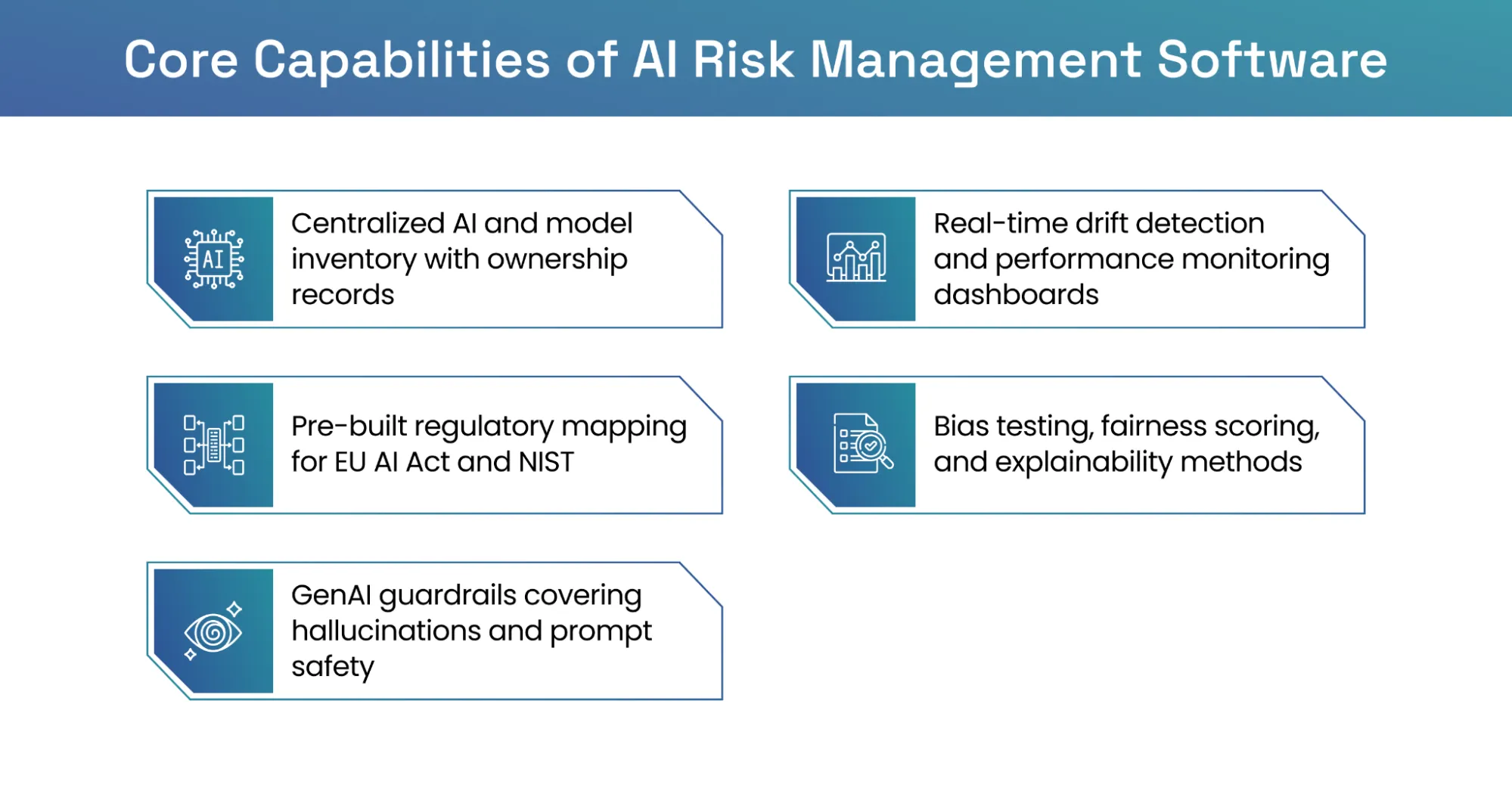
- Real-time observability across ModelOps, LLMOps and AgentOps: AI model monitoring by tracking drift, hallucinations, prompt safety, grounding quality, and other key GenAI observability metrics alongside traditional model performance indicators in real time.
- Pre-built regulatory mapping for global frameworks: Pre-loaded templates cover SR 26-02, EU AI Act, NIST AI RMF, OFSI E23, MAS and CBUAE. Audit reports generate automatically from live model data.
- Integration with leading LLM providers: Native integration with OpenAI, Anthropic, Google and Meta supports prompt versioning, evaluation, and human in the loop governance controls for responsible AI oversight.
How much does Solytics Partners cost?
Solytics uses custom enterprise pricing based on model volume, selected ecosystem modules and deployment model. NIMBUS Uno Open Access is available at no cost for teams evaluating the platform before full deployment.
Why is Solytics Partners the best AI risk management software?
Solytics replaces the typical four-tool stack of governance platforms, observability layers, validation libraries, and documentation systems with a unified enterprise AI governance ecosystem where data flows natively. IT and risk teams eliminate sync lag, integration cost and the audit gaps that point solutions create.
2. IBM watsonx.governance
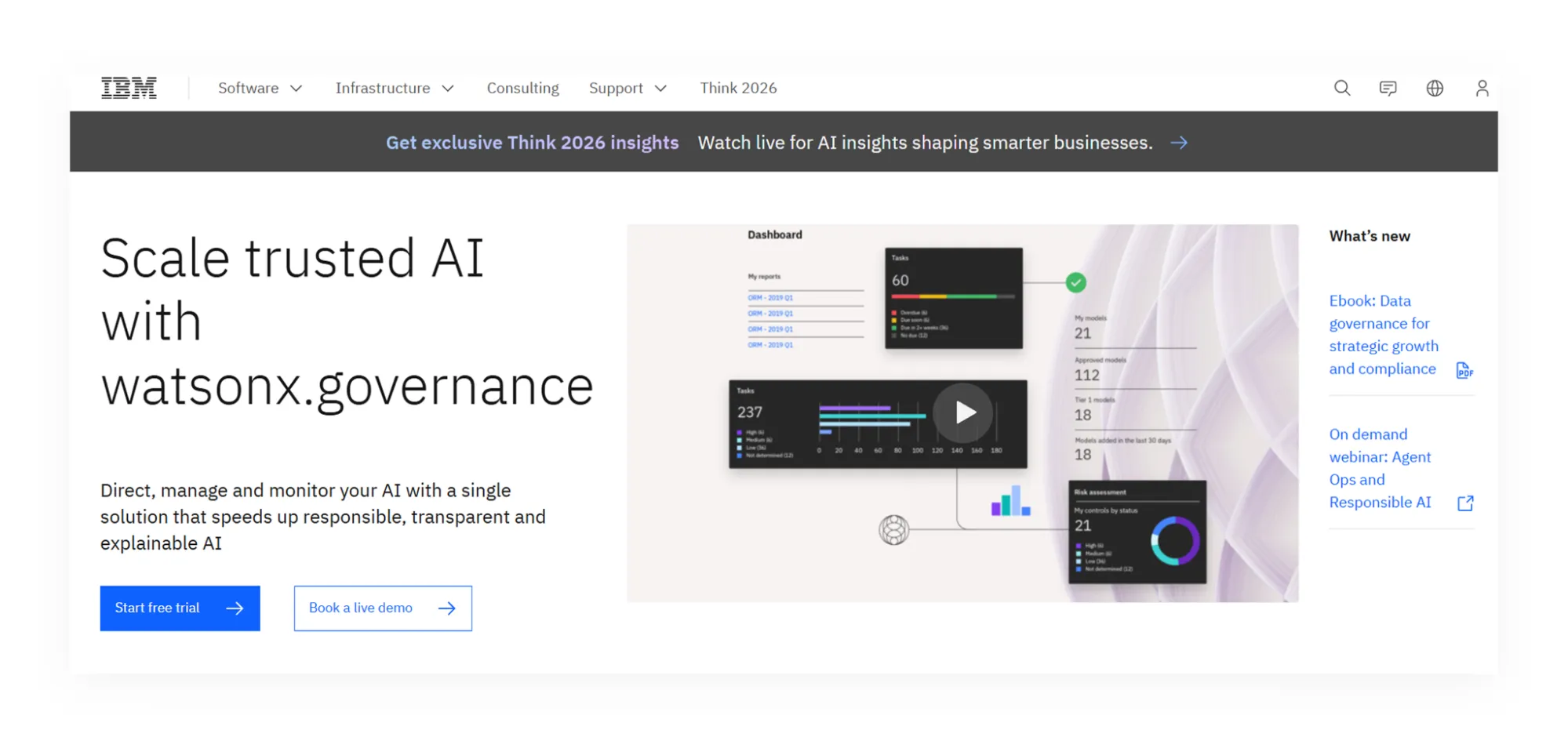
IBM watsonx.governance is the AI governance toolkit inside the broader IBM watsonx platform. It covers lifecycle management, model risk workflows and bias detection. The platform includes policy packs for compliance across the EU AI Act, ISO 42001 and NIST AI RMF.
What are the key features of IBM watsonx.governance?
- Automated metadata capture across model development pipelines
- Bias and drift detection integrated with watsonx.ai
- Compliance Accelerators activate Credo AI Policy Packs
- Cloud Pak deployment for enterprise watsonx environments
Why is Solytics Partners a better option than IBM watsonx.governance?
Solytics covers four risk domains in one platform: AI governance, model risk management, financial crime compliance, and trade surveillance. IBM watsonx.governance focuses on the governance layer within the watsonx ecosystem. Organizations need additional IBM products or third-party tools for model risk workflows and compliance management.
3. Microsoft Purview + Copilot Studio

Microsoft approaches AI risk management by combining Microsoft Purview’s data compliance capabilities with Copilot Studio’s development and customization layer. This combined offering is designed primarily for enterprises heavily invested in the Azure and Microsoft 365 ecosystems, focusing heavily on GenAI governance and cross-system enterprise workflow orchestration.
What are the key features of Microsoft Purview + Copilot Studio?
- Data lifecycle and lineage tracking: Extends enterprise data governance policies directly to information ingested by internal AI models.
- Native Copilot guardrails: Implements automated content filtering, data loss prevention (DLP), and sensitive data labels across Microsoft 365 Copilot interactions.
- Low-code agentic governance: Provides built-in compliance gates and approval loops within Copilot Studio for publishing customized autonomous agents.
- Centralized compliance dashboards: Monitors data security posture and regulatory compliance signals from a unified Microsoft compliance portal.
What are the pros and cons of Microsoft Purview + Copilot Studio?
Why is Solytics Partners a better option than Microsoft Purview + Copilot Studio?
Microsoft Purview + Copilot Studio excels at governing data assets and workflows inside the Microsoft ecosystem, but it lacks the deep, model-agnostic mathematical validation required by rigorous regulatory frameworks like SR 26-02. Solytics Partners provides a dedicated Model Risk Management (MRM) ecosystem that can validate any model architecture, whether built on open-source, custom notebooks, or third-party APIs. Furthermore, Solytics utilizes proprietary geometric knowledge graphs to validate RAG systems with a degree of structural depth that generic compliance suites cannot replicate.
4. ServiceNow AI Governance
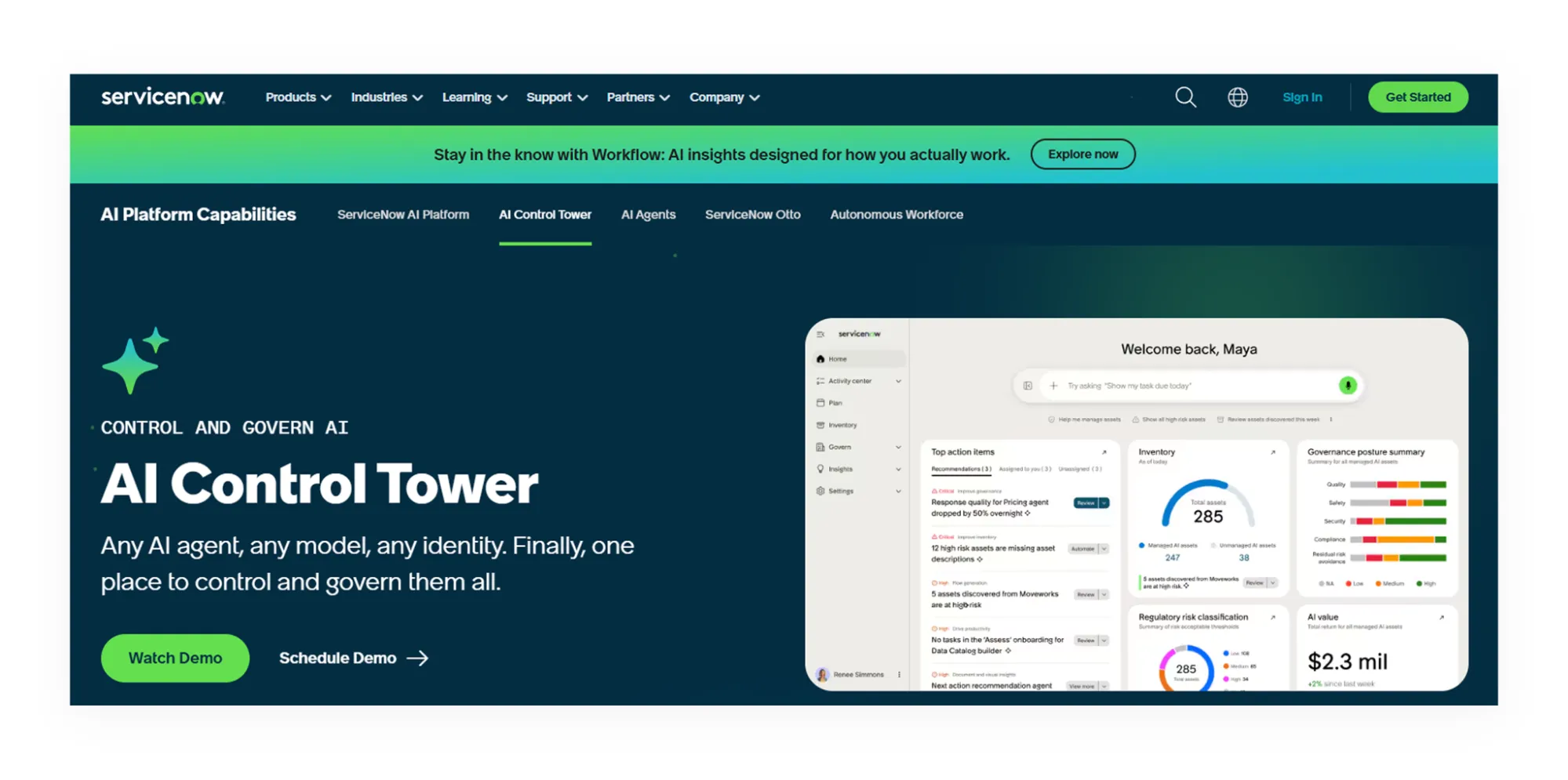
ServiceNow AI Governance integrates AI risk management directly into the ServiceNow Now Platform. Built on the company’s extensive workflow heritage, this solution focuses on connecting AI systems to enterprise IT Service Management (ITSM) and broader Governance, Risk, and Compliance (GRC) frameworks.
What are the key features of ServiceNow AI Governance?
- Automated risk intake and classification: Triggers standardized evaluation workflows whenever a new AI asset is registered or requested by business units.
- Cross-enterprise approval loops: Routes governance approvals dynamically between IT, legal, security, and compliance teams based on model risk tiers.
- Continuous controls monitoring: Links AI model performance alerts directly to corporate risk registers and incident mitigation workflows.
- Agentic workflow auditing: Tracks the operational boundaries and execution paths of automated business process agents.
What are the pros and cons of ServiceNow AI Governance?
Why is Solytics Partners a better option than ServiceNow AI Governance?
ServiceNow handles organizational workflow routing and process management at an elite level, but it functions primarily as an operational overlay rather than a deeply technical data science tool. It relies on integrations to see what a model is actually doing at runtime. Solytics Partners provides a natively unified environment where continuous production telemetry (NIMBUS Uno) and advanced testing libraries (MoDeVa) feed directly into the governance layer, eliminating data synchronization delays and integration overhead.
5. SAS AI Governance
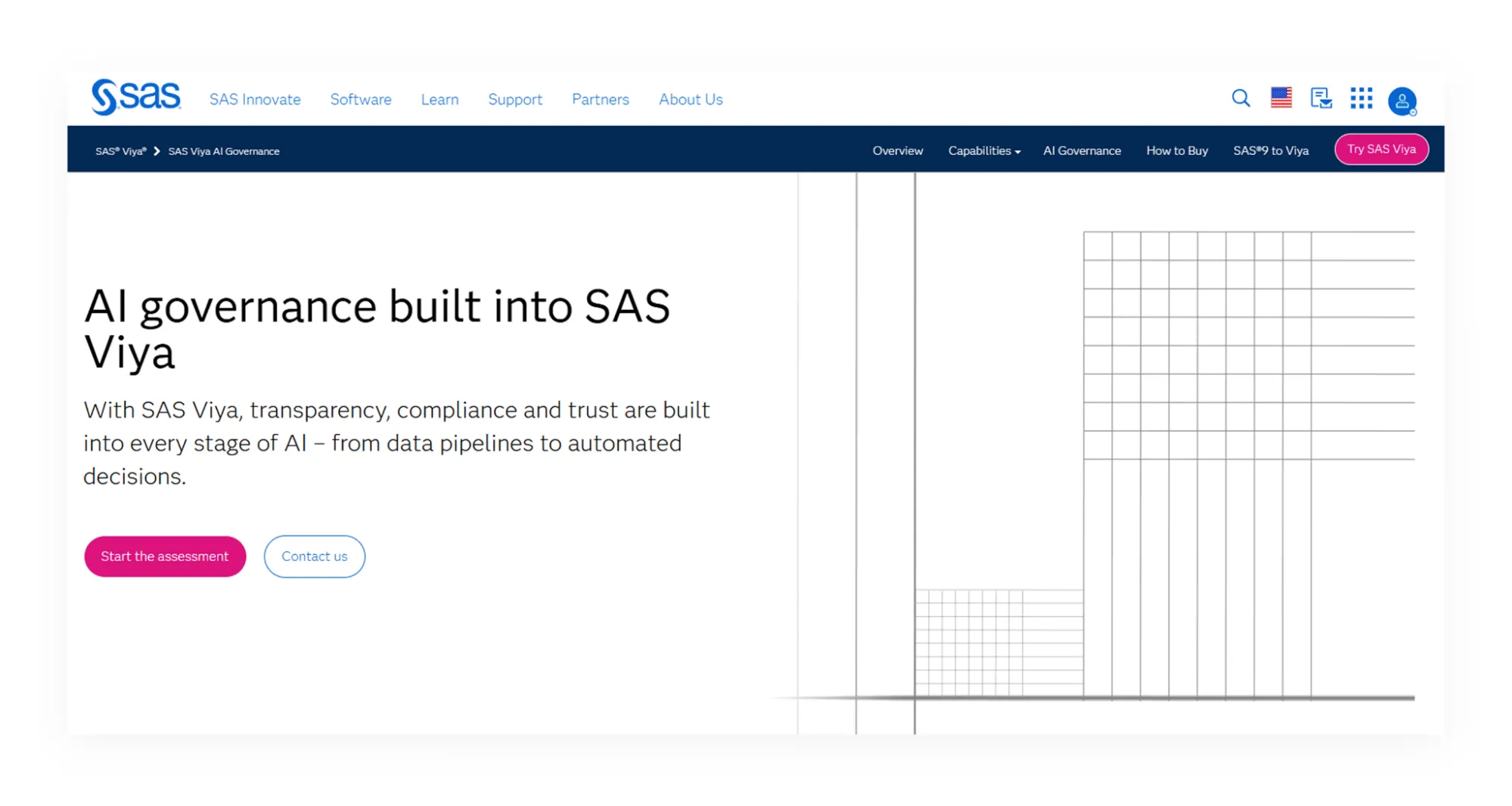
SAS AI Governance is a highly specialized platform tailored for highly regulated institutional environments, particularly banks, insurance firms, and government entities. Drawing on decades of institutional risk experience, the platform delivers immense depth in traditional model risk management (MRM) and regulatory alignment.
What are the key features of SAS AI Governance?
- Enterprise model risk accounting: Provides meticulous inventory tracking and documentation workflows designed for complex statistical and risk models.
- Pre-built regulatory compliance templates: Features deeply integrated mappings for prudential guidelines, including SR 26-02, OSFI E-23, and global banking frameworks.
- Rigorous validation pipelines: Automates mathematical validation and challenger model comparisons across analytical lifecycles.
- Lineage mapping for structured variables: Documents how credit scoring and financial data flow from raw inputs into downstream models.
What are the pros and cons of SAS AI Governance?
Why is Solytics Partners a better option than SAS AI Governance?
SAS remains a powerful option for legacy credit risk and traditional statistical models, but its architecture is poorly optimized for non-deterministic generative tools and autonomous AI agents. Solytics Partners matches the deep institutional MRM and regulatory validation rigor of SAS while offering native, cutting-edge coverage across ModelOps, LLMOps, and AgentOps. Solytics users can govern legacy models alongside real-time generative agents inside a single, unified inventory.
6. DataRobot AI Governance
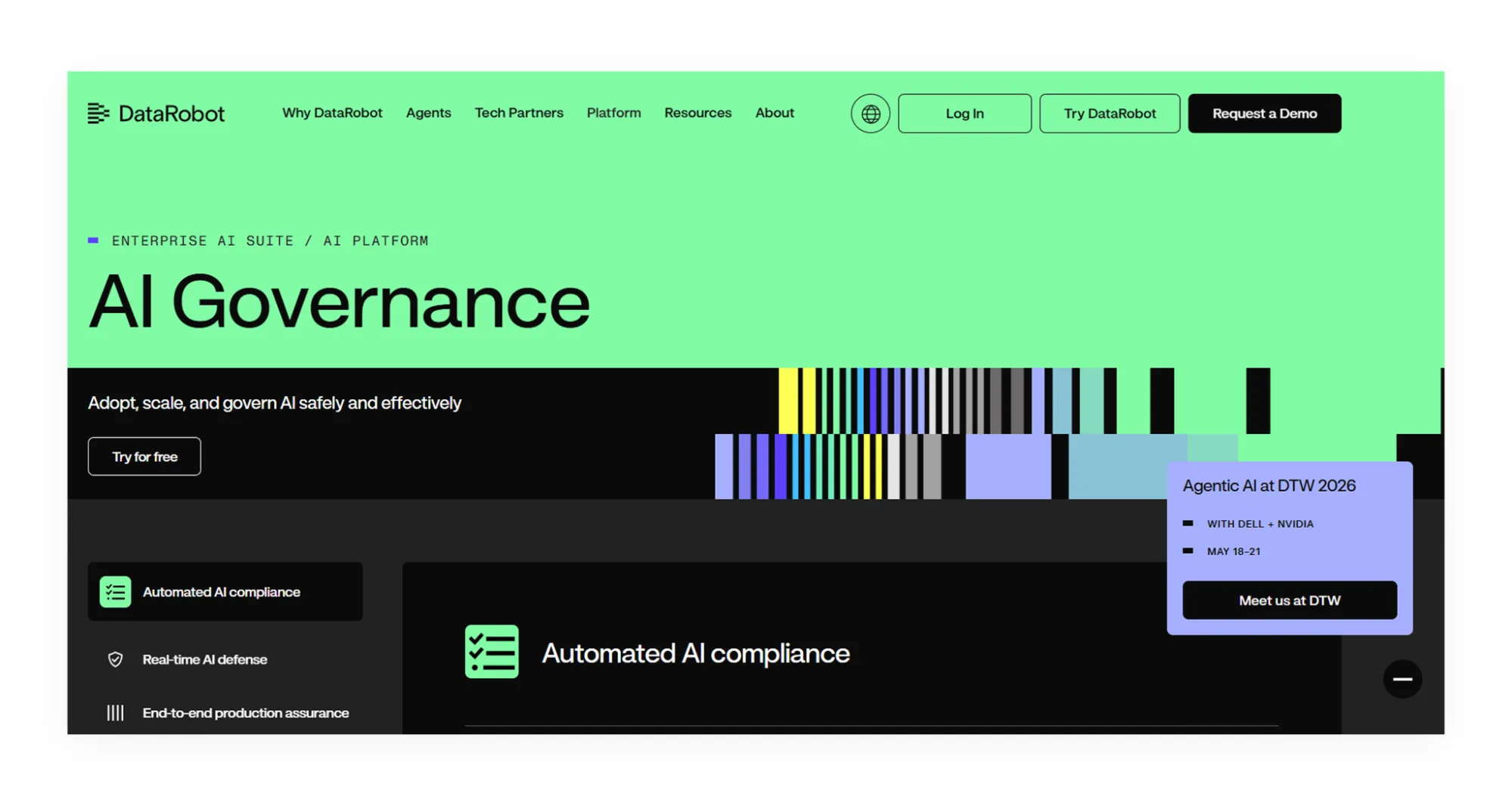
DataRobot AI Governance is a module inside the broader DataRobot platform. It provides bias detection, performance monitoring and approval workflows for DataRobot-built models.
What are the key features of DataRobot AI Governance?
- Native governance for DataRobot AutoML models
- Bias and fairness testing inside training workflows
- Approval workflows with role-based access controls
- Deployment gates for model promotion across environments
What are the pros and cons of DataRobot AI Governance?
Why is Solytics Partners a better option than DataRobot AI Governance?
Solytics is model-agnostic. It governs models built in any environment including notebooks, custom code and LLM APIs. Organizations are not locked into one model development tool to access full governance capabilities or access control workflows.
7. Credo AI
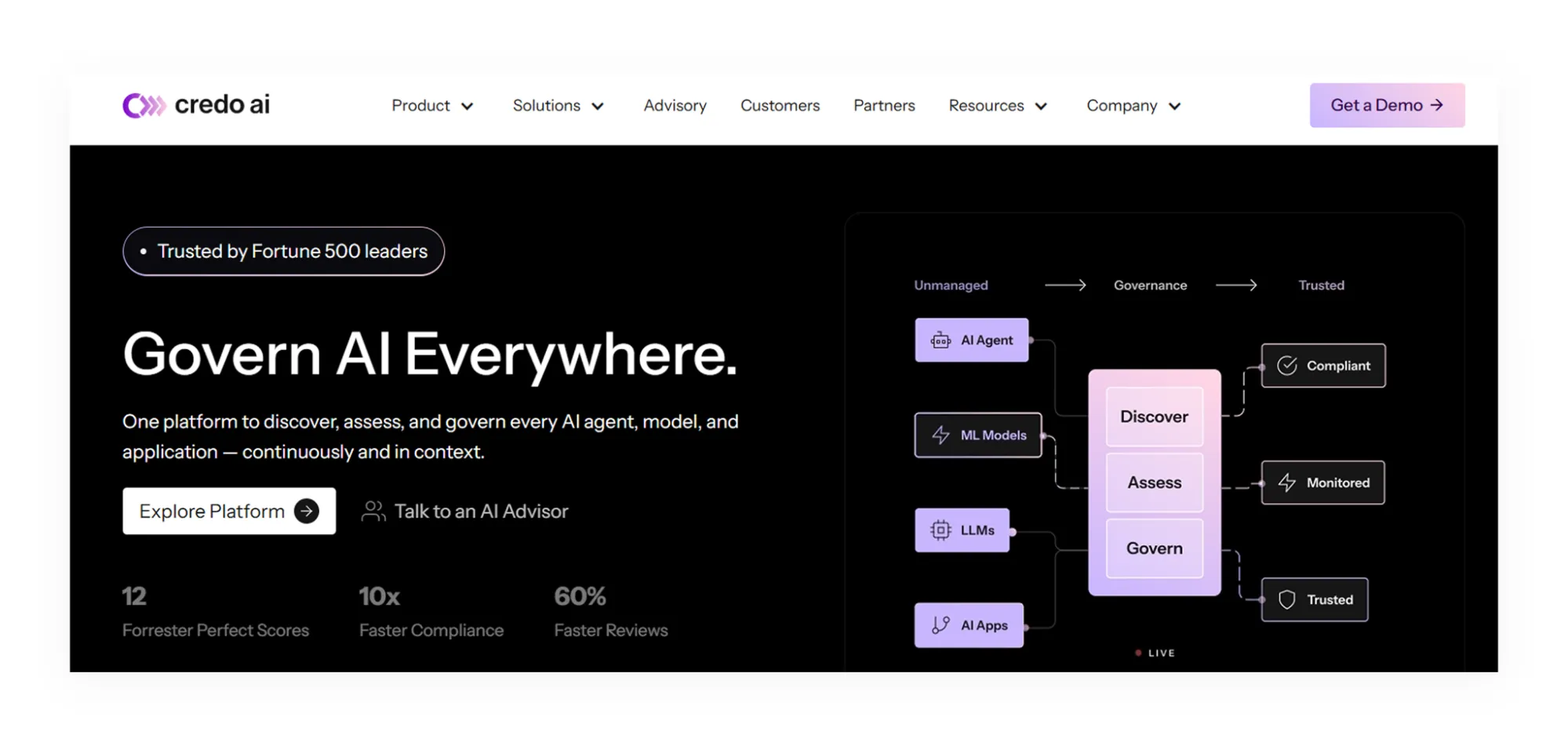
Credo AI is a purpose-built AI governance platform with policy intelligence at its core. The platform centralizes AI inventory, applies policy-as-code controls, and serves Fortune 500 customers, including Mastercard and Cisco.
What are the key features of Credo AI?
- Policy Packs for EU AI Act, NIST AI RMF and ISO 42001
- Agent governance covering registration, deployment gates and runtime
- Knowledge graph mapping regulations to model configurations
- Marketplace presence on IBM and Microsoft Azure
What are the pros and cons of Credo AI?
Why is Solytics Partners a better option than Credo AI?
Solytics delivers deeper regulatory integration for banking, insurance, and healthcare enterprises. The platform embeds SR 26-02, EU AI Act, MAS, and CBUAE compliance natively within MRM Vault workflows, eliminating manual mapping between governance policies and model risk controls. Credo AI provides policy-layer governance but lacks the model validation depth and regulatory workflow automation that financial institutions require under SR 26-02 and similar frameworks.
8. OneTrust AI Governance
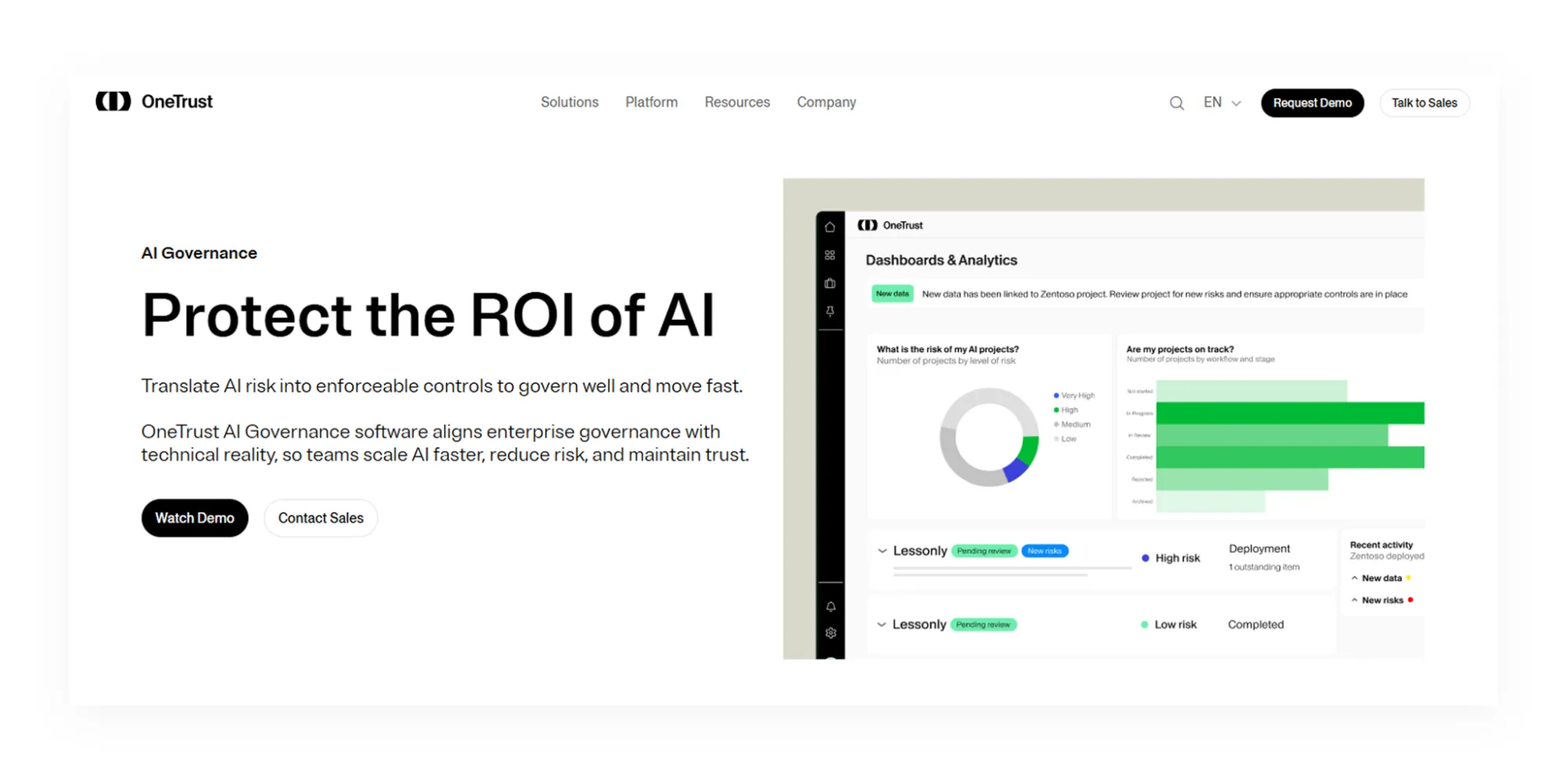
OneTrust AI Governance extends the vendor's market-leading privacy, security, and trust platform into the field of artificial intelligence. Its primary focus centers on compliance mapping, privacy management, data ethics, and automating Algorithmic Impact Assessments (AIAs) to meet global regulatory expectations like the EU AI Act.
What are the key features of OneTrust AI Governance?
- Algorithmic impact assessment automation: Evaluates models against global ethical, privacy, and safety frameworks via structured questionnaires.
- AI asset centralized registry: Maps AI models to the underlying datasets they process, leveraging existing data privacy maps.
- EU AI Act compliance wizard: Guides risk officers through conformity assessments and classification tiers for high-risk systems.
- Ethical risk scoring: Generates risk ratings based on data bias, transparency, and human-in-the-loop oversight parameters.
What are the pros and cons of OneTrust AI Governance?
Why is Solytics Partners a better option than OneTrust AI Governance?
OneTrust operates almost exclusively at the GRC and policy layer, relying heavily on manual inputs and self-reported risk assessments. It lacks the technical runtime observability and validation code integration necessary to verify if a model is operating safely. Solytics Partners connects policies directly to the actual code and data, using continuous runtime monitoring to verify compliance automatically, generate real-time metrics, and ensure your model inventory reflects actual production behavior.
9. Fiddler AI
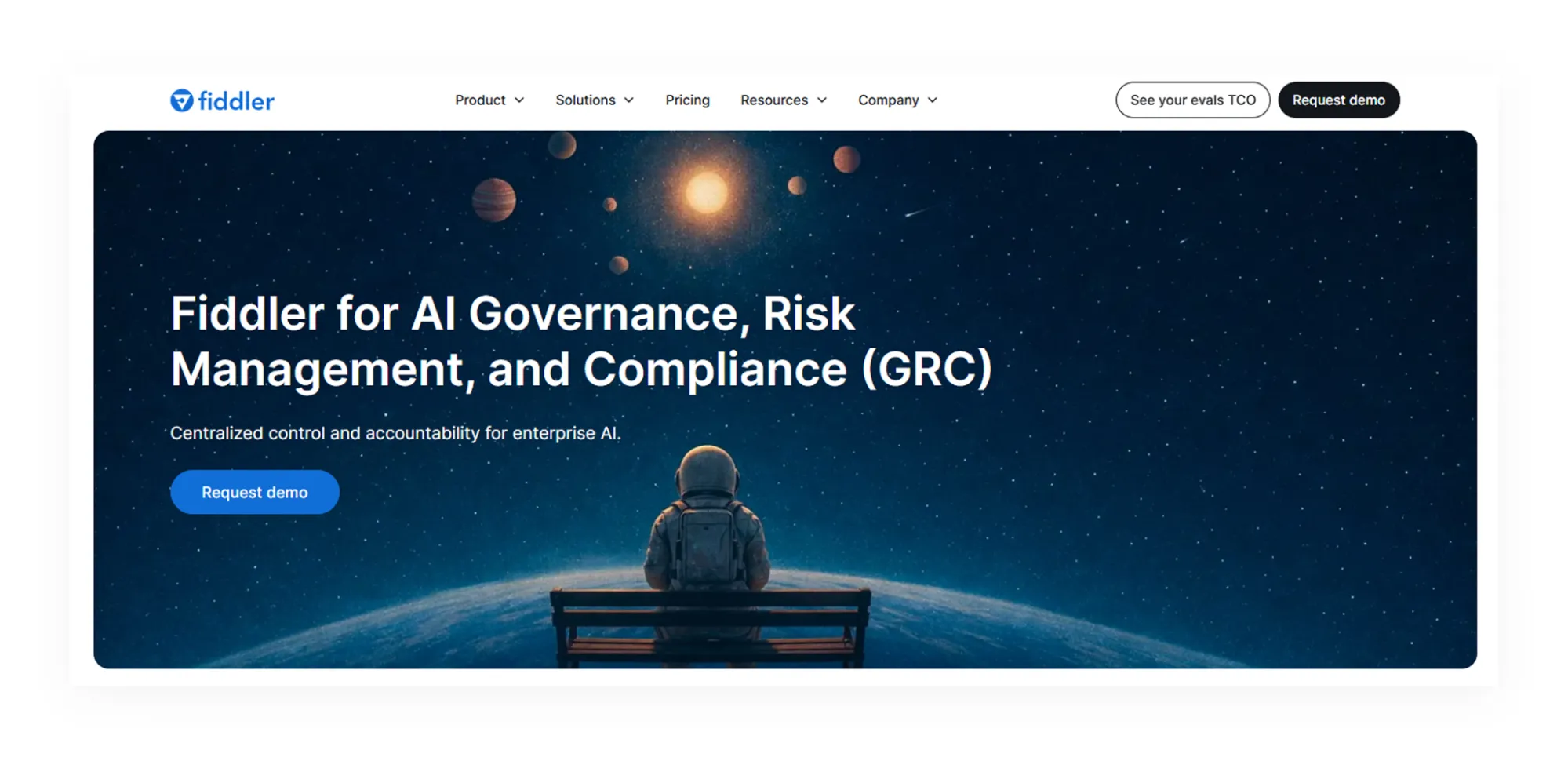
Fiddler AI is a dedicated AI observability and model monitoring platform built to give organizations deep visibility into model behavior. It focuses on the technical telemetry of models, specializing in tracking drift, explaining model outputs, discovering bias, and evaluating LLM application performance.
What are the key features of Fiddler AI?
- High-fidelity runtime monitoring: Captures real-time performance telemetry, instantly surfacing data and prediction drift anomalies.
- Explainable AI (XAI) engine: Provides deep feature attribution insights to explain exactly how complex models reach specific decisions.
- LLM evaluation and safety tracking: Supports GenAI model monitoring by tracking hallucinations, prompt injections, and conversational quality across generative AI deployments.
- Fairness and bias detection: Tracks operational data streams for disparate impacts or demographic parity violations in real time.
What are the pros and cons of Fiddler AI?
Why is Solytics Partners a better option than Fiddler AI?
Fiddler AI is an excellent point solution for MLOps engineers needing deep telemetry, but it lacks the organizational workflows, sign-off chains, and automated regulatory documentation templates required by risk and compliance teams. Solytics Partners includes robust runtime observability within its NIMBUS Uno module but embeds those metrics directly into a broader ecosystem containing automated model inventories (MRM Vault) and pre-built global regulatory reports.
10. Arize AI
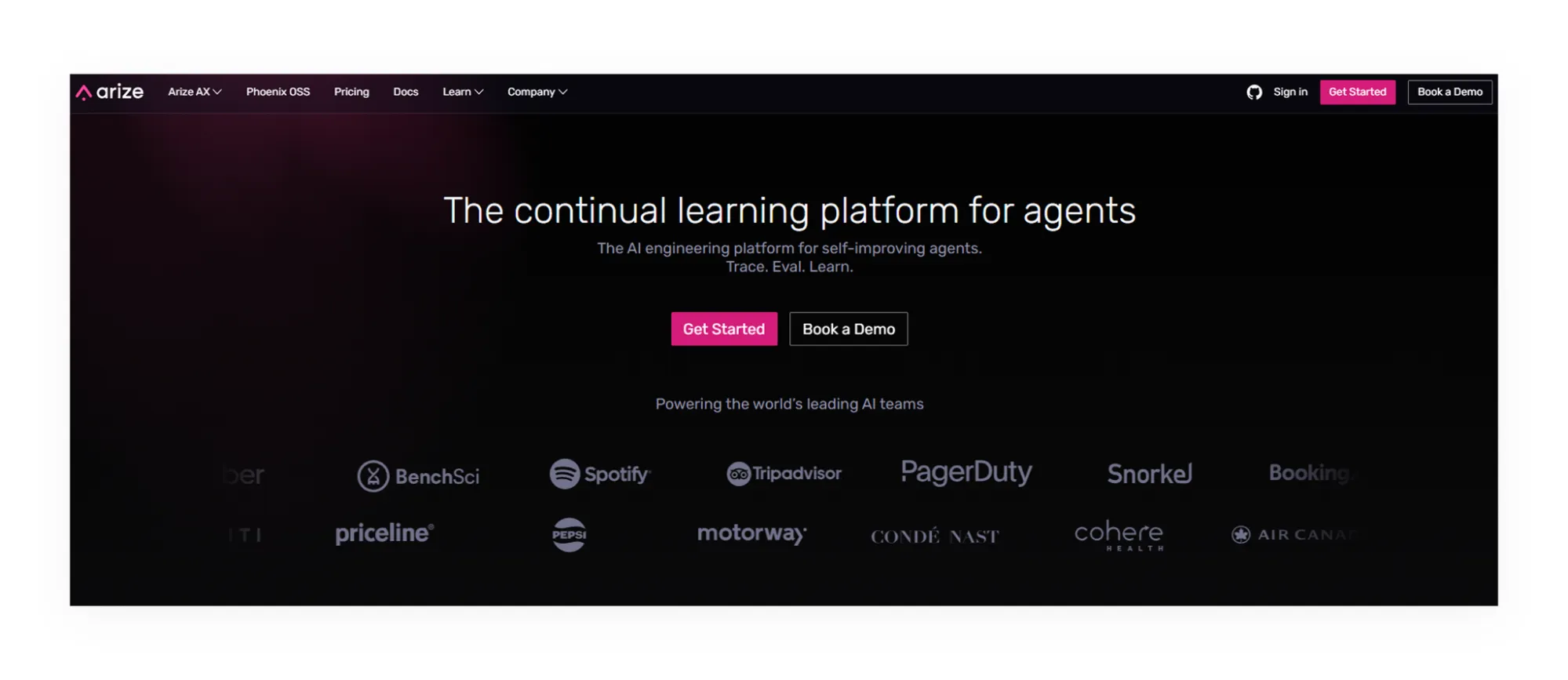
Arize AI is an enterprise AI observability platform designed to help data science and MLOps teams monitor, troubleshoot, and optimize machine learning and generative AI models in production, with LLM Observability capabilities for generative AI workloads. The platform focuses heavily on live operational environments, specializing in real-time runtime monitoring, data drift detection, and automated LLM evaluation tracing.
What are the key features of Arize AI?
- High-dimension embedding visualization: Allows teams to visualize unstructured data and model embeddings in 3D to quickly pinpoint data clusters causing performance degradation.
- Real-time drift and performance tracking: Monitors live production data streams to instantly surface data drift, concept drift, and unexpected drops in accuracy metrics.
- LLM tracing and evaluation: Captures granular execution paths across complex LLM chains and RAG pipelines to evaluate response quality, toxic outputs, and retrieval latency.
- Automated root-cause analysis: Triggers automated troubleshooting workflows that slice performance data across custom dimensions to identify the exact cohort causing an operational anomaly.
What are the pros and cons of Arize AI?
Why is Solytics Partners a better option than Arize AI?
Arize AI functions brilliantly as a diagnostic engine for data science teams, but it does not provide the organizational workflows, policy controls, or automated regulatory documentation required by compliance and risk management departments. While Arize requires you to purchase separate GRC tools to document your risks, Solytics Partners integrates technical telemetry and regulatory compliance into a single ecosystem. Solytics' NIMBUS Uno module handles real-time production telemetry and feeds those metrics directly into MRM Vault and MoDeVa testing libraries. This allows enterprises to automatically convert live runtime metrics into audit-ready documentation for frameworks like SR 26-02 and the EU AI Act without manual data pipelines.
11. Protect AI
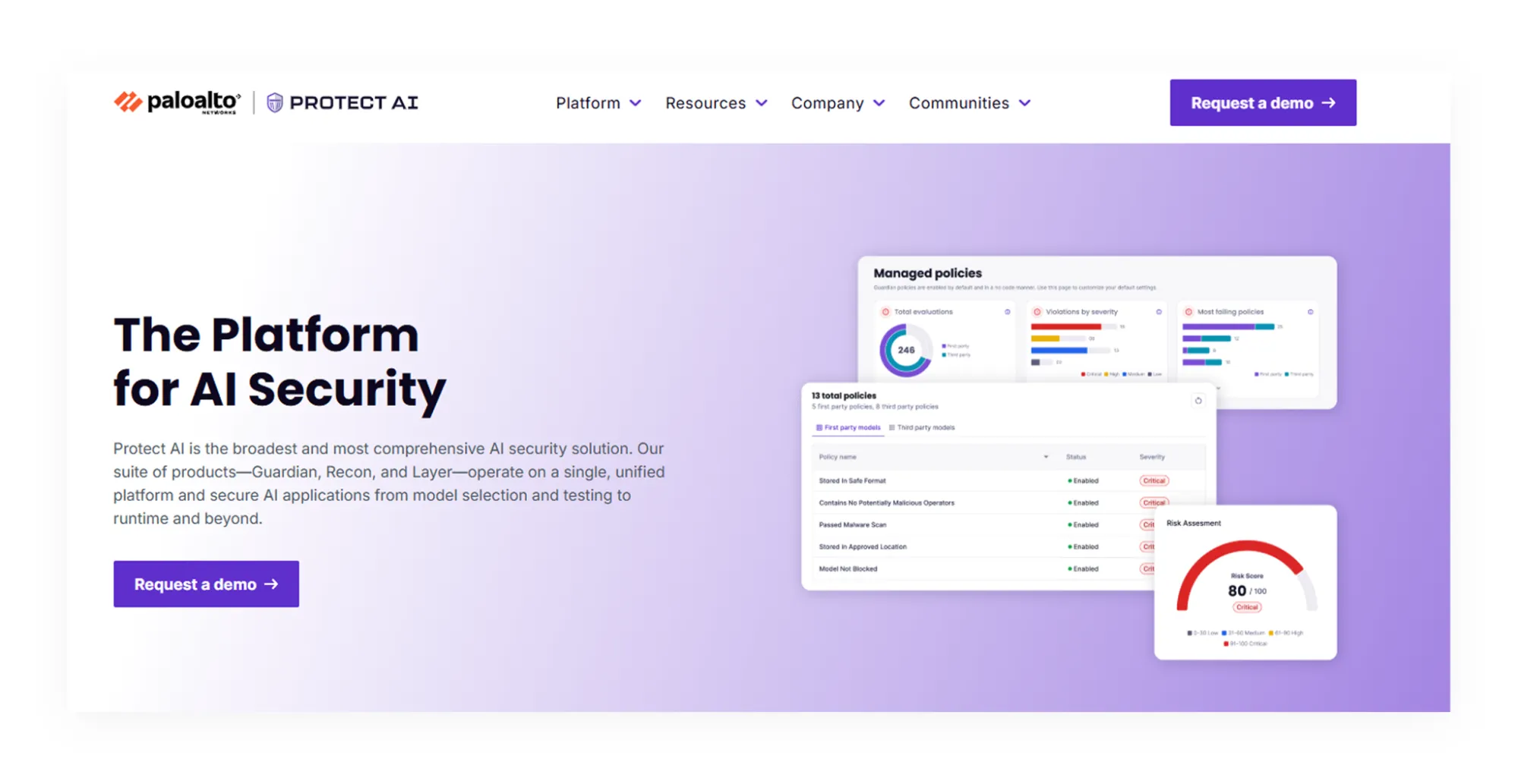
Protect AI is an AI Security Posture Management (AI-SPM) platform focused entirely on defending enterprise AI infrastructure. The platform treats machine learning models and LLMs as security assets, protecting pipelines against supply chain vulnerabilities, malicious open-source packages, and adversarial runtime exploits.
What are the key features of Protect AI?
- AI asset vulnerability scanning: Evaluates models, training datasets, and environments for security exploits before production deployment.
- LLM security guardrails: Deploys inline security proxies to block adversarial prompt injections, data exfiltration, and jailbreak attempts.
- AI supply chain security: Generates an AI Software Bill of Materials (AI-BOM) to track the lineage and integrity of open-source elements.
- Model scanner pipeline integrations: Hooks directly into MLflow and Hugging Face repositories to catch corrupted files.
What are the pros and cons of Protect AI?
Why is Solytics Partners a better option than Protect AI?
Protect AI is a security tool built for InfoSec teams; it does not address the regulatory compliance, model validation, or policy governance needs of risk departments. Solytics Partners treats security as a core element of a holistic risk framework. By deploying Solytics, enterprises gain robust real-time security guardrails while simultaneously managing mathematical validation workflows and automated documentation for regulators inside the same dashboard.
12. Airia
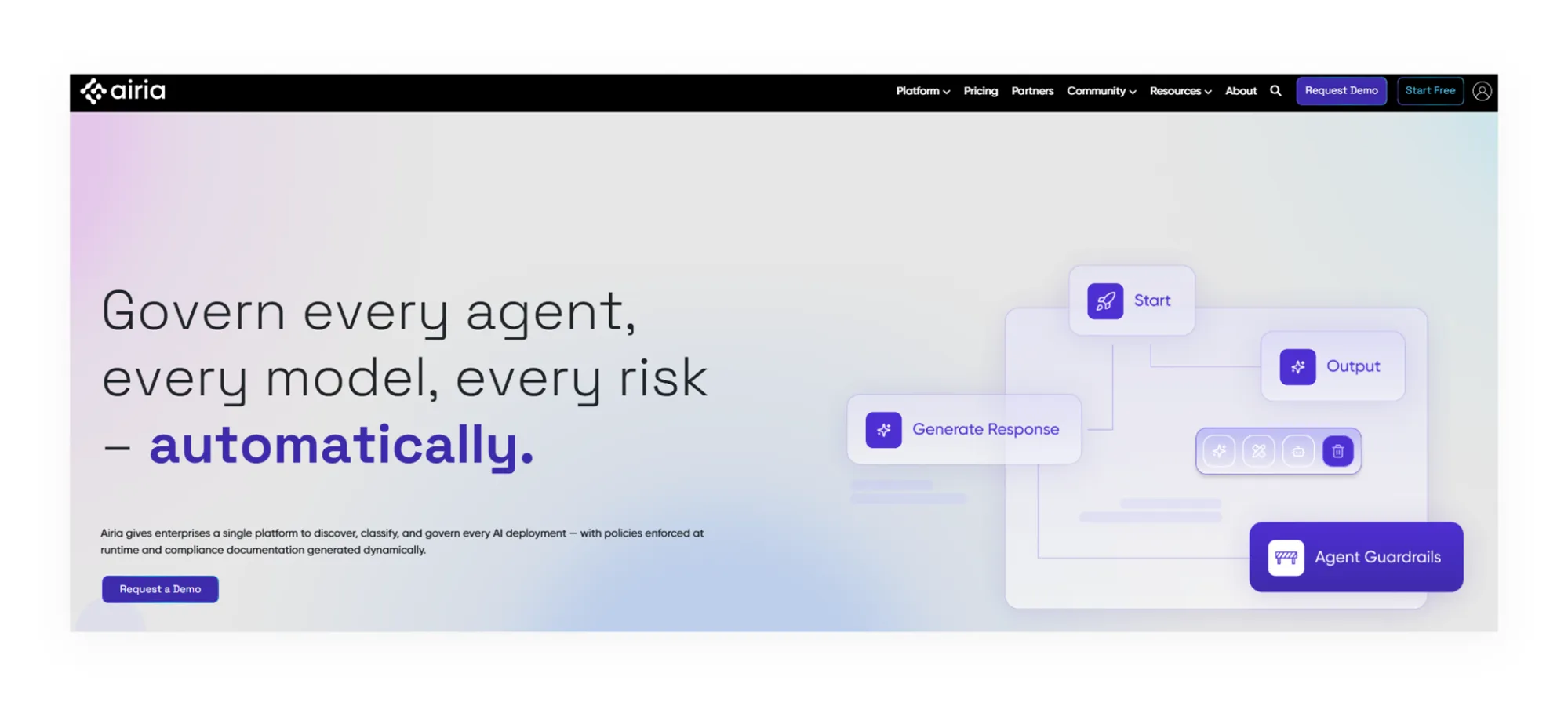
Airia is an agile AI orchestration and governance layer built to help enterprises safely deploy, manage, and scale generative AI applications. It focuses heavily on the modern AI stack, providing robust capabilities in GenAI/LLM governance and agentic oversight across multiple model providers.
What are the key features of Airia?
- Multi-model proxy and routing: Centralizes enterprise API access across OpenAI, Anthropic, Google, and open-source models under a single gateway.
- Agentic boundary enforcement: Implements policy-based operational gates that restrict what actions autonomous agents can execute.
- Unified prompt and response logging: Audits conversational interactions globally across different business units for compliance tracking.
- Token cost and usage governance: Monitors resource utilization and budgets across model endpoints in real time.
What are the pros and cons of Airia?
Why is Solytics Partners a better option than Airia?
Airia provides an effective gateway for modern LLM orchestration, but it leaves enterprises exposed if they need to govern legacy credit scoring, fraud detection, or traditional machine learning models. Solytics Partners spans both eras of enterprise analytics. It governs traditional, machine learning, and advanced agentic models with equal depth, ensuring your entire portfolio complies with global regulations without requiring distinct, fragmented platforms for different model generations.

Why Solytics Partners is the Best Platform for AI Risk Management Tools?
Solytics Partners delivers an integrated risk management ecosystem rather than a point solution. The platform handles traditional ML models, GenAI systems, RAG pipelines, and autonomous agents within one governance architecture, addressing the full spectrum of AI risk management challenges that single-category tools cannot match.
The table below compares Solytics against the typical capability gaps in other AI risk management platforms.
How to Evaluate the Right AI Risk Management Tool
Use these criteria when shortlisting AI risk management platforms across regulated environments.
- Confirm the tool covers traditional ML, agentic AI, and autonomous AI agents within one inventory architecture.
- Check pre-built regulatory mappings for the EU AI Act, NIST AI RMF and your regional rules.
- Distinguish between governance platforms that document risk and observability tools that monitor it through continuous monitoring.
- Evaluate deployment fit across cloud, hybrid and on-premise environments based on data privacy and regulatory compliance needs.
- Verify integration with existing MLOps tools like Databricks, MLflow, and SAS to avoid manual data pipelines and reduce implementation overhead.
- Assess the total cost of ownership, including implementation time, training needs, and support quality as you scale from pilot to production.
What are the Types of AI Risk Management Tools?
AI risk management tools fall into five broad categories based on the AI lifecycle stage they address.
- Governance platforms: These platforms centralize AI inventory, automate policy management and map systems to regulatory frameworks. Solutions like Credo AI and Trustible fall into this category. It is best fit for compliance-led teams operating risk management programs across diverse business units.
- Observability tools: These tools track model behavior in production, detecting drift, hallucinations and quality regressions over time. Platforms such as Arize AI, Fiddler AI, and Datadog are commonly used here. Data science teams requiring deep continuous monitoring signals across ML models in production prefer observability tools.
- Security tools: These tools protect AI workloads at runtime through security controls like prompt firewalls and output filtering. AccuKnox and Robust Intelligence are key examples. These tools are usually preferred by security teams running AI red teaming and security management programs alongside cybersecurity controls.
- Validation tools: These tools test models pre-deployment and across retraining cycles for bias, robustness and explainability. ValidMind and MoDeVa sit here. Model risk validators producing audit evidence under SR 26-02 and OSFI E-23 frameworks usually find value in these tools.
- Integrated platforms: These ecosystems combine governance, monitoring, validation and security into one system. Solytics Partners and ModelOp represent this category. Such platforms are ideal for large enterprises managing diverse model portfolios that need a single audit framework across multiple uses of AI.
Final Remarks
AI risk management has moved from a future-state initiative to an enforceable requirement. The EU AI Act, NIST AI RMF and SR 26-02 have raised the bar, and shadow AI has multiplied the surface area risk teams must govern. Most platforms cover one slice of the picture well.
Solytics Partners addresses the full picture across a single ecosystem and a single inventory. Automated documentation via VaultBot and AI Mate runs alongside real-time monitoring across all model types. Risk management solutions at this depth shift teams from chasing audit deadlines to running ahead of them.
Book a 1:1 call today and see how Solytics Partners simplifies your AI risk management program from end to end.
H2: Frequently Asked Questions
What is the difference between AI governance and AI risk management software?
AI governance focuses on policies, accountability and oversight structures across the AI lifecycle. AI risk management software actively identifies, measures and mitigates technical risks like bias, drift and hallucinations. Most leading platforms now combine both layers.
How much does AI risk management software cost in 2026?
Enterprise pricing varies based on model count, selected modules and deployment model across vendors. Most platforms use custom enterprise quotes starting around USD 50,000 annually for small deployments. Open-tier options exist for teams evaluating platforms before full deployment.
Can AI risk management tools integrate with existing MLOps platforms like MLflow or Databricks?
Yes, most enterprise platforms offer pre-built connectors and API-based integration. Leading tools ingest models from MLflow, Databricks, SAS and custom code environments. Integration depth varies between vendors and shapes total implementation effort.
Which AI risk management platforms support agentic AI and autonomous agents?
Solytics Partners, Credo AI and ModelOp offer native agentic AI governance covering registration, runtime controls and audit trails. Most legacy platforms still treat agents as edge cases inside model risk frameworks. Agent governance has become a 2026 buying criterion.
How long does it take to deploy an AI risk management platform across the enterprise?
Deployment timelines range from 90 days for cloud-native platforms to 12 months for complex on-premise installations. Implementation effort scales with model inventory size, integration scope and regulatory compliance mapping requirements. Pilot deployments typically launch within four weeks.
What is the best AI for risk management?
There is no single best AI risk management tool, as suitability depends on enterprise needs and regulatory scope. Platforms like Solytics Partners stand out for unified governance, monitoring, and validation. Others specialize in specific layers such as policy governance, observability, or security.
What are AI risk management tools?
AI risk management tools are software solutions that help organizations identify, measure, and mitigate risks across AI systems. They cover areas such as governance, monitoring, validation, and security. These tools support compliance with frameworks like the EU AI Act and NIST AI RMF.
How do AI risk management tools work?
AI risk management tools work by creating a centralized inventory of models and applying controls across their lifecycle. They monitor performance, detect drift or bias, and generate audit-ready documentation. Many tools also integrate with MLOps systems to continuously track and govern AI behavior.
What is the difference between AI risk management tools and platforms?
AI risk management tools typically focus on a specific function such as monitoring, validation, or security. Platforms, however, integrate multiple capabilities into one system, covering governance, observability, and compliance together. This reduces fragmentation and provides a unified framework for enterprise-wide AI risk management.
.webp)
.svg)


