We have been recognized in RegTech100 2026 - Strengthening leadership across AI governance, MRM and FCC

.png)
The AI governance market is expected to reach about $3.59 billion by 2033, growing at a 36% CAGR from 2026 to 2033.
The EU AI Act's phased rollout—with high-risk obligations now applying from December 2027 under the Digital Omnibus, alongside transparency duties from August 2026—plus ISO 42001 becoming a procurement criterion and the rise of agentic AI are driving that growth.
Legacy GRC tools were never designed to handle the failure modes these systems create.
Most large enterprises have already realized that spreadsheets and shared drives cannot scale past fifty AI models. Governance now requires centralized inventory, automated policy enforcement, continuous monitoring and audit-ready documentation. The teams still running manual processes face increasing regulatory exposure.
This blog reviews the 12 best AI governance tools available in 2026. Each section covers what the platform does, who it suits and where buyers should look more closely before committing. The goal is operational clarity for governance and risk teams evaluating their options.

What Are AI Governance Tools?
AI governance tools are software platforms that help enterprises maintain oversight, accountability and compliance across the AI lifecycle. They centralize AI inventory, automate risk assessment, enforce governance policies and produce the audit evidence regulators expect on demand.
These platforms differ from MLOps tools and AI security tools in a meaningful way. MLOps platforms focus on model deployment and machine learning operations. Security teams focus on attack prevention and unauthorized access controls. AI governance sits above both disciplines, answering four operational questions for every AI system.
Why Are AI Governance Tools Critical in 2026?
Let’s have a look at the key factors driving AI governance platform adoption across regulated enterprises:
- Ethics: Enterprises need bias detection, fairness review and transparency controls across high-impact use cases. These checks help teams explain outcomes and reduce harmful model decisions.
- Compliance: The EU AI Act, NIST AI RMF and ISO/IEC 42001 now shape governance programs. ISO/IEC 42001 defines requirements for building and improving an AI management system.
- Risk Management: AI failure now creates legal, financial, reputational and operational exposure. Mature risk management requires intake, risk assessment, controls, monitoring and escalation.
- Trust Building: Business users adopt AI faster when controls feel repeatable and visible. Customers and regulators also expect proof that firms protect sensitive data and sensitive information.
What Are the Core Capabilities of AI Governance Platforms?
Credible AI governance tools deliver six connected capabilities across the model lifecycle.
- Bias detection and fairness testing that scores AI models across protected classes with documented evidence.
- Automated monitoring and observability tracking model behavior, drift, hallucinations and prompt safety in real time.
- Compliance management and regulatory mapping across the EU AI Act, NIST AI RMF, ISO 42001 and sector rules.
- Explainability and transparency outputs that show stakeholders how model decisions are produced.
- Model lifecycle management covering registration, validation, approval, deployment, monitoring and retirement.
- Privacy and data loss prevention controls protecting sensitive data and sensitive information across AI workflows.
What is the Difference Between AI Governance and Data Governance?
These two disciplines work together but cover different scopes inside the enterprise. Here are the key differences:
- Data governance scope: Data governance manages quality, lineage, access controls and file permissions for data assets across the enterprise. It ensures data sources meet standards before they enter any downstream system.
- AI governance scope: AI governance covers model governance, output monitoring, ethical alignment, policy management and regulatory compliance for AI systems. It starts where data governance ends and adds model-specific risks like bias, drift, hallucinations and prompt injection.
- Integration architecture: Some enterprises run unified platforms that cover both disciplines. Others run separate governance tools with integration connectors. The choice depends on portfolio size and regulatory exposure.
Data governance feeds AI governance. Poor data quality produces biased, inaccurate or non-compliant AI outputs. Enterprises need both disciplines working together through shared infrastructure.
Three Categories of AI Governance Tools
Most AI governance tools fall into three categories based on operating model and enterprise maturity.
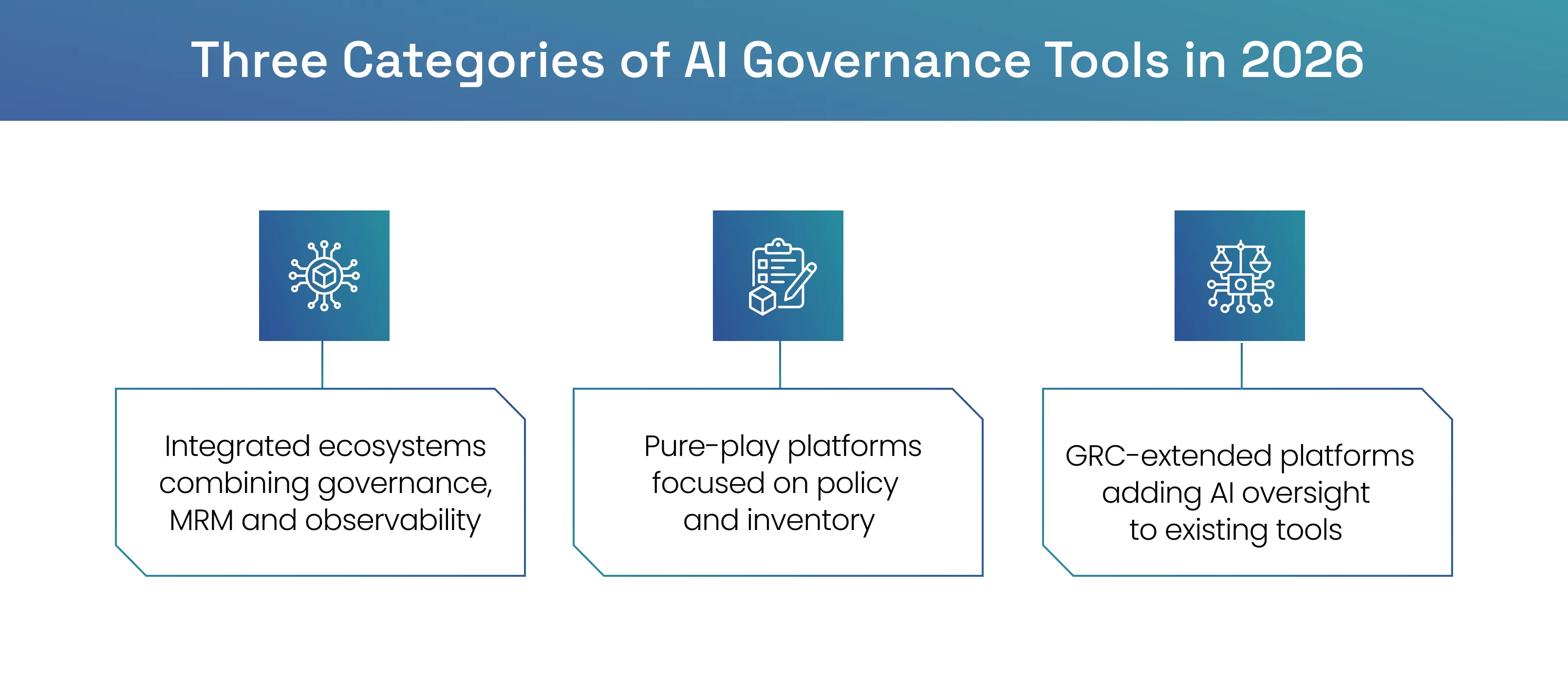
- Integrated AI ecosystems: These platforms combine governance with model risk management, validation and monitoring workflows. They suit regulated enterprises managing ML models, GenAI, agents and vendor systems.
- Pure-play governance platforms: These platforms focus on inventory, policy automation and regulatory mapping. They suit legal, compliance and governance-led programs that need faster control setup.
- GRC-extended governance: These platforms extend existing compliance systems into AI oversight. They suit enterprises consolidating AI reviews inside current risk, privacy or compliance processes.
Best AI Governance Tools in 2026
Here are the best AI governance tools for enterprise teams in 2026:
1. Solytics Partners
At Solytics Partners, we deliver an integrated AI governance ecosystem built for banks, insurers and healthcare enterprises. Our platform combines AI governance, model risk management, financial crime compliance and trade surveillance under one architecture. Risk and compliance teams use it to govern thousands of traditional, ML, GenAI and agentic models from a single control plane.
What Are the Key Features of Solytics Partners?
- Unified AI inventory through MRM Vault: We use MRM Vault to centralize every traditional, ML, GenAI and agentic model with risk tiering and ownership records. VaultBot extracts metadata automatically and flags governance issues without manual review.
- Automated documentation through AI Mate: AI Mate drafts validation reports, model cards and regulatory documentation directly from live model data. Documentation work drops by 40 to 50% across the model lifecycle.
- Real-time observability through NIMBUS Uno: NIMBUS Uno monitors traditional models, ML, GenAI and agents with trace-level GenAI visibility through TraceIQ. The platform captures drift, hallucinations, prompt safety and grounding quality continuously.
- Bias and fairness testing through MoDeVa: MoDeVa libraries deliver bias testing, fairness scoring and explainability methods including SHAP and LIME. Challenger model comparison runs alongside fairness checks for high-risk systems.
- Pre-built regulatory mapping: Pre-loaded templates cover the EU AI Act, NIST AI RMF, ISO 42001, SR 11-7, OFSI E-23, MAS and CBUAE. Audit reports generate automatically from current model data on demand.
For Whom Is Solytics Partners the Best AI Governance Tool?
Banks, insurers, healthcare enterprises and other regulated enterprises governing diverse AI portfolios at scale. Best fit for teams that need governance, model risk and compliance inside one platform rather than four stitched-together point solutions.
Why Is Solytics Partners the Best AI Governance Tool for 2026?
We replace the typical four-tool stack of inventory, validation, monitoring and documentation systems with one integrated ecosystem where data flows natively across functions. The 2026 Chartis RiskTech Quadrant named us a Category Leader for AI Governance Solutions, recognizing the architecture that links MRM Vault, NIMBUS Uno and MoDeVa. Risk teams eliminate sync lag, integration cost and the audit gaps that point solutions create.
2. Credo AI
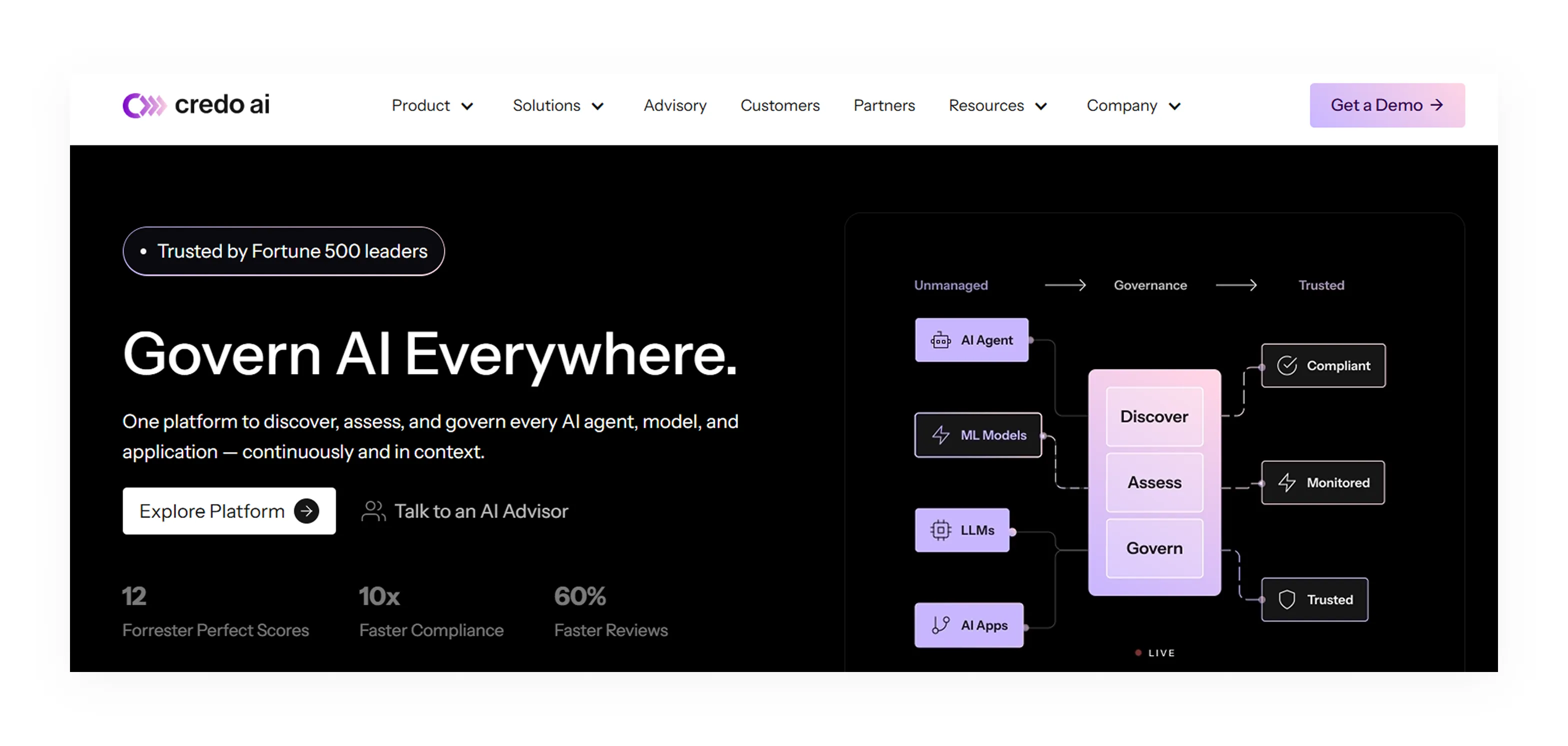
Credo AI is a purpose-built AI governance platform centered on policy intelligence and regulatory alignment. The platform centralizes AI inventory, applies policy-as-code controls and automates compliance workflows.
What Are the Key Features of Credo AI?
- AI asset inventory covering models, agents and applications.
- Pre-built Policy Packs for EU AI Act, NIST and ISO 42001.
- Continuous risk assessment for bias, security and privacy.
- Audit-ready documentation tied to regulatory frameworks.
What Are the Pros and Evaluation Considerations for Credo AI?
Why Is Solytics Partners a Better AI Governance Tool Than Credo AI?
Credo AI offers strong policy-led governance for compliance teams. Solytics Partners connects policy evidence with MoDeVa validation, NIMBUS Uno monitoring and MRM Vault workflows for regulated portfolios.
3. IBM watsonx.governance
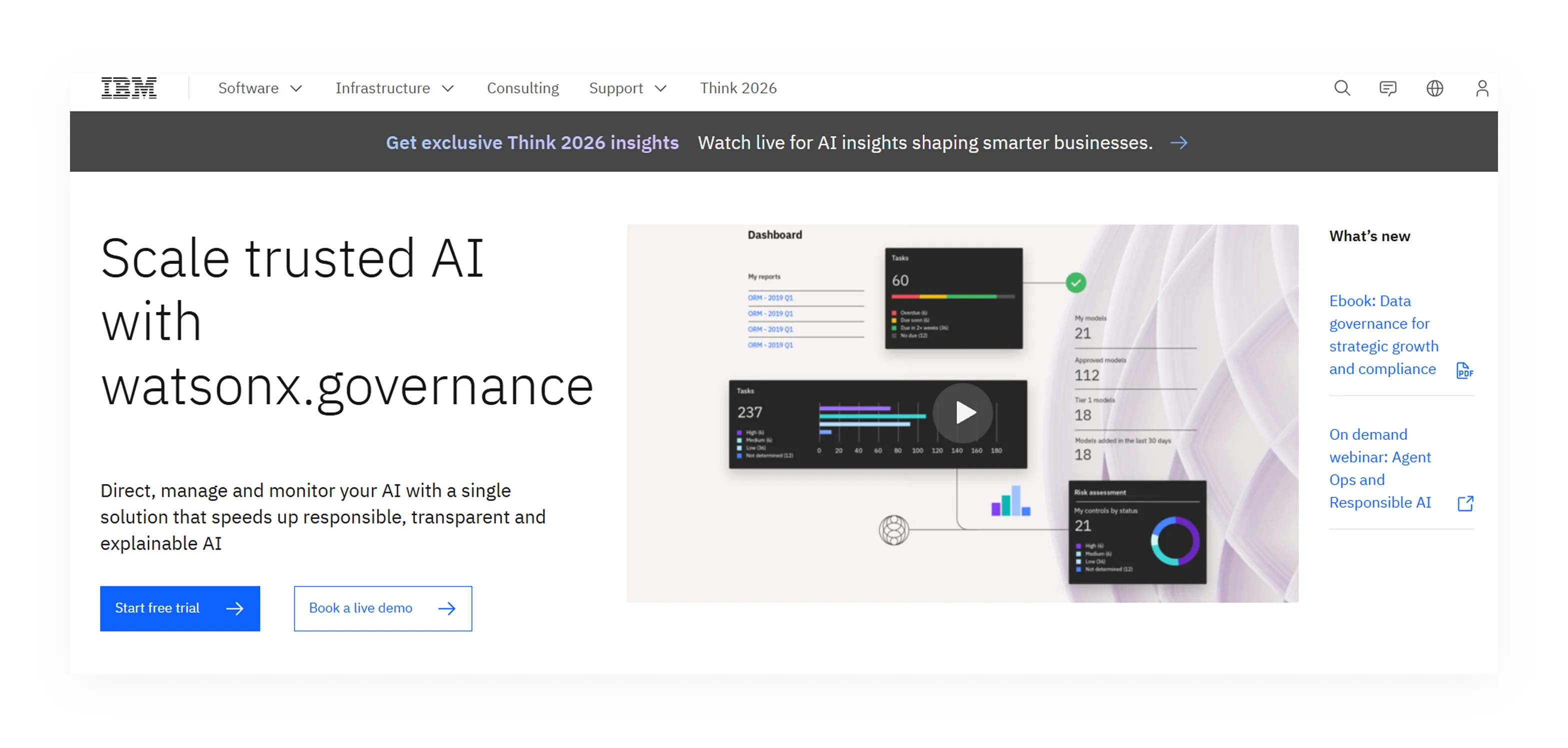
IBM watsonx.governance is the AI governance toolkit inside the broader watsonx platform. It covers lifecycle management, model risk workflows and bias detection with Credo AI Policy Packs as Compliance Accelerators.
What Are the Key Features of IBM watsonx.governance?
- Automated metadata capture across model pipelines.
- Bias and drift detection inside the IBM ecosystem.
- Compliance Accelerators through Credo AI Policy Packs.
What Are the Pros and Evaluation Considerations for IBM watsonx.governance?
Why Is Solytics Partners a Better AI Governance Tool Than IBM watsonx.governance?
IBM works well for organizations already invested in IBM environments. Solytics Partners adds deeper financial services workflows across governance, validation, surveillance and compliance reporting.
4. Holistic AI
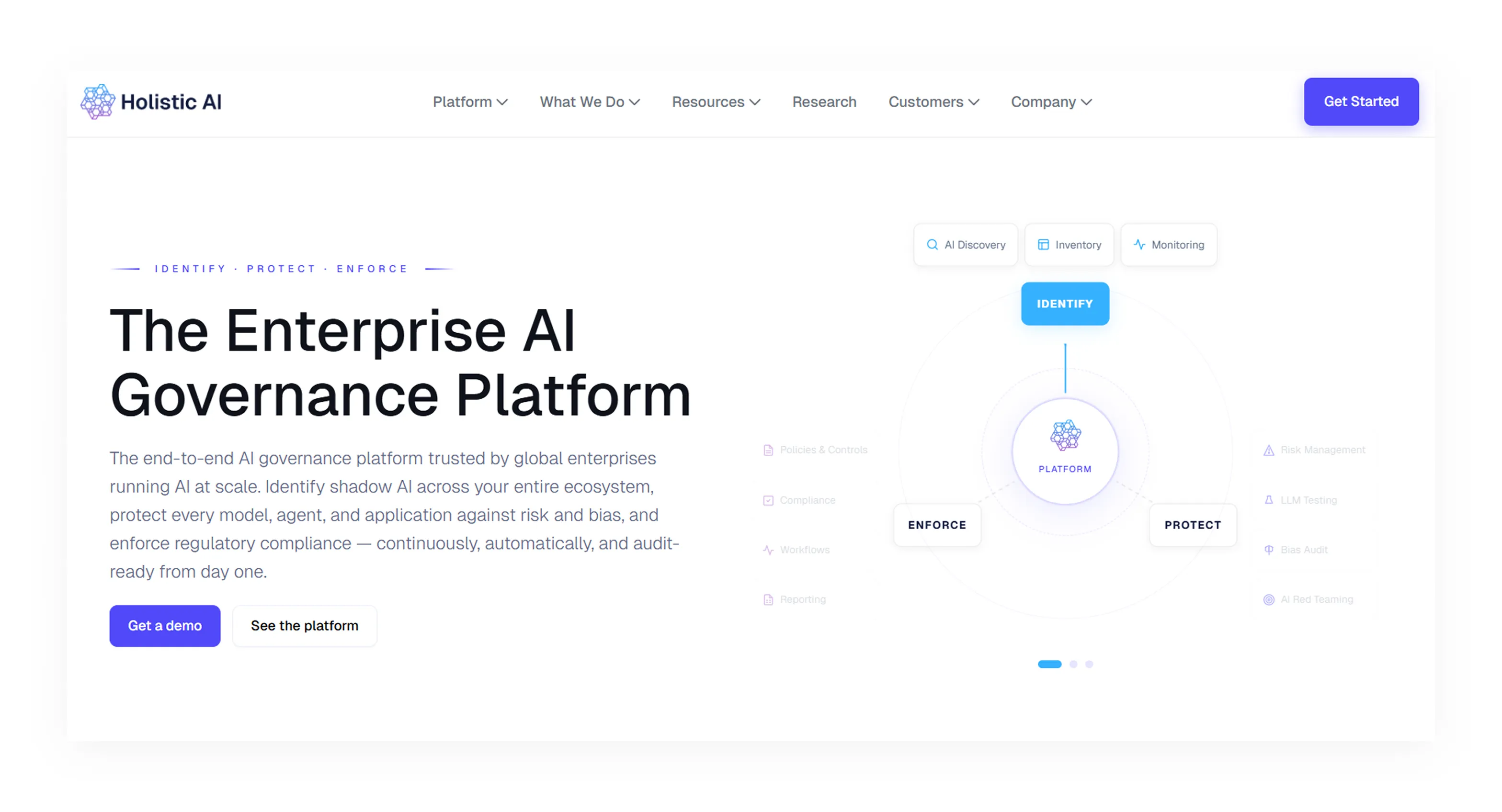
Holistic AI provides quantified risk scoring across fairness, robustness and privacy for AI systems. The platform produces structured assurance reports designed for regulator submissions and audit committees.
What Are the Key Features of Holistic AI?
- Quantified risk scoring across multiple AI dimensions.
- Bias auditing aligned with NYC Local Law 144.
- EU AI Act conformity assessment workflow templates.
- Structured assurance reports for regulator review.
What Are the Pros and Evaluation Considerations for Holistic AI?
Why is Solytics Partners a Better AI Governance Tool Than Holistic AI?
Holistic AI supports discovery, testing and assurance workflows. Solytics Partners connects those controls to model validation baselines, financial risk workflows and regulator-ready reporting.
5. OneTrust AI Governance
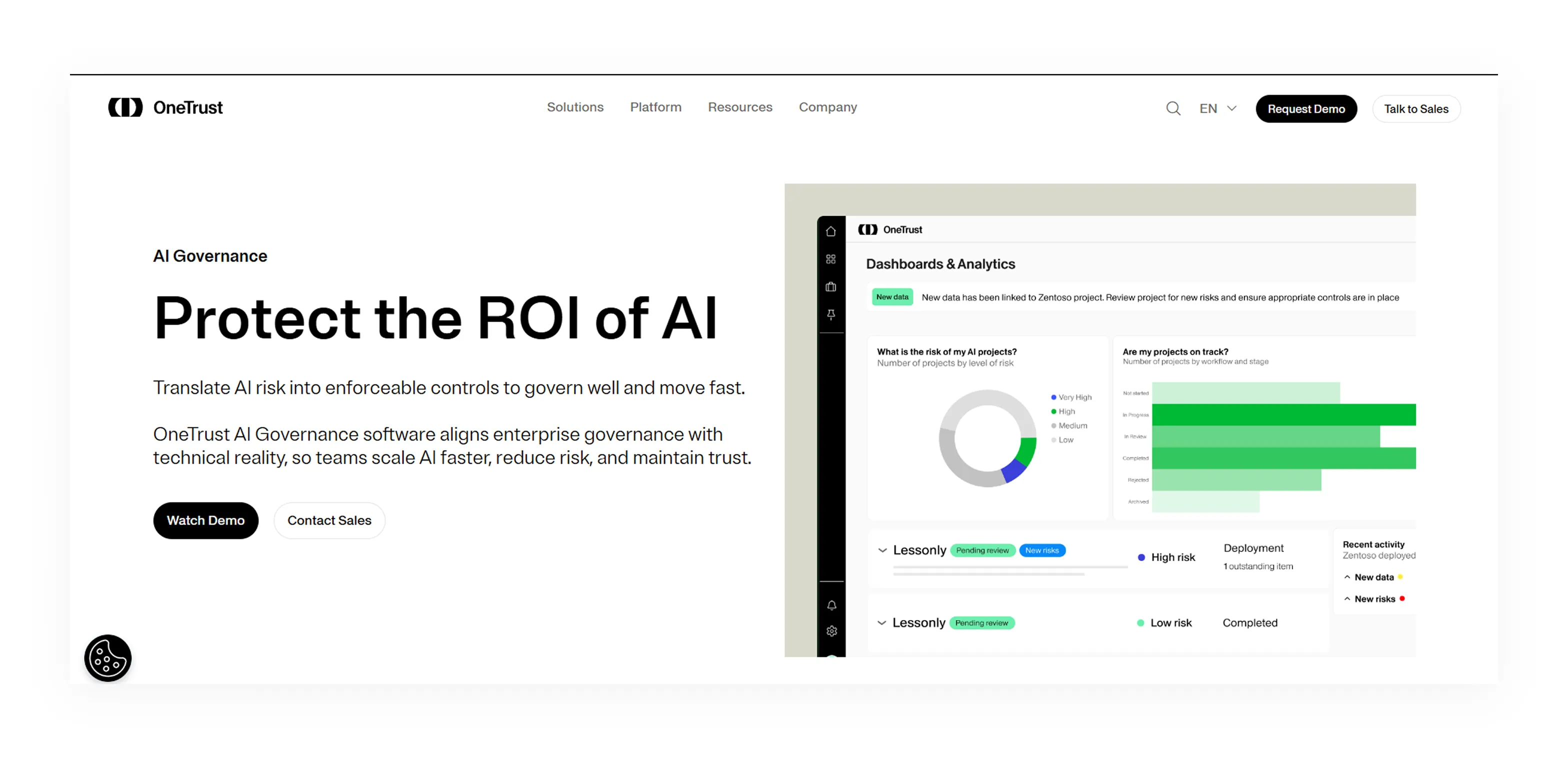
OneTrust extends its data privacy and GRC platform into AI oversight with assessment workflows and AI inventory. The module adds policy management and risk scoring to the existing OneTrust stack.
What Are the Key Features of OneTrust AI Governance?
- GRC-extended AI assessment workflows.
- Integration with OneTrust privacy and compliance platform.
- Policy templates for AI use case documentation.
What Are the Pros and Evaluation Considerations for OneTrust AI Governance?
Why Is Solytics Partners a Better AI Governance Tool Than OneTrust AI Governance?
OneTrust fits enterprises already consolidating privacy and compliance processes. Solytics Partners focuses on AI-native governance with model validation, monitoring and risk workflows for regulated use cases.
6. ModelOp
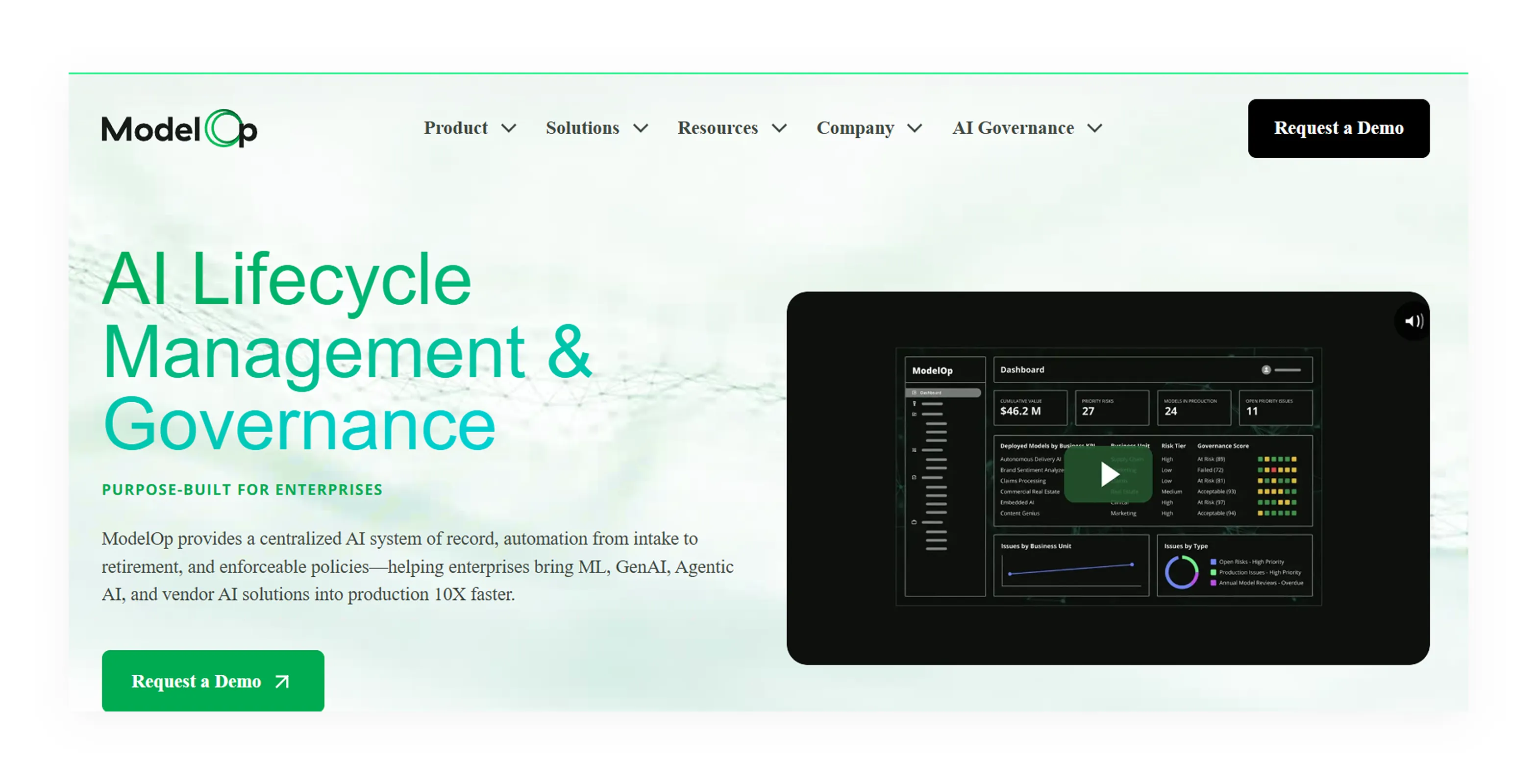
ModelOp is an enterprise AI lifecycle platform with governance workflows and integration connectors across major MLOps tools. The platform provides a cross-tool model registry with approval and decommissioning workflows.
What Are the Key Features of ModelOp?
- Cross-tool model registry for MLflow, SAS and H2O.
- Workflow automation for approvals and decommissioning.
- Performance monitoring with configurable thresholds.
- Strong integration connectors across enterprise systems.
What Are the Pros and Evaluation Considerations for ModelOp?
Why Is Solytics Partners a Better AI Governance Tool Than ModelOp?
ModelOp fits enterprises with mature MLOps programs and cross-tool lifecycle needs. Solytics Partners adds stronger regulated-sector mapping through MRM Vault, MoDeVa and pre-built supervisory frameworks.
7. Trustible
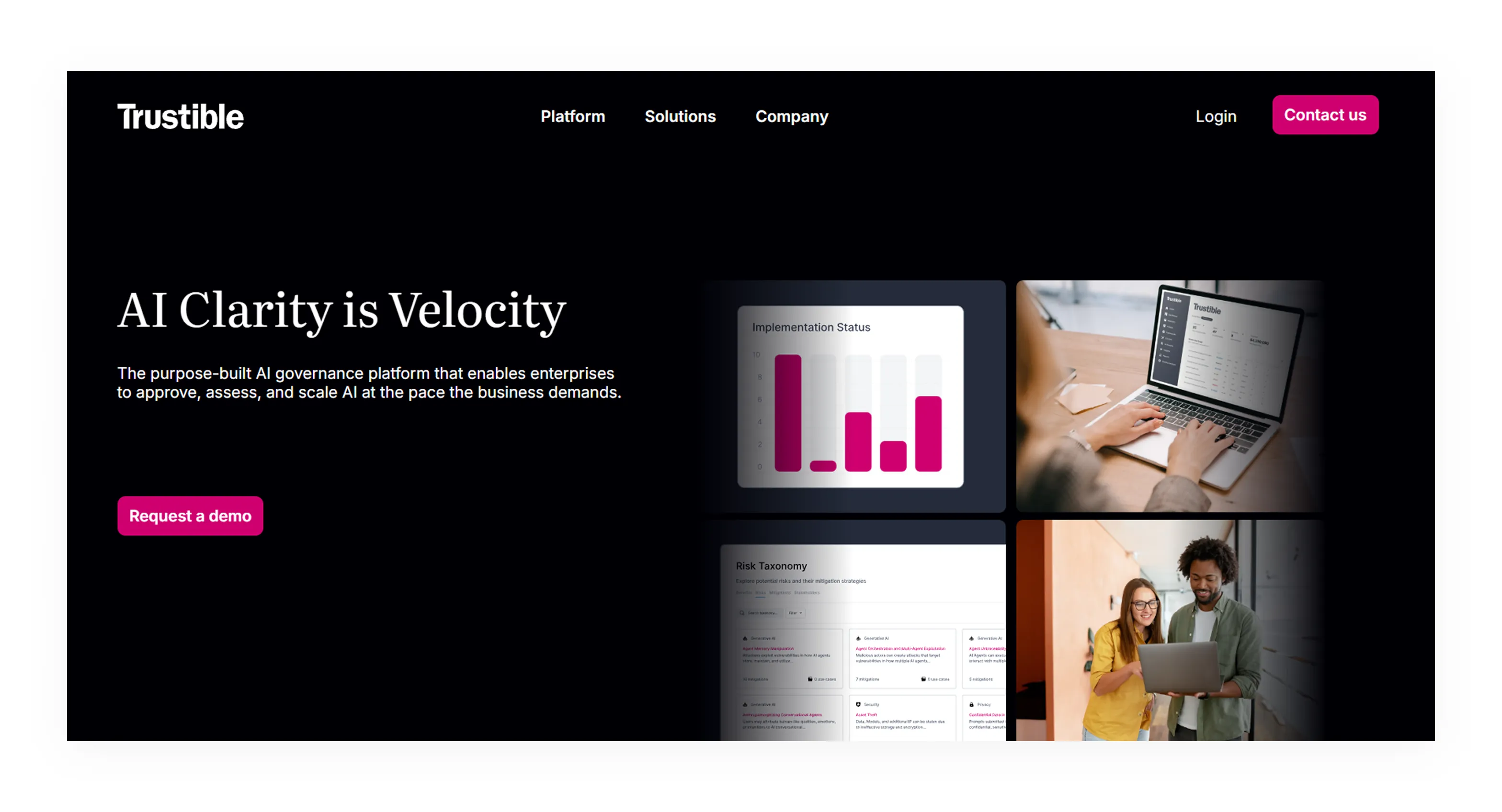
Trustible is a purpose-built governance platform with attribute-based risk scoring. The platform maps AI systems across more than ten compliance frameworks through configurable workflows.
What Are the Key Features of Trustible?
- Attribute-based risk scoring across frameworks.
- Configurable audit-ready workflows.
- Multi-framework compliance mapping.
- Internal policies management and enforcement.
What Are the Pros and Evaluation Considerations for Trustible?
Why Is Solytics Partners a Better AI Governance Tool Than Trustable?
Trustible gives compliance teams strong intake and framework workflows. Solytics Partners extends governance into validation, monitoring, documentation and model risk management for complex portfolios.
8. Monitaur
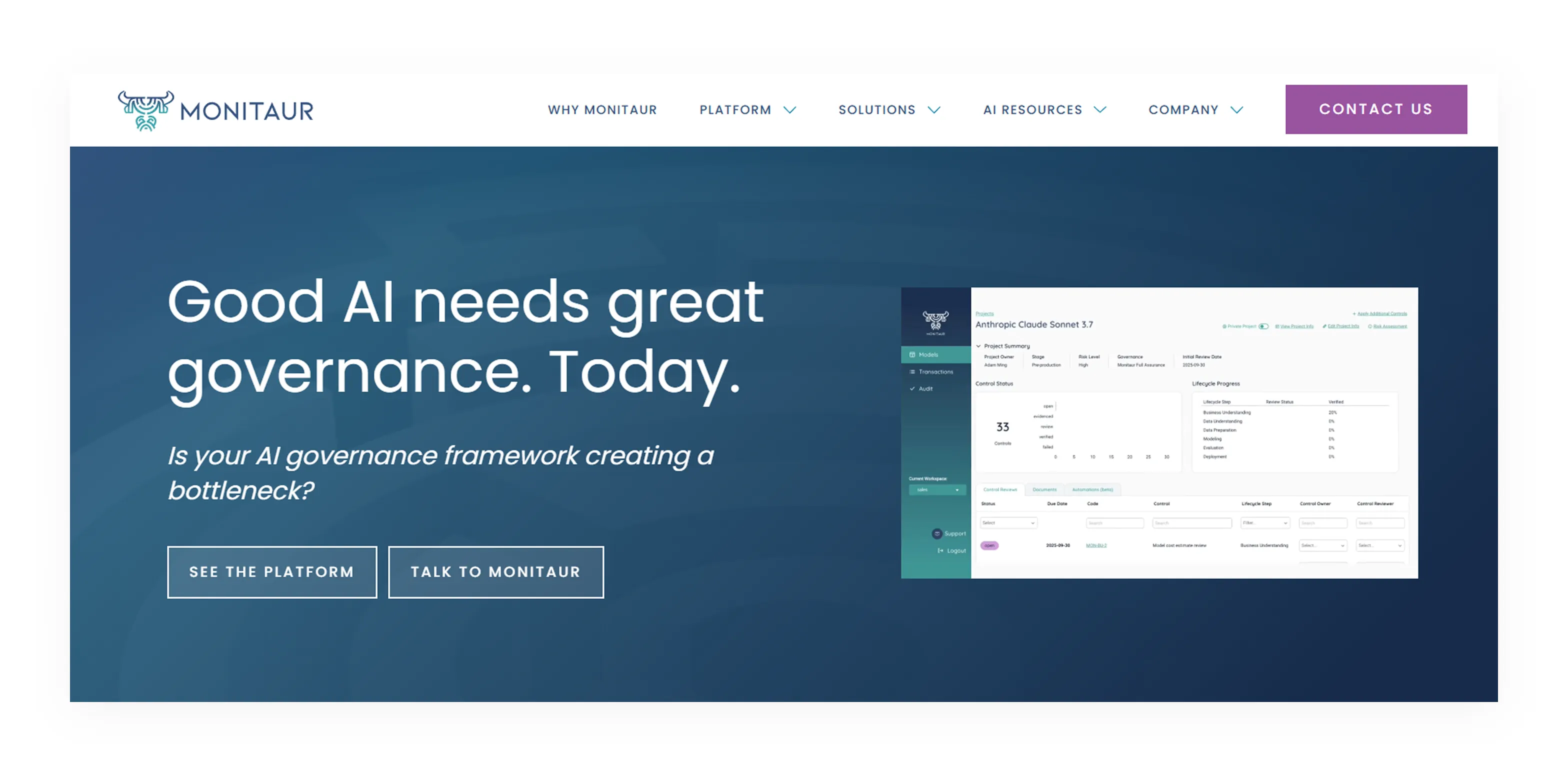
Monitaur focuses on turning AI governance policies into traceable evidence for regulated teams. Its policy-to-proof approach supports model inventory, control documentation, monitoring workflows and governance records that help teams prepare for audits.
What Are the Key Features of Monitaur?
- Policy-to-proof governance roadmap.
- System of record for model metadata.
- Governance workflows with approval routing.
What Are the Pros and Evaluation Considerations for Monitaur?
Why is Solytics Partners a Better AI Governance Tool Than Monitaur?
Monitaur fits teams formalizing policy-to-proof governance practices. Solytics Partners adds integrated model risk, validation libraries, monitoring and cross-domain financial risk coverage.
9. FairNow
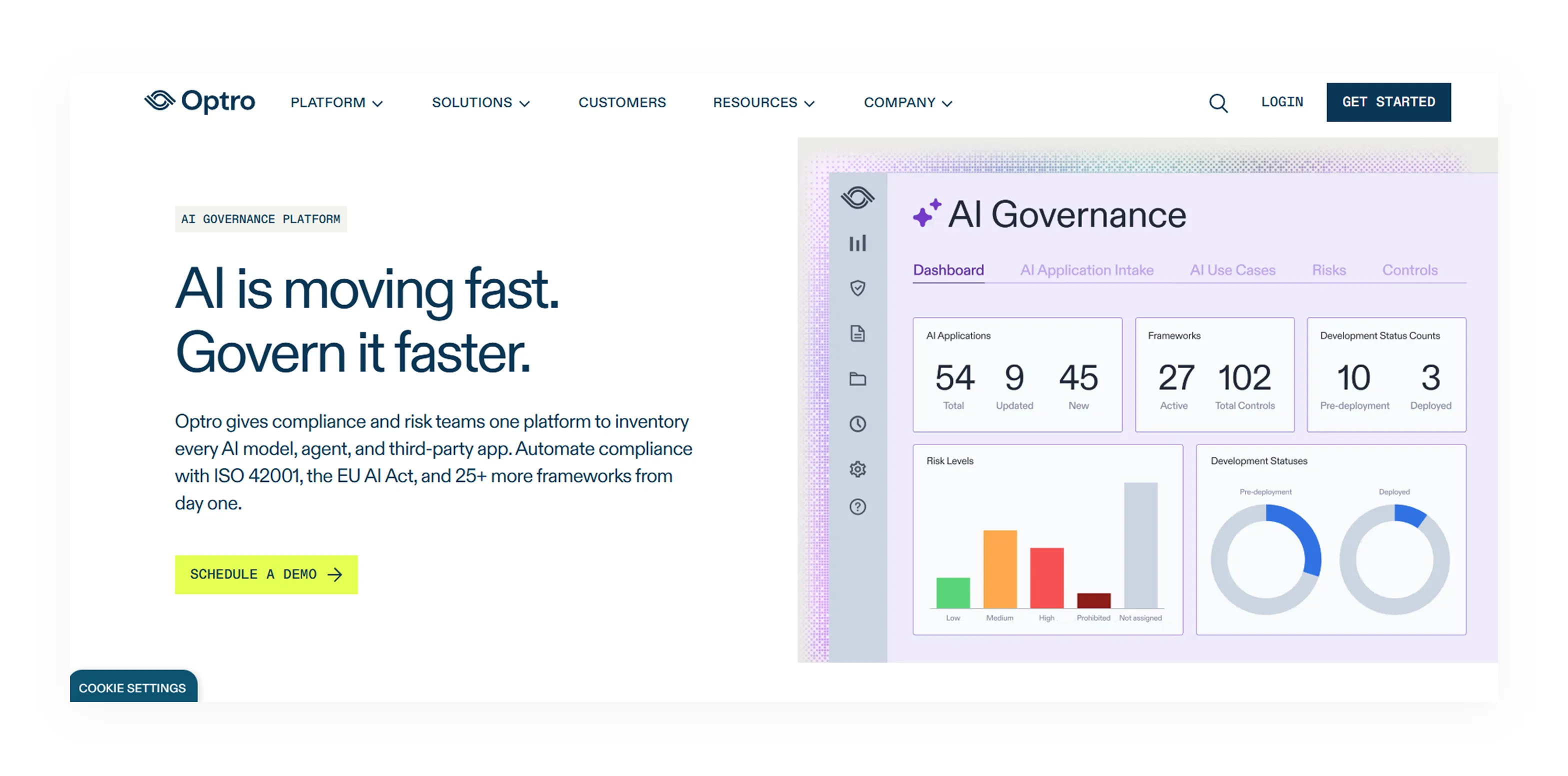
FairNow is a governance platform with centralized AI registry, automated risk assessment and shadow AI discovery. The platform targets mid-market enterprises building AI governance from the ground up.
What Are the Key Features of FairNow?
- Centralized AI registry with shadow AI detection.
- Automated risk assessment and scoring.
- Integration with GRC, MLOps and workflow tools.
- Compliance processes for policy enforcement.
What Are the Pros and Evaluation Considerations for FairNow?
Why Is Solytics Partners a Better AI Governance Tool Than FairNow?
FairNow suits companies building centralized governance programs with practical compliance workflows. Solytics Partners better supports complex regulated environments requiring validation, monitoring and audit-ready model risk evidence.
10. Lumenova AI
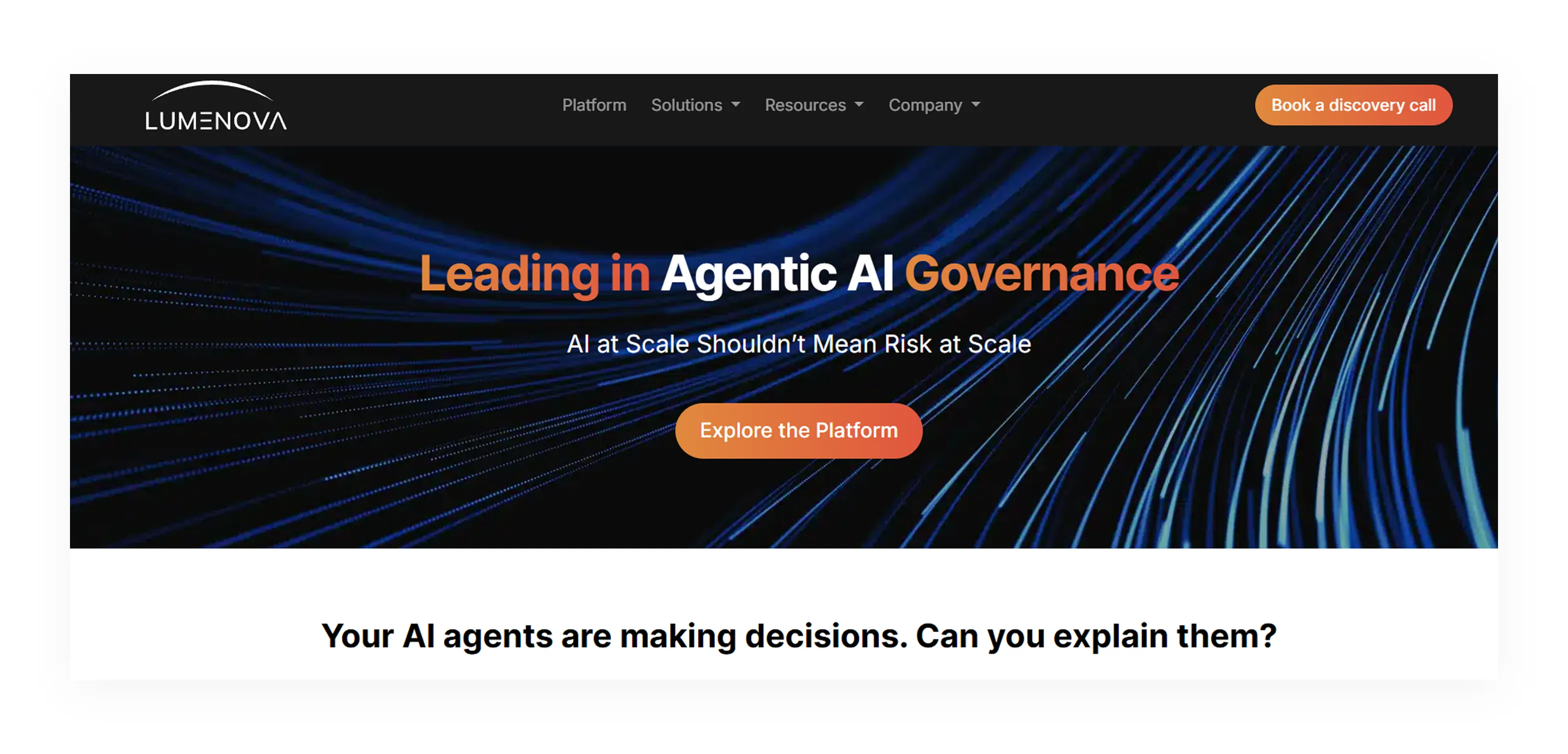
Lumenova AI is an enterprise governance platform with an extensive library of qualitative and quantitative AI tests. The platform supports private LLM deployment for organizations with strict data residency requirements.
What Are the Key Features of Lumenova AI?
- Extensive AI testing library across model types.
- Private LLM deployment for security controls.
- Risk and compliance workflow management.
What Are the Pros and Evaluation Considerations for Lumenova AI?
Why Is Solytics Partners a Better AI Governance Tool Than Lumenova AI?
Lumenova AI covers evaluations, monitoring and policy alignment across AI programs. Solytics Partners adds stronger model risk workflows and regulatory templates for financial services governance.

11. Saidot
Saidot focuses on AI governance workflows aligned with EU AI Act requirements. Its platform supports risk classification, compliance templates, evidence reuse and knowledge graph updates that help teams manage regulatory changes with clearer governance records.
What Are the Key Features of Saidot?
- EU AI Act-native risk classification workflows.
- Conformity assessment support.
- Post-market monitoring templates.
What Are the Pros and Evaluation Considerations for Saidot?
Why Is Solytics Partners a Better AI Governance Tool Than Saidot?
Saidot fits EU-centered governance programs with clear AI Act workflows. Solytics Partners supports wider financial services regulation through SR 11-7, OSFI E-23, MAS and CBUAE mapping.
12. Microsoft Purview AI Governance

Microsoft Purview extends data governance into AI with native Copilot DLP integration, sensitivity label enforcement and audit logs inside Purview. Coverage applies to Microsoft 365 Copilot only and does not extend to ChatGPT, Claude or non-Microsoft AI tools.
What Are the Key Features of Microsoft Purview AI Governance?
- Native Copilot data loss prevention integration.
- Sensitivity label enforcement across M365.
- Audit logs inside the Purview compliance portal.
What Are the Pros and Evaluation Considerations for Microsoft Purview AI Governance?
Why Is Solytics Partners a Better AI Governance Tool Than Microsoft Purview AI Governance?
Microsoft Purview supports AI data protection and Copilot governance well. Solytics Partners covers model inventory, validation, monitoring and regulatory evidence for high-risk enterprise AI portfolios.
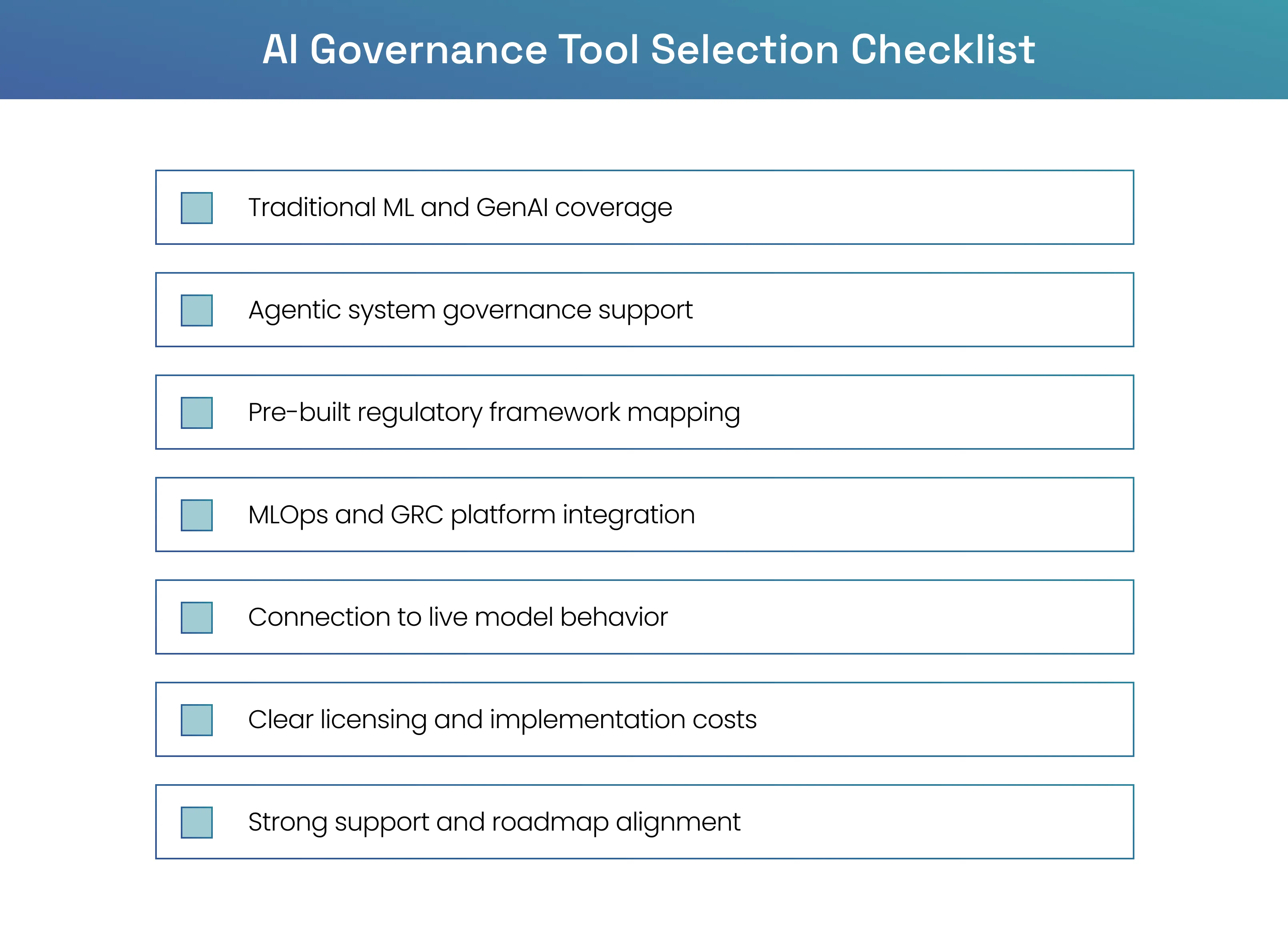
How To Choose the Right AI Governance Tool?
Use these criteria when shortlisting AI governance tools for your enterprise program.
- Confirm coverage across traditional ML, generative AI, agentic systems and third-party vendor models inside one inventory.
- Check pre-built regulatory mappings for the EU AI Act, NIST AI RMF, ISO 42001 and your sector-specific rules.
- Verify integration with existing MLOps, GRC and data catalog platforms to avoid duplicate inventories.
- Evaluate whether the platform connects governance to live model behavior or stops at static documentation.
- Calculate total cost of ownership across licensing, implementation fees, scale pricing and training requirements.
- Assess time-to-value by comparing out-of-the-box features against customization needs and deployment timelines.
- Prioritize a co-innovation partner over a vendor by reviewing roadmap alignment and ongoing support models.
When Should You Adopt an AI Governance Platform?
These signals indicate when enterprises need to move from manual governance to a dedicated platform.
- Upcoming regulatory exposure under the EU AI Act or sector-specific rules requires documented evidence.
- AI adoption is expanding across departments without consistent standards or governance policies.
- Rising use of LLMs, agentic systems and generative AI introduces failure modes that spreadsheets cannot track.
- External audits require AI documentation that the team cannot produce within regulator response windows.
- No one can answer basic questions about model ownership, data usage or approval history on demand.
Open-Source vs Commercial AI Governance Tools
Here are the key differences between open-source and commercial AI governance tools to help with informed decision-making:
- Open-source strengths: Open-source tools offer customization, lower upfront cost and community support. Teams with engineering capacity can adapt workflows to specific requirements and avoid vendor lock-in.
- Open-source gaps: Open-source governance requires manual compliance mapping, limited compliance workflows automation and self-managed infrastructure. Audit-ready reporting needs custom development for most frameworks.
- Commercial strengths: Commercial platforms provide audit-ready workflows, pre-built integrations, regulatory mapping and faster deployment. They reduce the internal engineering burden that open-source tools demand.
- When open-source works: Early-stage governance programs and technical teams with dedicated AI engineering capacity. Organizations with fewer than fifty models under management can start here.
- When commercial platforms work better: Regulated industries, large enterprises managing hundreds of models and enterprises with tight audit deadlines. The time-to-compliance advantage drives the commercial case.
Implementation Timeline: What to Expect
AI governance implementation works best when enterprises phase rollout across pilot, expansion and maturity.
- Pilot phase (4 to 8 weeks): Focus on one high-risk use case and onboard the core governance team. The pilot validates platform fit before broader deployment. Most teams run two to four models through the full governance workflow during this phase.
- Rollout phase (3 to 6 months): Expand to department-wide governance, activate policy enforcement automation and integrate with existing MLOps and GRC platforms. This phase covers most production AI systems.
- Maturity phase (6 to 12 months): Achieve enterprise-wide governance with continuous monitoring, automated documentation and regular third-party audits. Mature programs reach ISO 42001 certification readiness during this phase.
Why Do Ecosystem Platforms Win in 2026?
Point solutions for AI governance struggle when enterprises also need model risk management, financial crime compliance and trade surveillance under one audit framework. The four-tool stack of inventory, validation, monitoring and documentation creates integration debt that slows audit response.
Leading institutions are consolidating onto platforms that share a single inventory, audit trail, reporting layer and policy framework. This structured way of managing AI reduces operational overhead and accelerates compliance readiness. Enterprises running four separate tools spend more time integrating than governing.
At Solytics Partners, we combine governance with advanced analytics to reduce that overhead. Our platform connects governance capabilities to validation baselines, monitoring evidence, document decisions and audit reporting. The 2026 Chartis RiskTech Quadrant recognized our integrated control plane as the category leader.
Book a 1:1 demo and see how governance, validation, monitoring and regulatory mapping work together inside one AI control plane.
Frequently Asked Questions
What is the difference between AI governance tools and AI security tools?
AI governance tools manage inventory, policies, documentation and compliance across the AI lifecycle. AI security tools protect against prompt injection, unauthorized access and data exfiltration at runtime. Most enterprises need both disciplines working together under one program.
Can AI governance tools detect and inventory shadow AI used by employees?
Some platforms like FairNow include shadow AI discovery features that scan the enterprise for unregistered AI usage. Others rely on manual inventory processes that miss unapproved deployments. Discovery is the first step before governance controls can apply.
What is the typical pricing model for enterprise AI governance platforms in 2026?
Most platforms use custom enterprise pricing based on model count, selected modules and deployment model. Annual costs start around $50,000 for small deployments, though pricing varies significantly by vendor. Free tiers exist for teams evaluating platforms before full commitment.
How do AI governance tools support ISO 42001 certification audits?
Leading AI governance platforms provide pre-built control mappings aligned to ISO 42001 clauses. They generate the documentation, audit evidence and process records that certification auditors inspect. Platforms reduce audit preparation from weeks to hours per system.
What are the best tools for governing AI models?
The best AI governance tools for regulated enterprises include Solytics Partners, Credo AI, IBM watsonx.governance and Monitaur. The right choice depends on model portfolio size, regulatory exposure and existing technology stack. Integrated ecosystems suit large organizations managing diverse model types.
What are the 7 Sutras of AI governance?
There is no universally recognized framework called the "7 Sutras" of AI governance in any major regulatory standard or industry reference. The term may refer to an informal vendor or community framework. The NIST AI RMF, EU AI Act and ISO 42001 remain the most widely adopted standards.
.webp)
.svg)


