Solytics Partners Secures a Trifecta of Wins at the Economic Times Enterprise AI Awards 2026


Large language models are being integrated into enterprise workflows at a pace that outstrips the governance infrastructure built to manage them. LLMs do not execute deterministic logic the way conventional AI applications do.
They generate outputs probabilistically, drawing on patterns across training data, context windows, vector retrieval results, and tool calls. This creates a class of operational risk that traditional software controls were never built to address through machine learning or rule-based defenses alone.
Regulated enterprises face exposure across multiple risk dimensions in production. A language model deployed in financial services, healthcare, insurance, or legal advisory contexts can produce hallucinated facts.
It can leak sensitive information, produce non-compliant outputs, or be vulnerable to prompt injection via adversarial user inputs. These are not theoretical risks, as they have already materialized in generative AI applications across industries.
LLM guardrails are the control mechanisms that constrain and monitor LLM behavior throughout the inference lifecycle. They are not optional additions bolted on after launch as an afterthought.
For enterprises operating LLMs in regulated environments, LLMs form the foundation of a defensible AI governance posture that covers input filtering, output evaluation, retrieval scoping, and audit trail generation. The sections below explain how the different types of guardrails work in practice and the best practices enterprise teams should adopt.

What Are LLM Guardrails?
LLM guardrails are technical and procedural controls applied to AI systems that use large language models in production. They govern which inputs the AI model receives, how the model processes and routes requests across the stack, which outputs are permitted to reach end users, and how the full interaction is logged for audit purposes. They define the operational boundary within which any LLM application can run.
The term is sometimes used loosely to mean content filters alone, which understates what mature programs deliver. In practice, a mature GenAI guardrails framework covers policy enforcement, access control, prompt governance, retrieval governance, agentic workflow constraints, real-time monitoring, and escalation mechanisms.
Guardrails operate at every layer of the LLM application architecture, not just at the output. They cover content generation across chat, summarization, decisioning, and tool-using agents.
Guardrails differ from model alignment techniques such as RLHF or instruction tuning that depend on human feedback during training. Alignment shapes the model's behavior during training using curated data sources.
Guardrails are runtime controls applied during inference, independent of the AI model itself. Enterprises can apply guardrails AI controls to any LLM, including third-party APIs or open-source models, without modifying the underlying weights.
Why Content Filters Alone Are Insufficient
A common misconception is that deploying a toxicity filter or a keyword blocklist constitutes adequate guardrail coverage. These narrow controls catch a thin band of known-bad outputs across surface patterns. They miss prompt injection, hallucination, retrieval poisoning, data leakage, and the governance failures that arise when no team owns monitoring.
LLMs can produce harmful outputs using language that bypasses keyword-based rules entirely through paraphrase or indirection. Adversarial users routinely phrase input prompts to avoid trigger terms while achieving the same outcome through clever prompt engineering.
Effective guardrails require semantic classification powered by deep learning rather than surface pattern recognition. They must cover the full request-response lifecycle, not a single checkpoint at the output stage.
Guardrails in the Context of AI Risk Management
From an AI model risk management perspective, LLM guardrails serve several functions concurrently across enterprise deployments, acting as the operational enforcement layer within a broader AI risk taxonomy for structured AI risk management. They are preventive controls that reduce the frequency of harmful outputs reaching production users.
They are detective controls that surface anomalies, policy violations, security threats, and inherent biases for compliance review. They generate the audit evidence that governance teams, internal audit, and external regulators require to demonstrate that AI systems operate within sensitive data boundaries.
Frameworks including SR 26-02, the EU AI Act, NIST AI RMF, and ISO/IEC 42001 each place obligations on enterprises to demonstrate ongoing oversight of AI systems in production.
Guardrails are the primary operational mechanism through which this oversight is exercised, documented, and made auditable across the model lifecycle. They sit alongside AI security posture management practices that protect the broader AI estate from misuse and intrusion.
How Safety Guardrails for LLMs Work
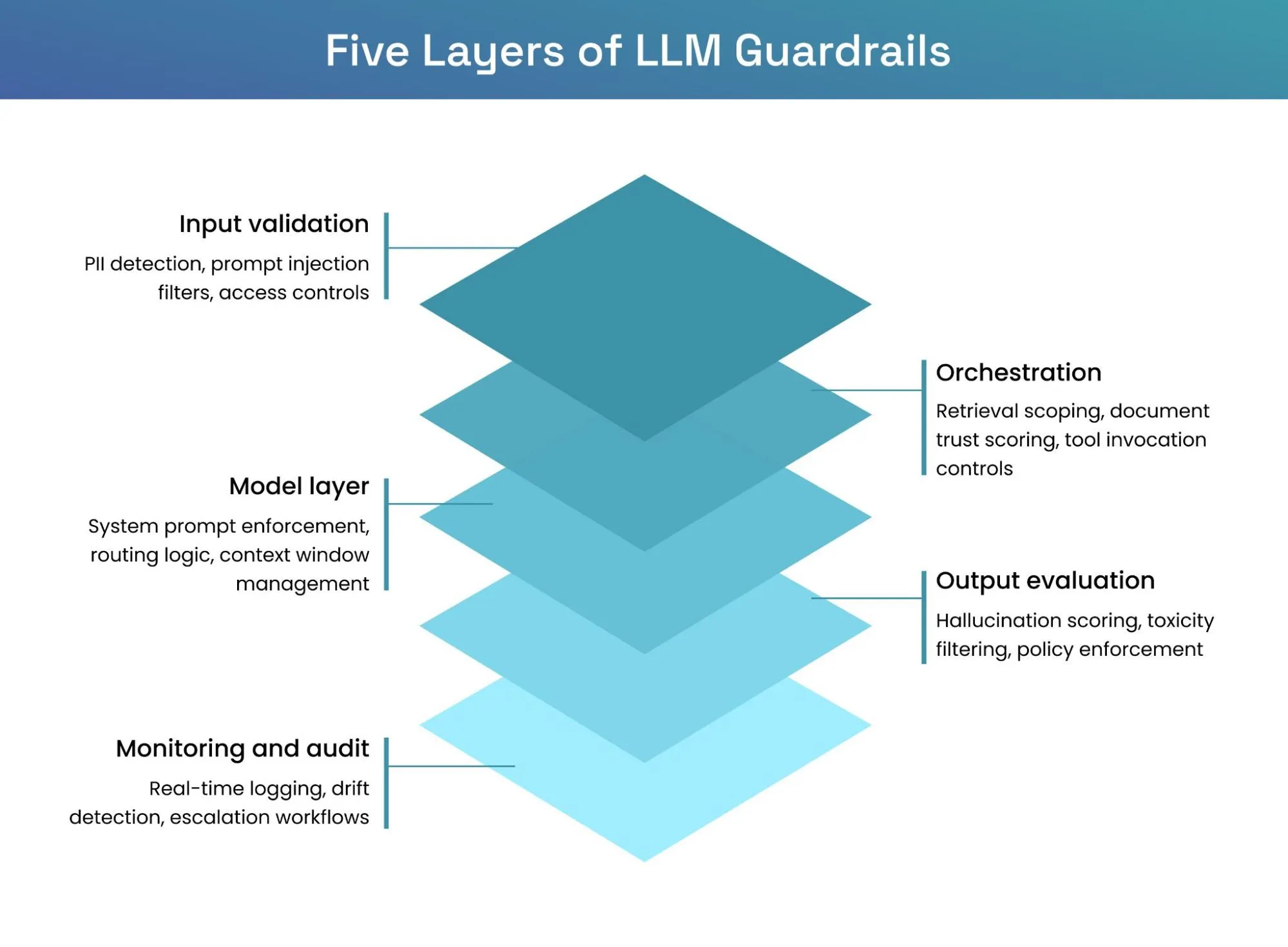
Safety guardrails for LLMs operate across five layers of the inference pipeline at runtime. Each layer addresses a distinct class of risk and generates distinct types of control evidence for review.
Layer 1: Input Validation and Filtering
- The first control point is the input layer, where user input and any injected context are evaluated before reaching the model. Input validation checks perform several functions in sequence or in parallel across the request:
- PII detection: Identifies personal information in the prompt and either redacts it, blocks the request, or flags it for compliance review.
- Prompt injection detection: Identifies attempts to override system instructions or manipulate LLM behavior through crafted inputs, including indirect injection via documents.
- Unsafe instruction filtering: Detects requests that fall outside the permitted operational scope, including requests for harmful information or hate speech generation.
- Access-based filtering: Restricts what a given user or role can request from the model based on authentication context and permission level.
- Contextual policy checks: Validates that the request is appropriate for the deployment context, for example blocking financial advice queries in a customer service tool.
Input validation does not require running the full LLM for every check across the queue. Many checks can be performed by lighter classifiers, rules engines, or dedicated moderation models. This reduces latency and cost while providing early-stage protection at the perimeter.
At Solytics Partners, we operationalize input guardrails through NIMBUS Uno, our enterprise AI orchestration platform. Our input layer combines PII detection, prompt injection classifiers, and access policy checks that run before any prompt reaches the underlying model.
Layer 2: Orchestration and Retrieval Controls
For systems using retrieval-augmented generation, the orchestration layer introduces a second set of control requirements. Documents and data chunks retrieved from vector databases or knowledge stores become part of the model context. They can influence outputs in ways that bypass input-layer controls entirely.
Retrieval guardrails address this by applying document trust scoring before content is passed to the model. They filter chunks containing sensitive, outdated, or out-of-scope material and validate that the retrieved content comes from authorized data sources. Retrieval poisoning, where malicious content in the index manipulates LLM outputs, is a specific threat vector that requires dedicated detection logic.
In agentic architectures, the orchestration layer also governs tool selection and invocation pathways. Guardrails at this layer enforce which external tools or APIs the agent can call, under what conditions, and with what permission scope. Autonomous execution without these constraints creates a significant risk of unintended actions or unauthorized access to downstream systems.
Layer 3: Model-Level Controls
Some guardrail functions operate at the model call itself across the inference path. These include system prompt enforcement, temperature and sampling constraints, and model routing logic that directs different request types to different models. A high-stakes compliance query may be routed to a more conservative model configuration than a general-purpose summarization task.
Model-level controls also include context window management, which prevents private information from earlier in a conversation from surfacing in later LLM responses. Token budget enforcement limits the length and complexity of LLM outputs in contexts where verbosity itself creates risk.
Layer 4: Output Evaluation and Enforcement
Output guardrails evaluate each LLM's response before it reaches the end user. This is the layer most associated with guardrails. It remains one layer among several rather than the complete picture. The output guardrails include several distinct functions across the generated output:
- Hallucination detection: Assesses whether claims in the response are grounded in retrieved context or verifiable sources, flagging unsupported assertions for review.
- Toxicity and harmful content filtering: Screens responses for language that violates content policies, including subtle bias or hate speech that keyword filters miss.
- Policy enforcement: Verifies that the response complies with enterprise acceptable use rules, regulatory restrictions, and ethical guidelines for the domain.
- Structured output validation: Confirms that responses intended for downstream systems conform to the expected schema, format, or data type.
- Confidence and uncertainty flagging: Identifies responses where the model demonstrates low certainty, routing them to human review rather than automatic delivery.
Inside NIMBUS Uno, we pair the output guardrails with SHAP and LIME-based explainability, so reviewers see why a response was flagged. This visibility makes audit defensibility and reviewer training far more practical across regulated workflows.
Layer 5: Monitoring, Logging, and Audit
The monitoring layer is where operational oversight becomes possible at scale. Without comprehensive logging, there is no basis for detecting anomalies, demonstrating compliance, building governance evidence, or improving the effectiveness of guardrails over time. A mature monitoring layer captures every prompt, every retrieved document, every model output, every guardrail decision, and the outcome of any escalation or human review.
Real-time monitoring also enables drift detection, identifying when input distributions or output patterns shift in ways that indicate model degradation or evolving adversarial techniques.
Abuse detection surfaces accounts or sessions systematically attempting to circumvent policy controls. Audit trails provide the documentary evidence required by governance frameworks and external regulators during examination.
Our TraceIQ module within NIMBUS Uno captures trace-level telemetry for every prompt, retrieval call, and model response across the deployment. This visibility lets compliance teams reconstruct any LLM interaction without piecing together fragmented application logs.
Key Risk Categories That LLM Guardrails Address
Different deployment contexts expose enterprises to different combinations of LLM risk profiles. Guardrail configurations should be calibrated to the specific use cases under deployment rather than applied as a uniform default. The next section breaks down four high-impact risk categories that enterprise teams should configure for.
Hallucination and Factual Accuracy
Hallucination is the production of outputs that sound confident in tone yet remain factually incorrect or unsupported by any source the model can cite. In enterprise contexts, hallucination risk runs highest where the model surfaces regulatory requirements, contractual terms, medical information, or financial data. A compliance officer relying on a hallucinated regulatory citation faces direct liability exposure.
Effective guardrails address hallucination through grounding checks that compare model claims against retrieved sources, with confidence thresholds that gate the automated delivery of low-certainty outputs.
Citation validation requires the model to attribute factual claims to specific documents within the retrieval index to ensure traceability. These controls reshape the model's behavior toward conservative, source-anchored responses inside regulated contexts.
Prompt Injection and Adversarial Manipulation
Prompt injection exploits the fact that LLMs process instructions and data through the same input channel, with little separation. An attacker can embed instructions in a document, email, web page, or knowledge base that the model processes as part of its context.
The injection redirects model behavior without the user's awareness. In agentic deployments where the model takes external actions, successful prompt injection attacks can cause consequences beyond a bad response.
Defense requires input sanitization that treats all externally sourced content as untrusted data by default. Enforcing the instruction hierarchy prevents user or document content from overriding system-level instructions during inference. Monitoring for behavioral anomalies surfaces injection attempts that bypass the static defenses and signal emerging application security risks.
Data Privacy and Information Leakage
LLMs operating over enterprise data can surface sensitive information in ways that violate privacy regulations or internal data governance policies. This includes PII surfaced from retrieval results, confidential business information included in model context that appears in outputs, and cross-user data leakage in multi-tenant deployments where context is not properly scoped between tenants.
Guardrails address this through PII redaction at input and output layers, with strict context scoping that isolates per-user retrieval results across sessions. Output scanning detects sensitive data patterns before LLM responses are delivered. Token-level filtering catches edge cases that classifier-based redaction misses inside high-volume traffic.
Regulatory and Policy Non-Compliance
Enterprise LLM applications in regulated industries must operate within specific content boundaries. A model used for credit decisioning cannot produce outputs that violate fair lending requirements. A healthcare assistant cannot provide clinical recommendations outside its licensed scope. A financial services chatbot cannot offer investment advice without appropriate disclaimers and regulatory alignment in place.
Domain-specific policy guardrails enforce these boundaries by classifying both request and response content against a defined policy ruleset. They block or flag outputs that fall outside the permitted scope, generate audit records that demonstrate compliance with applicable regulatory requirements, and feed governance dashboards for ongoing review.

Implementation Considerations for Enterprise Teams
The implementation of guardrails moves from architecture decisions to operational ownership across multiple enterprise teams. Engineering owns latency budgets and integration patterns. Compliance owns policy definitions and acceptable use rules. Risk and audit teams own evidence requirements and escalation pathways.
Here are the practical considerations teams encounter when moving from pilot to production-grade deployment.
Designing for Latency and Throughput
Every guardrail check adds latency to the inference pipeline. For synchronous customer-facing applications, this is a material constraint on user experience. Enterprises typically address this through parallel evaluation, running multiple guardrails checks concurrently rather than sequentially.
They also use tiered architectures that apply lightweight fast checks at the input layer and reserve heavier semantic evaluation for the output layer or asynchronous post-processing.
The latency budget must be defined as part of the system design, not discovered after deployment goes live. Guardrail performance benchmarks should be part of the pre-production testing program alongside model performance metrics.
Managing False Positives
Guardrails that are too sensitive generate false positives, with legitimate requests flagged or blocked incorrectly across the queue. In a legal research tool, blocking queries that mention criminal law because they contain restricted terms creates friction. The friction drives users to unmonitored channels and undermines the control program. False positive rates must be measured, reported, and actively managed through threshold tuning and classifier improvement.
Escalation workflows for false positives should be designed into the system from the first step. Users should have a documented path to challenge a block decision. Governance teams should have visibility into false positive volume and distribution to inform ongoing calibration cycles.
Governance Ownership and Documentation
Guardrail frameworks require named ownership across functions. One named owner must hold accountability for policy definitions across business units. Another must own the monitoring program and incident triage. A third must approve threshold changes and configuration updates.
A fourth must run the testing and re-validation cycle when models or policies change. Without this structure, configurations drift, monitoring gaps accumulate, and audit evidence becomes unreliable.
Documentation standards should cover the rationale for each policy rule, the test evidence supporting each guardrail configuration, the incident records for any policy violations detected in production, and the change history for all guardrail updates. This documentation constitutes the governance record that regulators and internal audit teams will request during examinations.
At Solytics Partners, our VaultBot and AI Mate modules automate evidence collection and policy documentation across the model inventory. Pre-built regulatory mappings to the EU AI Act, NIST AI RMF, and ISO/IEC 42001 reduce the manual effort our clients spend assembling audit packs.
Choosing Between Build, Buy, and Open Frameworks
Enterprise teams face a choice between building guardrails in-house, adopting open frameworks, or buying a commercial platform. NVIDIA NeMo Guardrails is an open framework that lets teams define programmable rails for LLM applications using a Colang-style configuration language.
Llama Guard, released by Meta, is an open classifier model fine-tuned for input and output moderation across common safety categories. Both are useful building blocks for diverse use cases. Neither delivers a complete enterprise guardrail program on its own.
Amazon Bedrock Guardrails offers a fully managed service inside Amazon Web Services that applies configurable safety controls to models hosted on Amazon Bedrock. The service integrates with Amazon CloudWatch for monitoring and logging across the AWS estate. The trade-off is provider lock-in and limited portability across model providers outside the Bedrock environment.
Build-versus-buy decisions hinge on regulatory scope, integration complexity, and the maturity of internal teams. Open frameworks like NeMo Guardrails offer flexibility at the cost of integration overhead. Managed services like Amazon Bedrock Guardrails offer speed at the cost of platform dependency. Commercial guardrail platforms designed for regulated industries typically combine the orchestration depth of build with the operational maturity of buy.
Evaluating Third-Party and Open-Source Models
Enterprises that deploy third-party LLM APIs or open-source models face additional governance obligations. The model provider's own safety measures, including built-in content filters or alignment training shaped by human feedback, cannot substitute for enterprise-controlled guardrails.
These provider-side controls are not configurable enough for enterprise use, and they may change without notice across model versions.
Enterprise guardrail layers must operate independently of the model provider for consistent policy enforcement. This means the control architecture sits in the middleware layer between the application and the API call. The architecture cannot rely on the provider to enforce enterprise-specific policies on the enterprise's behalf during inference.
Testing and Validating LLM Guardrails
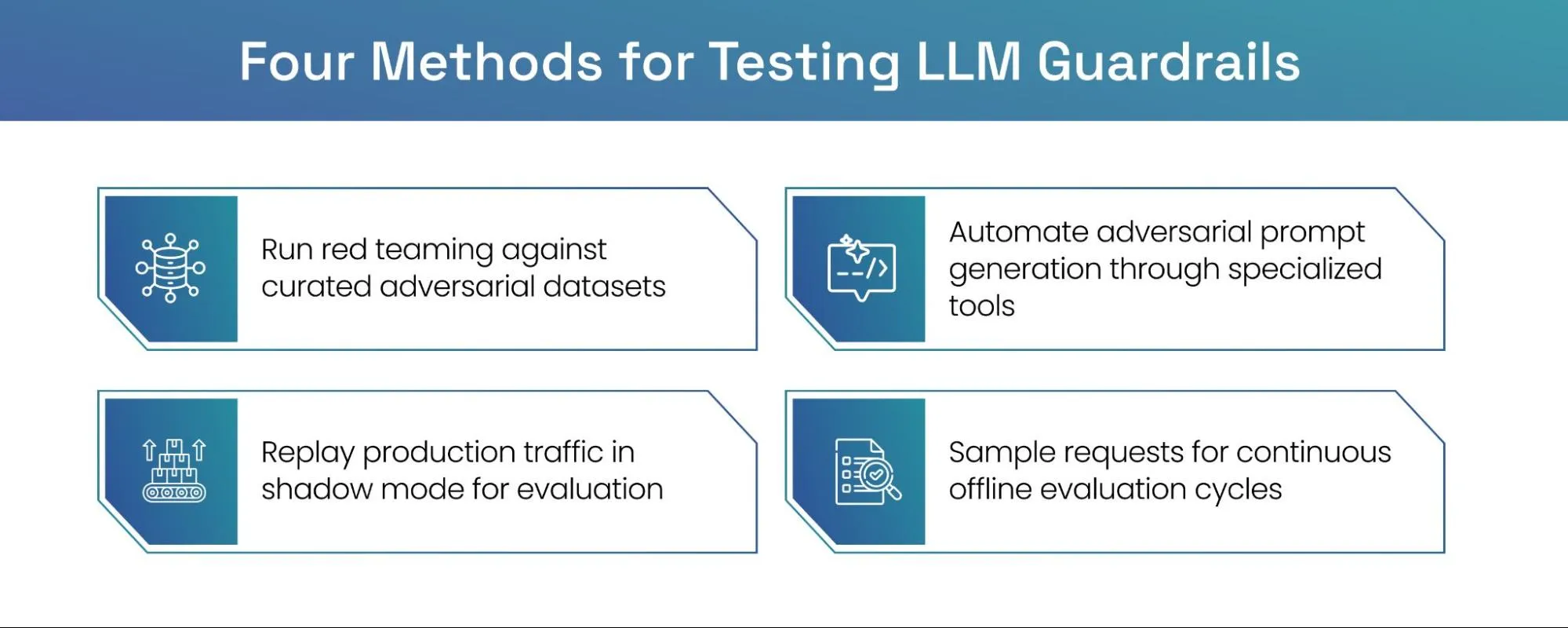
Guardrails must be tested before deployment and revalidated continuously in production. The testing program should cover both the guardrail controls themselves and the LLM system. Attention should go to adversarial scenarios that representative users or malicious actors might attempt against natural language processing pipelines.
Red Teaming and Adversarial Testing
Red teaming exercises simulate adversarial use to identify gaps in guardrail coverage before launch. Teams attempt prompt injection, jailbreak techniques, policy circumvention via indirect phrasing, and edge cases that exploit the boundaries of the deployment context. Results are used to update guardrail configurations and inform threshold calibration before production deployment goes live.
Adversarial testing should be repeated after any model update, policy revision, scope expansion, or vendor change. Guardrails effective against known attack patterns at launch may be insufficient against new techniques that emerge after deployment.
For evaluation, we use geometric knowledge graphs inside NIMBUS Uno to validate that LLM responses align with curated enterprise truth sources. This approach surfaces hallucinations that string-match or embedding-similarity checks routinely miss.
Benchmark and Regression Testing
Benchmark testing measures guardrail detection rates against standardized datasets of known harmful and known acceptable inputs. The benchmark provides a quantitative baseline for the effectiveness of guardrails across releases. Regression testing runs the same benchmark suite after each guardrail update to confirm that improvements in one area have not degraded coverage elsewhere across diverse use cases.
Domain-specific scenario testing covers the failure modes most relevant to the deployment context. For a banking copilot, this includes scenarios involving financial advice, credit eligibility, regulatory interpretation, and anti-money-laundering edge cases. For a healthcare assistant, it includes scenarios involving clinical recommendations, drug interactions, patient data handling, and licensure boundaries.
Final Thoughts
LLM guardrails are the operational infrastructure that makes enterprise AI deployment governable at scale. They are not a substitute for model quality or alignment, nor a compliance checkbox to be completed at launch. They are a continuous program requiring ownership, monitoring, testing, and iterative improvement as models, data, and threat patterns evolve over time.
For enterprises in regulated industries, the question is not whether to implement guardrails. The question is how comprehensively and how rigorously the program is run. The frameworks that support defensible AI governance operating model, including the EU AI Act, NIST AI RMF, sector-specific supervisory guidance, and emerging ISO standards, expect enterprises to demonstrate active documented oversight of AI systems in production. A mature guardrail program is how that demonstration is made.
This is the work we lead at Solytics Partners for regulated enterprises across financial services, insurance, banking, and capital markets. We combine deep model risk management expertise with NIMBUS Uno and other AI risk management tools to deliver auditable LLM governance that our clients can defend before any regulator.
Ready to operationalize LLM guardrails inside your enterprise? Book a 1-on-1 demo call with Solytics Partners.
Frequently Asked Questions
Should LLM guardrails be model-specific or shared across model providers?
LLM guardrails should sit in the middleware layer between the application and the model so they remain shared across providers. This portability lets enterprises swap between OpenAI, Anthropic, and open-source models without rebuilding controls each time. Lightweight model-specific tuning is normal, yet the core policy logic and audit trail must remain provider-agnostic.
What is the regulatory expectation for documenting guardrail effectiveness?
Regulators expect documented evidence of policy definitions, testing methodology, incident records, and the change history for every guardrail configuration in production. Frameworks like the EU AI Act and NIST AI RMF require enterprises to demonstrate ongoing oversight rather than one-time validation. Effectiveness metrics, false positive trends, and red-team results form the core evidence pack.
What's the difference between input filtering and output validation?
Input filtering evaluates the user input before it reaches the model, catching PII, prompt injection, and unsafe instructions early. Output validation evaluates the generated output before it reaches the end user, catching hallucinations, toxicity, and policy violations. Both layers are required because some risks only become visible after the model produces a response.
How do you tune guardrail thresholds without breaking user experience?
Threshold tuning starts with measuring false positive and false negative rates against representative production traffic samples. Teams iterate by adjusting the sensitivity of individual classifiers and tracking the impact on legitimate workflows in each tuning cycle. Shadow-mode deployment, where guardrails flag without blocking, lets teams calibrate thresholds safely before enforcing them in live traffic.
Can guardrails work across multimodal inputs (text + images)?
Modern guardrails span text, images, audio, and structured documents via multimodal classifiers and OCR preprocessing pipelines. Image inputs require dedicated detection for embedded text-based injection attempts, visual policy violations, and sensitive content categories. The same five-layer architecture applies, with each layer extended to handle the relevant modalities at consistent thresholds.
What are examples of AI guardrails?
Examples include PII detection in inputs, hallucination scoring in outputs, prompt-injection filters, and toxicity classifiers running in real time. Other examples cover retrieval poisoning detection, citation validation, tool invocation limits for agentic systems, and approval checkpoints for high-impact decisions. Drift monitoring, abuse detection, and human escalation workflows also count as critical guardrail safeguards.
Why does ChatGPT have guardrails?
ChatGPT has guardrails because language models can produce harmful, biased, or unsafe content without runtime controls layered over the base model. OpenAI applies content classifiers, refusal training, and usage policies to limit hate speech, misinformation, and unsafe instructions across millions of users. Consumer-facing deployment requires defensive layers that the underlying model alone does not provide.
How to set guardrails in LLM?
Setting LLM guardrails starts with defining acceptable use policies, identifying risk categories, and mapping each risk to a control layer in the architecture. Teams then implement classifiers at input and output, configure retrieval scoping for RAG systems, and instrument logging across the full inference path. Continuous testing and threshold tuning maintain effectiveness across releases.
Do open source LLM models have guardrails?
Most open-source LLMs ship with limited safety training and no runtime guardrails by default across enterprise deployments. Tools like NVIDIA NeMo Guardrails and Llama Guard let teams add programmable rails and moderation classifiers around any open-source model. Enterprise deployments should always layer additional controls, regardless of the base model provider's safety claims.
.webp)
.svg)


