Solytics Partners Secures a Trifecta of Wins at the Economic Times Enterprise AI Awards 2026


.webp)
LLMs are already in real workflows. Frontier models from OpenAI, Google, Anthropic and Meta are handling customer escalations at global banks. They are summarising regulatory filings for asset managers. They are running inside compliance review and clinical documentation workflows.
But here is the thing. Moving a model into a high-stakes environment is the easy part. But whether it will hold up once it leaves controlled testing? That is a different question entirely.
A model may pass every internal check. It can still behave differently across users, datasets, and prompts. It may sound fluent while missing the logic. In regulated settings, that is enough to create real exposure.
That is where LLM evaluation comes in. We’ve compiled a guide that covers what LLM evaluation is, why it matters in regulated industries, the four main approaches, the metrics that matter, and the platforms that make it operational at scale.
.webp)
What is LLM Evaluation?
LLM evaluation is how you test whether your large language model does what you need it to do accurately every time.
Here is what makes this tricky. LLM outputs are non-deterministic. The same prompt can produce different responses across runs. That means you cannot test them the way you test normal software. You need frameworks built for systems that do not always give the same answer.
At its core, the LLM evaluation meaning comes down to one question: can this model be trusted to do the job you are deploying it for?
There are two types every team needs:
- LLM Model Evaluation tests the raw model on standard benchmarks. It shows what the base model can do in controlled conditions.
- LLM System Evaluation tests the model inside the full application. That includes prompts, retrieval, tools, policies, and workflow logic. A model can score well in isolation and still fail in a real workflow.
One of the most common benchmarks is MMLU. It covers 57 subjects and 15,908 multiple-choice questions. Useful? Yes. Enough on its own? No. A high benchmark score does not prove the system is ready for production.
One type helps with model selection. The other helps teams make deployment decisions. You need both.
Why is LLM Evaluation Important?
Once an LLM enters a real workflow, the meaning of evaluation shifts. You are no longer testing a model in isolation. You are testing a business process. One that may affect customers, analysts, compliance teams, or regulators.
That is why evaluation is so important.
- It helps catch hallucinations early
LLMs produce wrong answers with the same confidence and formatting as correct ones. There is no error flag or warning. Without evaluation, these catch customers, business teams, or regulators.
- It shows what generic benchmarks miss
Public benchmarks test broad reasoning and general knowledge. They do not test your documents, terminology, or edge cases. That is where custom evaluation becomes important.
For example, FinanceBench was created using real financial material, earnings reports and earnings call transcripts. When tested on it, GPT-4 Turbo with a retrieval system failed or refused to answer 81% of questions. That is the gap between benchmark performance and domain performance.
- It supports compliance and audit readiness
In regulated industries, saying "the model works well" is not enough. NIST AI RMF calls for testing, evaluation, validation, and ongoing monitoring. The EU AI Act requires Article 12 record-keeping and Article 72 post-market monitoring for high-risk AI systems. Evaluation creates that paper trail.
- It helps catch drift over time
A model that works well in January may behave differently by June. Prompts may change, or user behavior can shift. Continuous evaluation catches that degradation before it becomes a compliance event.
- It gives stakeholders something concrete to trust
In many enterprises, the biggest delay is not technical. It happens when risk teams or senior stakeholders ask for proof. Evaluation gives them something real to review.
Offline vs Online LLM Evaluation
Evaluation happens in two stages. Both are needed because each one checks a different part of the system. Here is how they differ:
Why You Need Both
Offline evaluation tells you whether the model is ready. Online evaluation tells you whether it stays ready. When production finds a new failure, that example goes back into offline tests. The system gets sharper every time something goes wrong.
The 4 Main Approaches to LLM Evaluation
No single method can catch every failure. Each approach answers a different question. Thorough evaluation usually combines more than one.
Benchmark-Based Evaluation
The model answers multiple-choice questions from a standard dataset. Performance is measured as the percentage of correct responses. Simple in theory and increasingly hard to rely on in practice.
Common benchmarks include:
- MMLU: 57 subjects, 15,908 questions across STEM, humanities, and social sciences
- HellaSwag: Common sense reasoning
- TruthfulQA: Avoidance of false or misleading answers
- HumanEval: Code generation measured with pass@1
- ARC Challenge: Scientific reasoning
- BIG-Bench Hard: Complex reasoning and instruction following
- FinanceBench: Financial questions from real SEC filings and earnings reports
Here is the problem. Top models now score above 90% on MMLU. When every capable model clusters at the ceiling, the benchmark can no longer tell you which one is better. Domain-specific benchmarks like FinanceBench give far better signals for specialized deployments.
Verifier-Based Evaluation
The model gives a free-form answer. An external system checks whether it is correct. A rubric is not needed. The verifier simply returns pass or fail.
This works best when one right answer exists:
- Math problems using GSM8K and MATH-500
- Code generation, where outputs can be compiled and run
- Structured outputs like JSON, which can be checked against a schema
Two metrics matter here. pass@1 checks whether the model gets it right on the first try. pass@k checks whether it produces at least one correct answer across k tries.
The most advanced setups use Process Reward Models (PRMs). Instead of only checking the final answer, a PRM checks each step of the reasoning. If the logic breaks halfway through, it gets caught early.
The limit is simple. Verifiers need a correct answer to check against. For open-ended tasks, there is no answer key, so this method does not apply.
Human Evaluation
A reviewer reads the output and scores it. Still the gold standard when nuance, context, or domain knowledge matters.
Two formats are common.
- Direct rating scores helpfulness, correctness, and clarity on a 1 to 5 scale.
- Pairwise comparison shows two responses to the same prompt and asks the reviewer to pick the better one.
Pairwise comparison gives a better signal. It is easier to choose between two answers than to score one in isolation.
Platforms like LM Arena (now Arena) aggregate pairwise preferences into leaderboards using Elo-style ranking. Millions of blind preference votes have been logged across hundreds of models, giving continuously updated head-to-head rankings. Meta's $14.3 billion investment in Scale AI in June 2025 signals how seriously the industry takes human evaluation for high-stakes applications.
The downside? It is slow and expensive, and reviewers tend to favor confident answers over careful ones, even when the careful answer is more accurate.
LLM-as-a-Judge
This method uses a more capable model to score another model's output using a fixed rubric. It is fast, scalable, and useful for production monitoring.
Three formats are common:
- Single answer grading, where the judge scores one response.
- Pairwise comparison, where the judge picks the better of two responses.
- Reference-guided grading, where the judge compares the response with a known correct answer.
LLM judges like GPT-4 achieve over 80% agreement with human evaluators. That is enough for CI/CD testing and continuous monitoring. But not enough to replace human review in high-stakes settings.
Two techniques improve results.
- G-Eval prompts the judge to reason step by step before scoring.
- LLM juries run the same output through several judges and combine the scores.
Watch out for position bias, verbosity bias, and self-enhancement bias. These issues come up often and need to be built around from the start.
.webp)
How to Build an LLM Evaluation Dataset
The dataset is the foundation of any evaluation system. Weak data means weak scores regardless of the testing setup.
There are four common ways teams build one:
- Curated test sets: Manually written inputs that cover core use cases and edge cases.
- Golden datasets: Expert reviewed inputs with approved reference answers.
- Synthetic data generation: Question-answer-context triplets from the document base.
- Production logs: Real user inputs from live traffic for regression testing and drift detection.
One rule that always applies: keep a held-out set that never touches training or tuning. It protects your evaluation from overfitting and keeps results honest.
Key LLM Evaluation Metrics
LLM metrics fall into two groups. Reference-based metrics compare the output against a known answer. Reference-free metrics judge quality without needing a perfect reference. The right choice depends on whether the task has a ground truth.
Reference-Based Metrics
Use these when you already know the expected answer:
- BLEU: n-gram precision, used in translation tasks
- ROUGE: Recall, useful for summarization
- BERTScore: Semantic similarity, not just word overlap
- F1 Score: Balances precision and recall
- Exact Match: Checks whether the output matches the reference exactly
- METEOR: Word overlap and semantic similarity
These work best when the wording matters, and there is only one right answer. Less useful for open-ended tasks where many valid answers exist.
Reference-Free Metrics
Use these when there is no perfect reference answer:
- Hallucination Rate: How often the model invents unsupported facts
- Faithfulness: Whether the output stays grounded in the source
- Relevance: Whether the answer addresses the user's question
- Toxicity: Checks for harmful or offensive language
- Coherence: Whether the response reads clearly and logically
- Perplexity: How well the model predicts text
- Latency and Cost: Speed and operational efficiency
These are most useful for production quality, safety, and user experience.
RAG-Specific Evaluation Metrics
RAG systems can fail in two places. Either the system retrieves the wrong documents, or the model turns good documents into a wrong answer. If you do not separate the two when testing, you cannot tell which one failed.
Evaluate retrieval first. Then evaluate generation.
Retrieval Metrics
- Retrieval Precision: How many retrieved documents were relevant
- Retrieval Recall: How many relevant documents were retrieved
- Context Relevance: Whether the retrieved context matches the query
- Chunk Utilization: How much of the retrieved context the model uses
If retrieval fails, generation will usually fail too.
Generation Metrics
- Faithfulness: Whether the answer stays grounded in retrieved documents
- Response Relevancy: Whether the answer addresses what the user asked
- Answer Correctness: Whether the final answer is factually accurate
Evaluation Flow
Generate synthetic test question sets from your knowledge base. Test retrieval first. Then test generation against the retrieved context. This split shows exactly where the system works and where it needs fixing.
LLM Safety Evaluation
Safety evaluation is important because enterprise AI can pose legal, security, and reputational risks even when it provides the right answers. This is especially important in regulated industries, where teams need to test for unsafe behavior before launch.
The main safety activities are:
- Red-teaming: Tricky or harmful prompts designed to break the model
- Bias testing: Checks whether the model treats groups unfairly
- Guardrails: Block unsafe inputs or outputs
- AI Security Risk Assessment: Checks where the model is vulnerable, including prompt injection, data leakage and misuse scenarios
Key safety metrics: toxicity score, bias detection rate, jailbreak success rate, PII leakage rate. In regulated settings these are logged and reported under EU AI Act Article 12 for record-keeping, Article 72 for post-market monitoring, NIST AI RMF and SR 11-7.
LLM Evaluation Frameworks and Tools
The right tool depends on what you need to test. Some are built for RAG, some for production monitoring, some for benchmark runs.
Here is a simple guide:
Why Do Regulated Industries Trust Solytics Partners for LLM Evaluation?
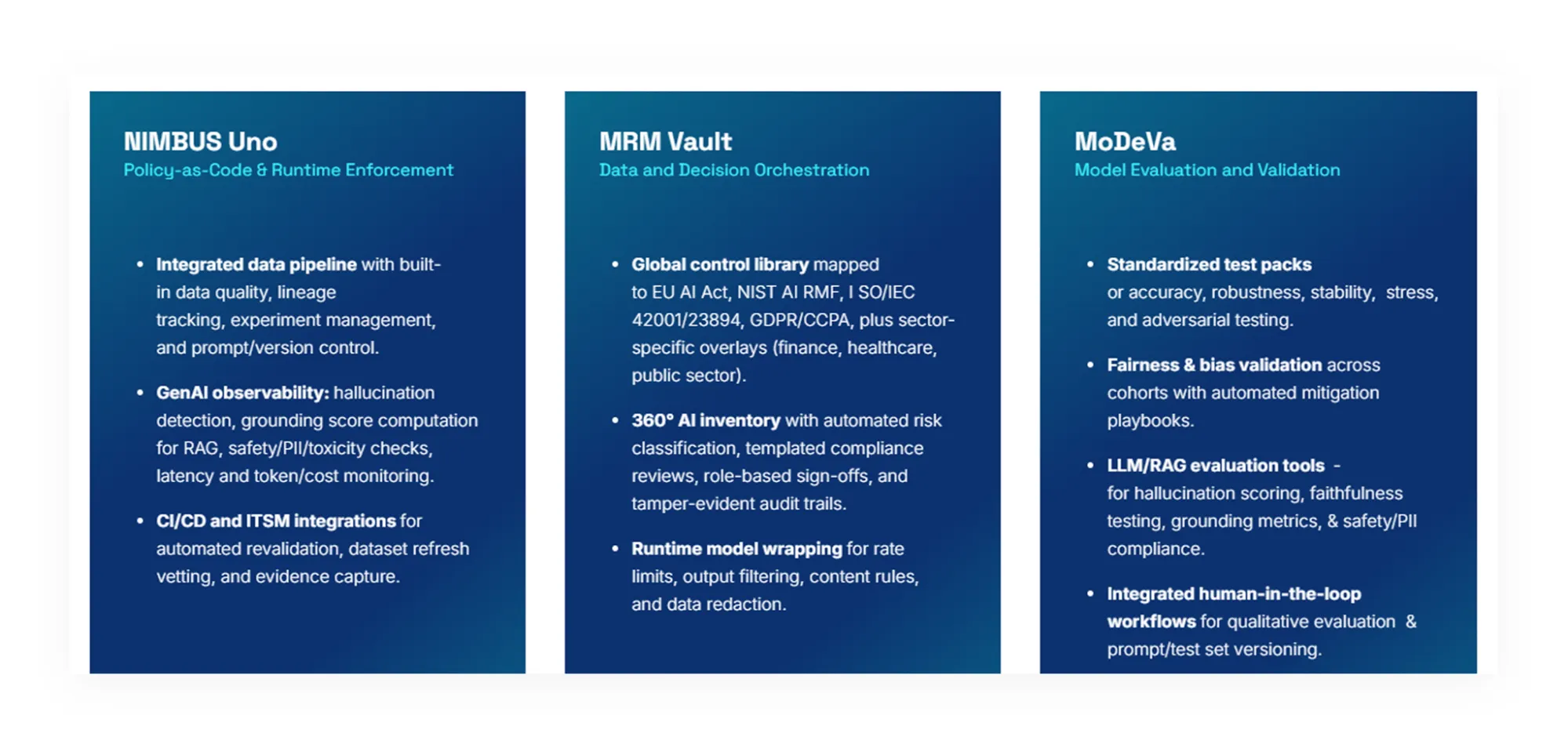
General evaluation tools can tell you whether a model scored well. Solytics Partners goes further by tying evaluation to AI governance actions, approval workflows and audit evidence, so the output is usable inside regulated model risk processes.
- NIMBUS Uno handles LLM validation, observability, benchmark testing, drift detection and live monitoring across prompts and responses.
- MRM Vault keeps the model inventory, workflow history, approvals, lineage and audit trail in one place.
- MoDeVa focuses on depth, speed, scale and auditability through fairness checks, robustness testing, explainability and compliance reporting.
AI security and compliance frameworks in NIMBUS Uno run red-teaming, jailbreak tests, guardrails and incident logging as part of a continuous assurance layer.
That is the difference. Instead of treating evaluation as a one-time quality check, Solytics Partners treats it as the evidence chain that supports model approval, oversight and reporting.
For firms operating under SR 11-7, the EU AI Act, NIST AI RMF and Basel frameworks, that structure is important because the question is whether the institution can prove how it was tested, who approved it, what risks were found and how those risks are being controlled.
LLM Evaluation Best Practices
A good evaluation starts with the failure modes of your product.
- Pick three to five checks that match real risks in your system.
- Build a custom dataset from real prompts, edge cases, and past failures.
- Keep a small golden set for regression testing.
- Validate any LLM judge on human-reviewed examples before using it widely.
- Test in both production and development.
- Split retrieval and generation in RAG.
- Log prompts, context, outputs, scores, and feedback for later review.
LLM Evaluation Challenges
LLM evaluation is hard because many failures still look acceptable at first glance.
- There is often no single correct answer for summaries, advice, or conversation.
- Benchmark scores can be inflated when training data overlaps with test data.
- LLM judges can prefer longer answers, first answers, or familiar wording.
- Agent workflows add more steps and more failure points.
- Costs rise quickly once human review and production monitoring are included.
Future-Proofing Your Enterprise with Rigorous LLM Evaluation
Deploying large language models into real enterprise workflows is a major milestone, but ensuring they remain accurate, safe, and compliant requires a continuous, multi-layered approach to LLM evaluation. As organizations move beyond generic public benchmarks, the true test lies in how well a system handles domain-specific nuances, mitigates hallucination risks, and maintains stability against drift over time. For highly regulated industries, a robust evaluation framework is no longer just a technical nice-to-have—it is the foundational paper trail required to meet strict compliance, governance, and audit-readiness standards.
Ready to move past generic testing and establish a bulletproof validation pipeline for your AI applications?
Book a demo with Solytics Partners today to discover how our enterprise governance tools can secure, monitor, and scale your workflows with total confidence.
Frequently Asked Questions
What is an LLM evaluation?
LLM evaluation is the process of testing whether a large language model produces accurate, safe, and useful outputs for a specific task. It covers benchmarks, real-world prompts, safety checks, and metrics tied to how the model performs in your workflow. In enterprise settings, evaluation also produces the evidence needed for approval and audit.
What are the 4 approaches to LLM evaluation?
The four approaches are benchmark-based evaluation, verifier-based evaluation, human evaluation, and LLM-as-a-judge. Benchmarks measure general capability. Verifiers check tasks with a clear right answer. Human reviewers handle nuance and domain judgment. LLM judges scale scoring across production traffic. Most enterprise setups combine two or three approaches.
What does pass@1 mean in LLM evaluation?
Pass@1 measures whether the model gets the answer right on its first attempt. It is used in verifier-based evaluation for tasks such as math, code generation, and structured output, where correctness can be checked automatically. A related metric, pass@k, measures whether at least one correct answer appears across k attempts.
What are the best LLM evaluation tools?
The right tool depends on what you need to test. RAGAS and TruLens work well for RAG evaluation. DeepEval and Promptfoo are well-suited to CI/CD testing. LangSmith and NIMBUS Uno cover production monitoring and observability. For regulated deployments, NIMBUS Uno ties evaluation to governance workflows and audit reporting.
What are rubrics in LLM evaluation?
Rubrics are structured scoring criteria that define what a good response looks like. They usually cover correctness, completeness, relevance, and safety. Rubrics give human reviewers and LLM judges a consistent basis for scoring, reducing variability and producing defensible evaluation records for audit review.
What are the key metrics for safety evaluation of LLMs?
Key safety metrics include toxicity score, bias detection rate, jailbreak success rate, and PII leakage rate. These metrics come from red-teaming, structured bias tests, and guardrail monitoring. In regulated environments, they are logged for reporting purposes under the EU AI Act Article 12, NIST AI RMF, and SR 11-7.
How do you evaluate LLM performance?
A working evaluation program combines offline testing against golden datasets, benchmark runs for capability comparisons, human review of high-stakes outputs, and LLM-as-a-judge scoring on production samples. Live A/B testing between prompt or model versions catches regressions that offline tests miss. Continuous monitoring covers drift, safety, and quality over time.
.svg)


