Solytics Partners Secures a Trifecta of Wins at the Economic Times Enterprise AI Awards 2026


Enterprise AI adoption has expanded faster than many governance programs can keep pace with, let alone classify and oversee every system at scale. A meeting summarizer does not require the same review depth as a credit approval or fraud model workflow. When enterprises govern every system with the same controls, they waste effort and miss higher-risk exposure.
AI risk tiering addresses that governance gap by placing every AI system into a defined risk category. The assigned tier guides validation depth and approval requirements. It also influences monitoring frequency and the supporting documentation needed throughout the AI lifecycle. This gives teams a practical way to match oversight with system impact.
This blog explains how AI risk tiering works and why enterprises use it to prioritize governance resources. It also covers classification criteria, implementation steps, and relevant regulatory references

What Is AI Risk Tiering?
AI risk tiering is the process of classifying an AI system into a defined risk category. The assigned tier determines validation depth, monitoring frequency, approval routing, and documentation requirements. It gives governance teams a repeatable way to allocate effort across the AI portfolio.
Risk tiering is closely related to risk assessment, but the two activities serve different purposes. A risk assessment examines potential harm and exposure within the system. Tiering uses those findings to assign an overall risk level that governs the subsequent control requirements.
For example, a chatbot handling internal meeting notes may qualify for a lower internal tier if its data access is restricted. A model that influences credit eligibility typically requires a deeper assessment, as an incorrect decision could affect a customer's access to financial services.
This distinction helps teams avoid flat governance across all models and workflows. A chatbot that answers internal policy questions may need limited oversight. A credit approval model affecting essential services requires stronger review and tighter controls.
The output should connect each system to a clear risk level and control path. Higher-tier systems may require independent validation and additional approvals. Lower-tier systems can follow proportionate review procedures while retaining documented ownership and inventory records.
Why Does AI Risk Tiering Matter for Governance?
AI risk tiering helps enterprises allocate governance effort in proportion to system exposure. It prevents both over-control of low-risk tools and under-control of high-impact systems. The approach also gives auditors a clear logic for how each system entered its assigned control regime.
- Resource allocation: Governance teams have limited capacity for validation and review. Tiering directs that capacity toward applications with greater potential consequences for customers or business operations. It also helps teams prioritize systems exposed to higher legal or operational risk.
- Regulatory alignment: The EU AI Act establishes legal classifications that determine whether specific prohibitions or high-risk obligations apply. The NIST AI RMF supports risk prioritization but does not prescribe mandatory organizational tiers. In US banking, SR 26-2 takes a tailored, materiality-based approach to model risk management. It does not require institutions to adopt a particular AI tiering structure. Generative and agentic AI models are outside its stated scope.
- Approval routing: Tier assignments determine which reviewers, committees and evidence each system needs before deployment. This removes ambiguity from the approval workflow.
- Audit response: A documented tiering rubric helps reviewers reconstruct the reasoning behind individual classification decisions. Findings then map to specific tier requirements.
- Portfolio visibility: Aggregated tier data shows leaders where AI risk concentrates across business units. It also supports capacity planning for risk teams covering higher-tier systems.
- Vendor and third-party review: Tiering extends to vendor AI, so procurement and risk functions apply proportional due diligence. Higher-risk vendor systems may require additional technical evidence and stronger oversight of their operational dependencies.
The result is a governance program that scales with AI adoption rather than breaking under its weight. A comprehensive AI governance framework helps organizations connect these risk classifications with accountable decisions throughout the AI lifecycle
What Are the Standard AI Risk Tiers?
There is no universal internal tiering model that every enterprise must adopt. Organizations often use three or four internal categories to prioritize controls. The EU AI Act's commonly described four-risk-level model provides a useful conceptual reference, but it should not be treated as a complete legal classification of every AI technology.
The EU AI Act prohibits specified practices under Article 5 and defines high-risk systems under Article 6. Annex III identifies areas including employment and education, while other provisions address regulated products covered by Annex I.
Under the amended application schedule, high-risk obligations for standalone Annex III systems apply from December 2, 2027. The corresponding date for Annex I embedded systems is August 2, 2028.
Article 50 transparency obligations have applied since August 2, 2026. The amended legislation provides a limited transition until December 2, 2026 for machine-readable marking of specified systems already on the market.
General-purpose AI models also require separate consideration. Models with systemic risk face additional obligations and cannot be placed neatly within a simple four-tier model designed around AI system use cases.
Enterprises do not need to copy EU labels into their internal tier structure. They can develop internal categories that reflect business risks while mapping applicable systems to legal classifications. The classification of AI should remain explainable to business owners, auditors, and regulators.
What Criteria Define an AI Risk Tier?
AI risk tiers come from law, internal appetite, and operational exposure. Teams should document classification criteria before assigning tiers across the portfolio. Consistent criteria make AI risk classification easier to defend during audits.
- Decision consequence: Teams should assess whether AI outputs affect money, employment, healthcare access, or other important outcomes. The greater the consequences of wrong AI decisions, the stronger the tier should be.
- Reversibility: Teams should ask whether the organization can reverse the decision without lasting harm. Irreversible outcomes require deeper review than recommendations that a user can ignore.
- Regulatory exposure: Systems inside regulatory frameworks may need stricter tiering and documentation. The AI Act can require conformity assessments for specific high-risk systems within its legal scope.
- Data sensitivity: Systems that handle personal data, sensitive data, or protected records require stronger controls. Data protection and data privacy requirements should shape the tiering rubric.
- Autonomy level: Systems with limited automation carry different exposure from agents that trigger workflows. Strong human oversight can reduce some exposure when reviewers have authority and context.
- Scale of use: Teams should measure how many people, transactions, or processes the system affects. Larger scale can increase exposure even when a single decision appears low-risk.
- System complexity: Generative AI, agents, and dynamic retrieval systems introduce new failure modes. These systems may also increase risks such as data leakage, hallucination, and prompt injection.
- Security posture: Higher tiers may need stronger security controls and access controls. Teams should also review integration points connecting AI tools to production systems.
These criteria feed the scoring rubric that produces the final tier for each system. Organizations should document the relative importance of each criterion rather than relying on an unexplained numerical score. A defensible risk tier should reflect the system's intended use and the potential consequences of failure.

How Do You Implement AI Risk Tiering in Enterprises?
Enterprises implement tiering by identifying AI systems and applying consistent risk criteria. Each classification should then determine relevant controls and approval requirements. Reassessment keeps the assigned tier aligned with changing operational exposure.
The following seven steps provide a repeatable process:
Step 1: Build a Complete AI Inventory
Enterprises cannot classify systems they have not identified. The inventory should include approved tools, shadow AI, machine learning models, copilots, agents and analytics workflows.
Teams should record the system owner and intended purpose. Data sources and deployment status provide further context for assessing risk. This record gives governance teams a baseline for regulatory compliance and internal review. It also helps teams find duplicate systems and hidden exposure.
Step 2: Define the Tier Structure and Scoring Rubric
Teams need to choose a three-tier or four-tier structure that fits their governance model. The rubric should account for decision impact and system autonomy. Reversibility and data sensitivity can further influence the final classification.
This rubric prevents subjective classification decisions across departments. It also helps teams compare AI tools, decision engines and quantitative modeling workflows through the same lens. Senior governance teams should approve the rubric before broad rollout.
Step 3: Score Autonomy, Agency and Data Access
Teams should score what the system can do, not only which model it uses. A summary tool carries less exposure than an agent that updates records or calls APIs.
Agency increases exposure when the system triggers actions without review. Data access also changes the tier when systems read customer records or write into production databases. These checks help teams understand real operating risk.
For autonomous applications, reviewers should examine the permissions available to each agent. They should also consider whether execution can affect downstream systems without prior human approval.
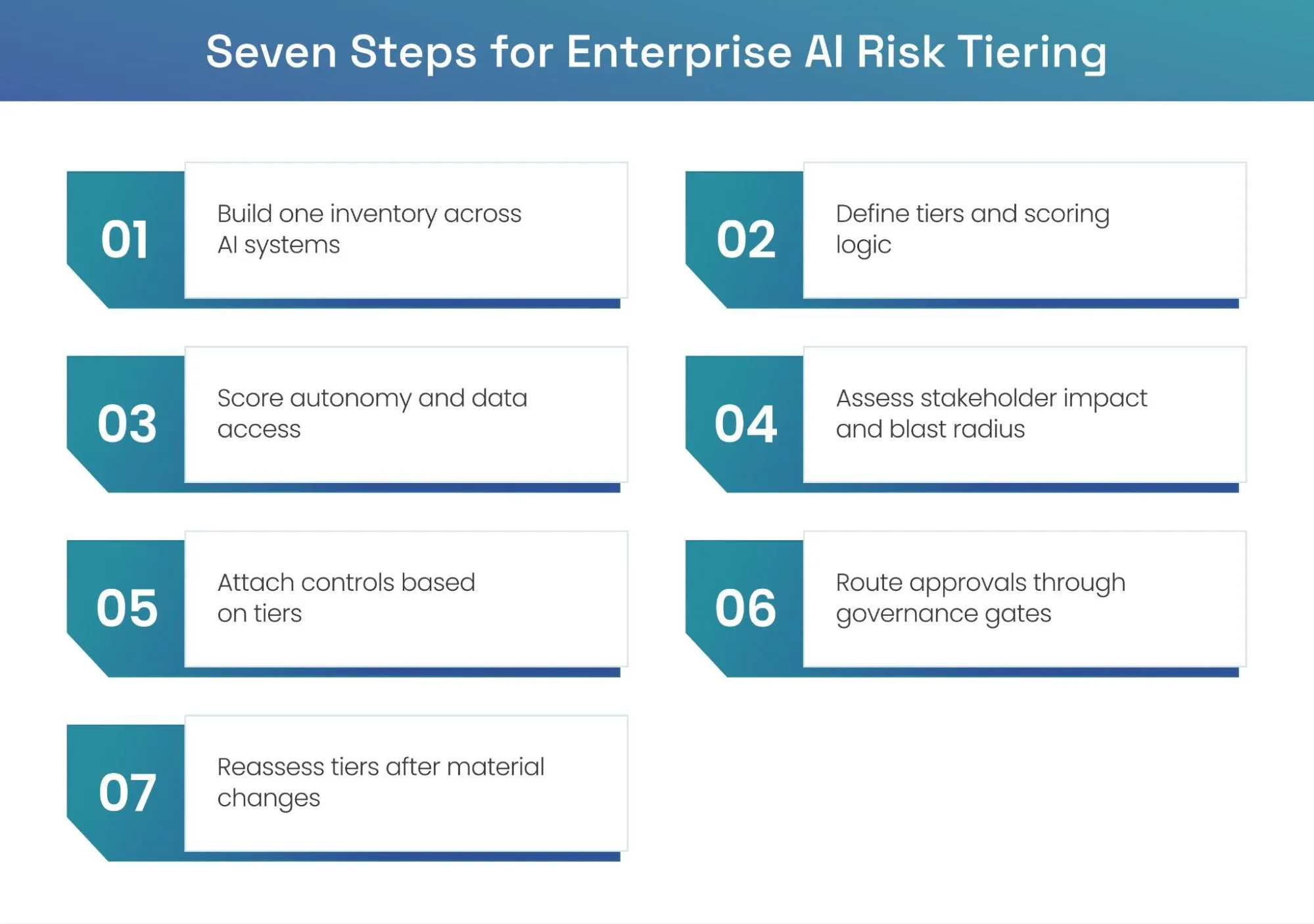
Step 4: Assess Blast Radius and Stakeholder Impact
Teams have to assess how far a system failure could spread across users or processes. A low-volume internal tool does not create the same exposure as a customer decision engine.
The assessment should identify affected customers and employees. Where relevant, it should also consider partners or communities that could experience consequences. This step helps teams connect trustworthy AI principles with practical operating decisions. It also helps governance teams compare harm across different business functions.
Step 5: Attach Controls to Each Tier
Each tier should map to defined validation requirements and approval workflows. Monitoring frequency and documentation depth should also reflect the assigned risk level.
Organizations may require independent validation for their highest internal tier. Additional approval authority may be required when the consequences of failure are substantial.
Lower-tier systems should still retain ownership, inventory records, and basic monitoring. This avoids unmanaged AI while keeping control effort proportionate. The control map also helps teams follow best practices across complex portfolios.
Step 6: Route Approvals Through Tier-Aware Governance Gates
The assigned tier must decide who approves the system before deployment. Higher-risk systems may need review by risk or compliance functions. Security teams and business owners can participate when their responsibilities are affected.
Approval workflows need to preserve who reviewed the system and what conditions applied. They should also record unresolved issues and acceptance decisions. This evidence helps committees manage mitigating risks across the AI portfolio.
Step 7: Reassess Tiers After Material Changes
Tiers should change when system exposure changes. Triggers include significant changes in purpose or data sources. Expansion to new users or operating environments may also justify another classification review.
Incidents and model drift can expose previously unidentified risks. New autonomous capabilities or greater access to connected systems may increase operational impact.
Reassessment ensures that governance controls reflect the system's current risk rather than its original classification. Enterprises can connect this process with AI model lifecycle management to maintain accountability as systems move through development and production use.
How Does Solytics Partners Operationalize AI Risk Tiering?
A risk tier becomes useful when it changes the decisions an organization makes about an AI system. Classification should determine the depth of review and approval requirements before deployment. It should also influence how the system is monitored after release.
Solytics Partners addresses this through a connected governance process built around AI Vault and NIMBUS Uno.
From Risk Assessment to an Approved Classification
AI Vault maintains a central inventory of enterprise AI assets, with ownership and lifecycle information linked to each record. Governance teams can assess an asset's materiality and apply configurable risk-tiering criteria.
AI-assisted tiering supports classification, while configurable approval workflows route decisions to relevant reviewers. AI Vault also maps controls to internal policies and applicable regulatory frameworks.
This means the assigned tier is linked to documented governance decisions rather than existing as an isolated label.
From Classification to Technical Evaluation
Once teams assign a risk tier, they can determine how much evaluation evidence the system requires. NIMBUS Uno supports risk-based testing for accuracy and robustness, with additional checks for bias or safety risks where relevant.
For higher-risk applications, reviewers can use these results to investigate identified weaknesses before granting deployment approval.
From Deployment to Ongoing Reassessment
Risk classification should remain connected to what happens in production. NIMBUS Uno monitors AI behavior across prompts and responses, while its observability capabilities also cover retrievals and tool calls.
More than 60 monitoring metrics help teams investigate drift and unexpected behavior. Findings can inform reassessment when the original risk assumptions no longer reflect operating conditions.
For autonomous agents, NIMBUS Uno also checks actions before execution and allows, escalates or blocks them under applicable policies. These controls help enforce the operating boundaries associated with an approved risk profile.
Keeping Tiering Relevant Throughout the AI Lifecycle
AI Vault maintains the governance record, while NIMBUS Uno contributes technical evidence from validation and production monitoring. This allows classification decisions to remain connected with subsequent oversight activities.
The approach reflects Solytics Partners' broader operating model of Govern → Validate → Assure at Runtime → Monitor. It helps organizations manage risk as an ongoing responsibility rather than a one-time assessment.
Solytics Partners is a Category Leader in the Chartis RiskTech Quadrant® for AI Governance Solutions, 2025.
Final Remarks
AI risk tiering provides enterprises with a practical way to align controls with system exposure. It helps teams decide which systems need deep validation, senior approval or closer production monitoring.
Strong programs connect tiering to inventory, scoring logic, approval gates and monitoring triggers. The assigned tier should guide daily governance work and change when the system changes. This makes effective AI governance easier to operate across growing portfolios.
Solytics Partners connects risk classification with validation and ongoing oversight through AI Vault and NIMBUS Uno. Book a demo to explore how a governed tiering process can support better decisions across your AI portfolio.
FAQs
What are the risk tiers for AI?
The EU AI Act is commonly described through unacceptable, high, limited and minimal risk categories. However, these labels do not form a complete universal classification for every AI model. Enterprises may define their own internal tiers while mapping relevant systems to applicable legal requirements.
What are the different risk levels in AI risk tiering?
Risk levels depend on the consequences of decisions and system autonomy. Data sensitivity and operational scale can further influence classification. A meeting summarizer may qualify for a lower internal tier, while a credit decision system typically requires deeper review. The rubric should reflect intended use and exposure.
How do you implement AI risk tiering in enterprises?
Implementation covers AI inventory and scoring rubric design, followed by control mapping and reassessment. The assigned tier should guide validation depth and approval routing, while monitoring requirements reflect operating risk. Teams should document classifications so reviewers can understand the rationale behind governance decisions.
What are Tier 1 and Tier 2 risks?
Tier 1 and Tier 2 are organization-defined labels rather than universal AI risk categories. Some enterprises reserve Tier 1 for systems requiring independent validation and senior approval. Tier 2 may cover material applications with lower exposure. Clear internal definitions determine how each tier operates.