Solytics Partners Secures a Trifecta of Wins at the Economic Times Enterprise AI Awards 2026


AI models can develop performance problems after deployment when operating conditions change, or teams fail to maintain adequate oversight. A fraud detection AI model may perform well at launch, then lose accuracy as customer behavior changes. When no owner monitors drift or reviews accuracy, the machine learning system may continue to make decisions based on outdated patterns.
This problem recurs when documentation is incomplete, handoff responsibilities are unclear, or retraining triggers remain undefined. Teams miss the early signals because responsibility for the deployed model sits between technical teams and business owners. Risk functions may also lack visibility into emerging issues.
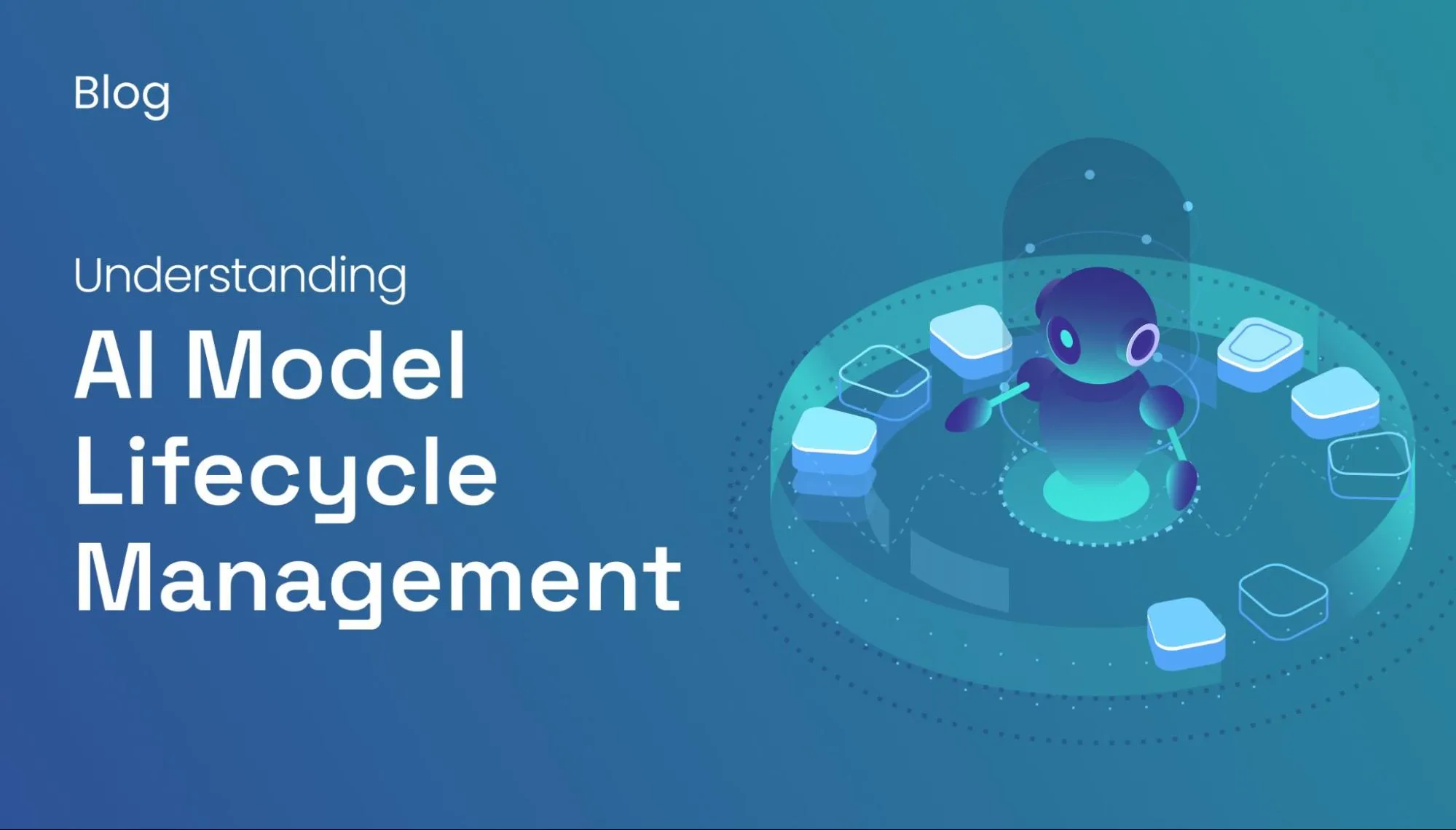
AI model lifecycle management is a structured discipline that manages every model from planning through retirement. The AI model lifecycle applies to statistical models, machine learning systems, generative AI applications, and autonomous agents. Regulated institutions can connect this discipline with established model risk management practices while applying additional controls to emerging AI technologies.
This blog covers the seven AI model lifecycle management stages, common failure points, governance integration, platform requirements, and the Solytics Partners approach.

What Is AI Model Lifecycle Management?
AI model lifecycle management structures how teams plan, build, validate, deploy, monitor, and retire models across their operational life. It assigns clear ownership, governance controls, and evidence requirements at every stage. This discipline keeps each model traceable, controlled, and aligned with its approved business purpose as conditions change over time.
This AI lifecycle management practice treats every AI model as a managed business asset rather than a one-time engineering output. Teams maintain ownership and approval records throughout the AI model lifecycle. They also track model versions and changes to the approved purpose.
Technical requirements differ between traditional statistical models and deep learning applications. Foundation models and autonomous agents introduce additional evaluation needs.
However, every AI system needs classification, validation evidence, monitoring rules, and retirement criteria. Clear model governance attributes help teams track the responsible owner and current lifecycle status. They also show how each trained model reached production.
How Does AI Model Lifecycle Management Differ From MLOps and AI Governance?
AI model lifecycle management coordinates ownership and evidence handoffs across a model's operational life. MLOps automates technical pipelines, while AI governance defines enterprise policies and decision rights. These disciplines work together, but each addresses a distinct operational responsibility.
MLOps supports the development process through testing, release pipelines and environment controls. Lifecycle management coordinates stages, while enterprise AI governance sets decision rights.
Regulated enterprises often need all three disciplines. MLOps supports technical execution, lifecycle management preserves continuity, and governance establishes decision authority
Why Does AI Model Lifecycle Management Matter?
AI model lifecycle management AI model lifecycle management helps reduce unmanaged model debt and preserve evidence across changing operating conditions. It gives risk, compliance, and business teams a shared view of every model in production. Without consistent oversight, organizations can lose ownership information and delay responses to performance deterioration.
Three operational concerns make lifecycle management important.
- Model debt compounds over time: Unmanaged models can lose documentation and technical relevance as operating requirements evolve. Unresolved validation findings and outdated dependencies become harder to correct once the original developers move on. The organization may continue operating systems without sufficient knowledge of their limitations.
- Regulatory expectations require appropriate model risk controls: On April 17, 2026, the Federal Reserve, OCC, and FDIC jointly issued SR 26-2. The guidance supersedes SR 11-7 and SR 21-8, replacing them with a tailored, risk-based approach. SR 26-2 focuses on conventional quantitative models and certain non-generative AI models. Its footnote 3 excludes generative and agentic AI from scope. However, banking organizations should still determine appropriate governance for excluded technologies as part of their broader risk management practices.
- Growing AI portfolios challenge manual coordination: Spreadsheets become harder to manage as organizations register more models and assign responsibilities across teams. Structured workflows help track ownership and overdue governance activities. Connected records can reduce the effort required to assemble evidence for internal reviews.
AI model lifecycle management provides the operating structure that connects these responsibilities throughout development and production use. Organizations can also explore the Solytics Partners analysis on AI model governance for additional discussion of ownership and lifecycle controls.
What Are the Seven Stages of AI Model Lifecycle Management?
The AI model lifecycle management framework moves each model through seven defined stages with governed transitions. The lifecycle remains an iterative process because monitoring, incidents, or changing requirements can return a model to earlier stages. This design lets teams manage change without losing the historical record.
Stage 1: Problem Definition and Use Case Planning
Teams first define the business problem, the intended users, the value, and the consequences of potential errors. The sponsor owns the outcome, while risk teams assess the proposed use and its materiality. This stage creates the use case record, success measures, and initial AI impact assessment.
The planning process also determines whether the system supports or automates a decision. Risk classification informs the required validation depth and approval process. It also guides the monitoring requirements for the proposed AI solution. A clearly defined scope helps teams establish meaningful ownership before technical development begins.
Stage 2: Data Collection and Preparation
Data teams manage the acquisition and preparation of development datasets. Owners document the original data sources and relevant transformations. The data collection record covers representativeness, missing values, and retention. Strong data preparation links each dataset version with the trained model.
Teams assess data quality and determine whether datasets contain sensitive information. Appropriate access controls and security measures protect records. A connected data strategy for model risk management supports data management across inventories, data sources, and data pipelines. The approved dataset should remain identifiable throughout subsequent development and validation activities.
Stage 3: Model Development and Experimentation
Development teams choose methods, establish baselines, and compare designs during model development. The model selection process should match the decision and operating constraints. Teams document dependencies and architectural choices throughout AI development. For neural networks, the records should also describe relevant training configurations.
Evidence links model training to approved training data and experimental results. Document feature engineering because it can affect fairness. GenAI teams version prompts and retrieval settings. Prompt governance makes changes reviewable before the next step. Maintaining reproducible records allows validators to evaluate the same system version that development teams propose for deployment.
Stage 4: Independent Validation and Testing
Independent reviewers assess conceptual soundness, limitations, and intended use. This separation plays a critical role in effective challenge. Testing covers model accuracy, robustness, fairness, and explainability. GenAI reviews may also examine hallucination behavior and retrieval grounding, alongside potential prompt-injection vulnerabilities.
A complete evaluation records testing methods and identified findings. Reviewers compare the results with approved performance expectations. Validation should examine the correct model version and its intended operating conditions. A technically accurate model still requires evidence that it suits the proposed business use.
Stage 5: Approval and Production Deployment
Approval teams review validation findings and implementation evidence before authorizing release. Business owners confirm accountability for the deployed system, while relevant control functions review unresolved limitations.
The deployment record should document approval decisions and applicable operating restrictions. Rollback arrangements provide a response option when implementation issues arise. The risk tier determines the depth of review in accordance with the organization's governance methodology.
For applicable EU high-risk systems, conformity obligations depend on classification and organizational role. Following Regulation (EU) 2026/1744, Annex III high-risk obligations apply from December 2, 2027. The corresponding application date for Annex I embedded systems is August 2, 2028. The technical team deploys the approved model into its production environment and confirms that the implementation matches the validated configuration.
Stage 6: Production Monitoring and Maintenance
Production teams track drift, fairness and incidents after release. The owner remains accountable for thresholds and responses. Continuous monitoring compares current outcomes with baselines and expected data patterns. Effective AI model monitoring also captures changing user interactions.
Teams define alert routing before deployment. Ongoing monitoring fails when alerts have no accountable responder.
Applicable high-risk AI providers must meet the EU AI Act's post-market monitoring requirements when those obligations take effect. Article 72 provides the relevant framework, with timing determined by the amended application provisions.
When teams detect model drift, feedback loops support remediation and continuous improvement. The Solytics Partners guide to AI model monitoring provides additional context on production monitoring requirements.
Stage 7: Retraining, Retirement and Replacement
Monitoring can trigger recalibration, retraining, replacement, or retirement. Teams should treat each outcome as a separate decision, supported by defined evidence. Retraining introduces revised features or updated methods into the existing lifecycle. Material changes may require renewed testing, approval and documentation.
Retirement triggers include persistent performance decline, obsolete purpose, unacceptable residual risk, or vendor discontinuation. Teams remove production access and define successor ownership. Retired models retain lineage, approvals, and retention decisions. This record helps auditors reconstruct past decisions and prevents inactive systems from processing data.
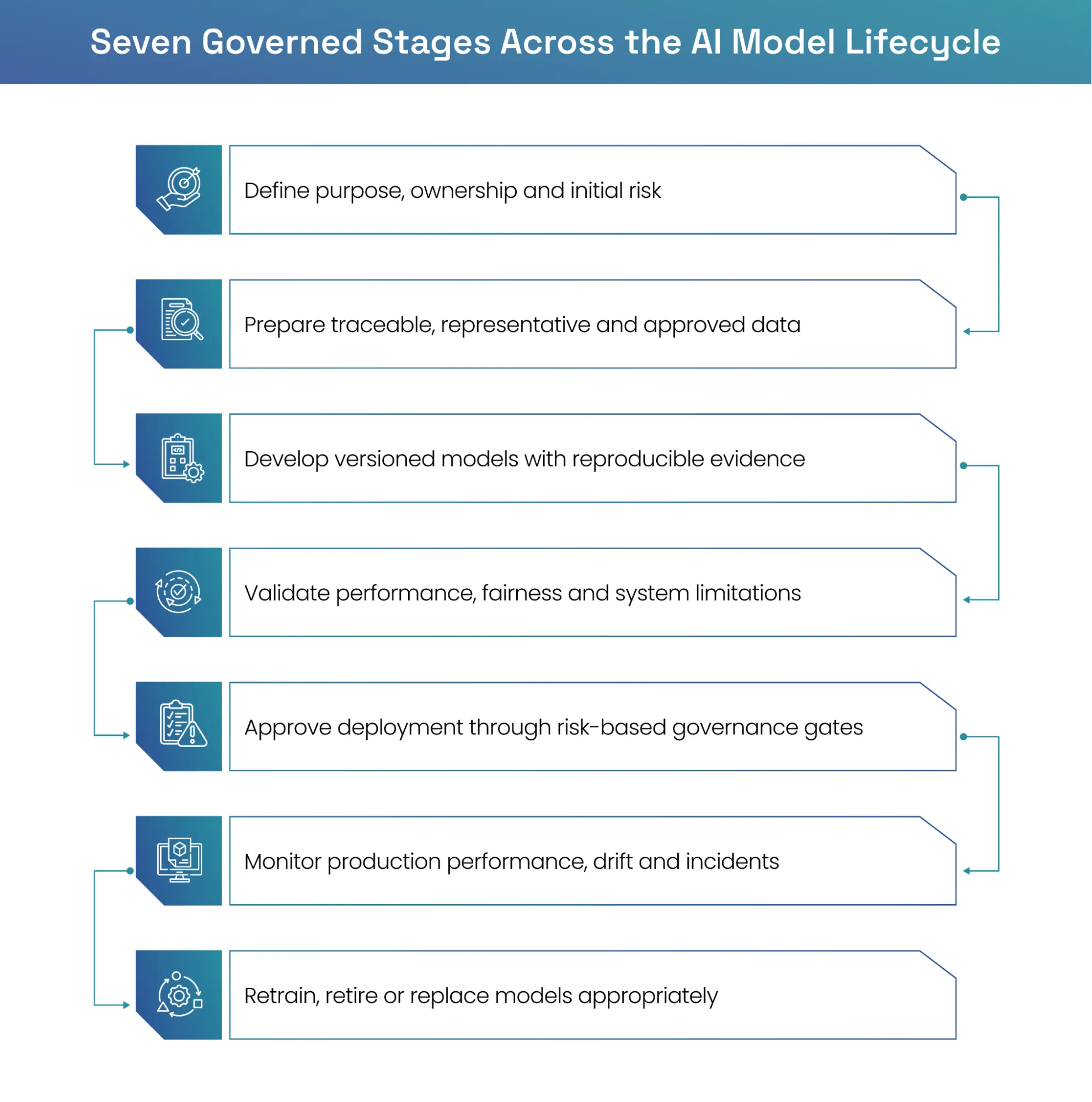
These seven stages also connect with the Solytics Partners operating model: Govern → Validate → Assure at Runtime → Monitor. Governance establishes approval requirements, validation challenges model behavior, and runtime assurance controls agent actions before execution. Monitoring then identifies changes that may require reassessment.
Where Do AI Model Lifecycle Programs Commonly Fail?
AI model lifecycle programs can develop weaknesses at transition points, especially when responsibility moves between teams. A model may enter production without a clearly assigned owner for the next activity. These gaps often become visible during incident investigations or periodic reviews.
- Ownership disappears during handoffs: A model may change ownership after development or validation. Teams can assume another function has accepted responsibility without confirming the handoff. Naming owners at every transition reduces this uncertainty and preserves accountability.
- Documentation starts too late: Teams often document decisions months after the original work. By then, key assumptions and rejected options are difficult to reconstruct. Documentation should come from current lifecycle activity, not from memory during an audit.
- Monitoring lacks baselines: Production alerts need approved thresholds before they carry any meaning. Without a baseline, dashboards become noise that teams stop reviewing. Each alert should have a responsible owner and defined response path. Escalation expectations should also reflect the severity of the underlying risk.
- Retirement remains undefined: Legacy models can keep running after the business use case has changed. Teams may stop supporting the model while the system continues to process production data. Formal retirement triggers help remove this quiet source of risk.
- GenAI sits outside the existing lifecycle: Prompts, RAG components, and agents need lifecycle evidence that older MRM workflows may not capture. Teams should extend the existing framework rather than create a separate process. GenAI guardrails can then support behavior-specific controls within the same lifecycle.
How Does AI Model Lifecycle Management Connect to Governance?
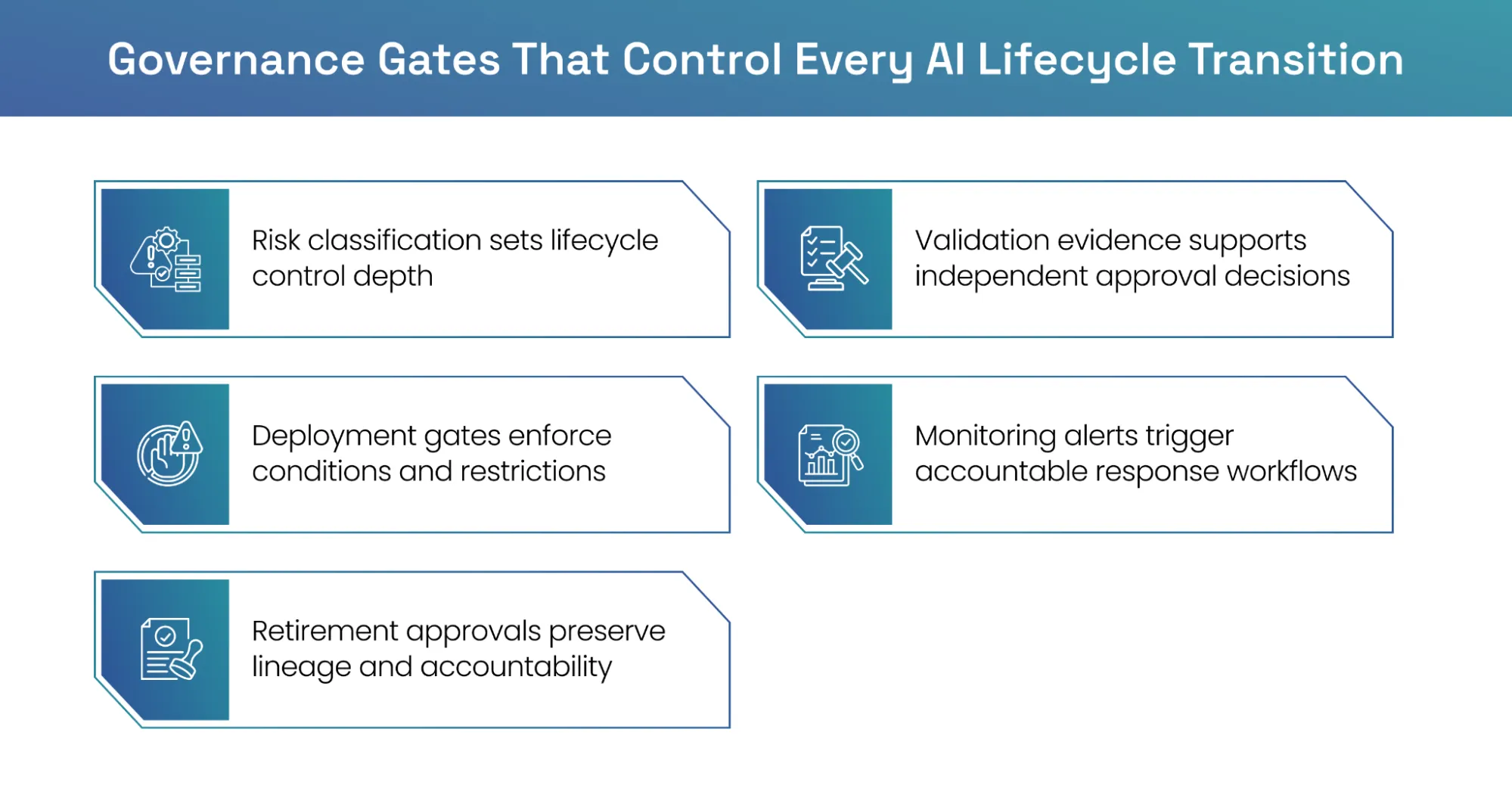
AI model lifecycle management AI model lifecycle management defines work at each stage, while governance defines decision rights and control requirements. Governance also sets evidence standards for approval and exception handling. These requirements extend to monitoring responses and retirement decisions.
Together, these disciplines connect technical activities with accountable decisions throughout the enterprise model lifecycle.
Model lifecycle governance works best at handoff points. A model should move forward only after owners have completed the required evidence and reviewers have approved the next step. AI governance and lifecycle evidence need to stay connected. Without evidence, policies are difficult to prove. Without governance, lifecycle activity can lose accountability.
What Features Should AI Model Lifecycle Management Tools Provide?
Effective tools should connect governance decisions with validation and production evidence. An appropriate AI solution should provide risk teams with access to current asset records and control status.
Tool selection should reflect existing data science systems and governance processes. Teams can compare AI risk management tools based on integration capabilities and evidence quality. Coverage across different model types also influences selection.
An effective platform should connect technical systems without replacing every engineering tool. It should show each model's performance and current control status.
For organizations evaluating enterprise controls, the Solytics Partners AI governance platform explains the relationship between governance workflows and runtime assurance.

How Does Solytics Partners Operationalize AI Model Lifecycle Management?
A model can pass validation and enter production, but governance responsibilities continue long after deployment. Teams still need to track changing performance, resolve emerging issues, and maintain evidence of decisions. Solytics Partners addresses these requirements by connecting lifecycle governance with technical validation and operational oversight.
The approach follows four connected activities, with each serving a different purpose in AI model lifecycle management.
Govern: Maintain Control Over Model Decisions
AI Vault helps organizations maintain a central record of AI assets throughout their lifecycle. It connects ownership records with risk assessments and approval workflows, allowing governance teams to identify pending decisions before models advance.
Validate: Challenge Models Before Deployment
NIMBUS Uno evaluates models against defined performance requirements, including accuracy and robustness. For use cases requiring additional independent challenge, MoDeVa supports explainability, bias testing, and fairness analysis. These capabilities help reviewers examine model limitations before approving production use.
Assure at Runtime: Keep Agent Actions Within Approved Boundaries
For autonomous agents, deployment introduces risks that conventional model validation cannot fully address. NIMBUS Uno checks proposed agent actions against policies before execution, allowing permitted actions while escalating or blocking those that exceed approved boundaries. High-impact decisions can require human review.
Monitor: Identify Changes That Require Action
Once systems enter production, NIMBUS Uno monitors performance and drift through its observability capabilities. Its 60+ metrics cover AI behavior across prompts, responses, retrievals, and tool calls. This evidence helps teams recognize when changing conditions require investigation or renewed validation.
The practical benefit comes from connecting each activity to the next. A monitoring alert can prompt a reassessment, while validation findings can inform subsequent approval decisions. AI Vault maintains the governance record, and NIMBUS Uno provides the technical evidence that supports ongoing oversight.
By connecting these activities, Solytics Partners helps organizations maintain accountability as models move through their lifecycle. This approach also reflects its recognized expertise in AI governance. Solytics Partners is a Category Leader in the Chartis RiskTech Quadrant® for AI Governance Solutions, 2025.
Book a demo with Solytics Partners to explore how connected governance and model monitoring support accountable AI lifecycle decisions.
Frequently Asked Questions
What Is AI Model Lifecycle Management?
AI model lifecycle management is a structured discipline that governs models from planning through retirement. It covers development and validation before production deployment, followed by monitoring and eventual retirement. Teams assign clear ownership and preserve evidence at each stage to support accountable model operations.
What Is Model Lifecycle Management?
Model lifecycle management applies structured processes from planning through retirement for analytical models used in business operations. It can include statistical and econometric models that do not rely on AI. The discipline maintains documented ownership and review processes, with retirement criteria appropriate to the model's purpose.
What Are Five Common Types of AI Models?
The five common types include classification, regression, clustering, generative, and reinforcement learning models. Each type carries different validation and monitoring requirements based on its outputs. Lifecycle controls should reflect the system's risk and intended use rather than relying on model type alone.
Why Is AI Model Lifecycle Management Important?
AI model lifecycle management preserves ownership and performance evidence throughout a model's operational life. It helps organizations identify deterioration and manage changes before problems become harder to resolve. Documented governance records can also support internal assurance and regulatory review where applicable.
What Is the Purpose of Lifecycle Management?
The purpose is to keep models useful, controlled, and traceable throughout their operational life. Consistent ownership and documented evidence help teams govern changes between lifecycle stages. Production monitoring provides additional information for corrective action. This structure supports both business continuity and regulatory examination.
What Is Included in AI Model Lifecycle Management?
AI model lifecycle management includes planning and data preparation, followed by model development and validation. It also covers deployment, monitoring, and retirement. Inventory and documentation serve as cross-lifecycle capabilities spanning every stage. Together, these elements form a connected record of technical activities and governance decisions.
How Does Lifecycle Management Support AI Risk Management?
Lifecycle management gives AI risk controls defined points of application throughout model operation. Classification guides control depth, while independent validation challenges assumptions before deployment. Monitoring identifies changes that require reassessment, and retirement procedures help remove obsolete or unacceptable risks.