Solytics Partners Secures a Trifecta of Wins at the Economic Times Enterprise AI Awards 2026


Enterprise AI governance sets the rules that AI systems must follow across development and production. AI assurance gives boards, risk teams, and auditors the evidence that those rules work in practice. Claims about fairness or reliability need supporting test results. Monitoring records and documented reviews help teams assess whether those claims remain valid.
An AI assurance framework gives teams a repeatable way to produce that evidence. It brings testing and evaluation into a process that continues after deployment. Monitoring results and oversight decisions are incorporated into the same evidence record, helping teams assess whether each AI model meets its approved requirements.
This blog explains what an AI assurance framework is, how it differs from governance and audit, and which practical pillars support its operation. It also covers assurance components and implementation steps, followed by the Solytics Partners approach.

What Is an AI Assurance Framework?
An AI assurance framework is a structured method for evaluating whether AI systems meet approved governance requirements and producing evidence of their performance. It connects policies with test results, monitoring signals, and human review records. Teams use it to assess AI behavior throughout the lifecycle.
The framework answers key questions for every AI system. Does the system perform reliably within its intended operating conditions? Are the identified risks adequately controlled? Can reviewers inspect evidence supporting those conclusions?
This evidence may include testing results, monitoring records, model documentation, and approval history. The framework also covers post-deployment assurance activities because system behavior can change. Model drift, new users or new data can change the risk profile after release.
AI assurance supports the responsible use of AI by providing governance teams with evidence rather than policy statements. The UK government describes AI assurance as the process of measuring, evaluating, and communicating the trustworthiness of AI systems.
Its guidance recognizes several assurance techniques, including impact assessments and performance testing. Organizations can select appropriate techniques according to system risks and the claims requiring verification.
How Does AI Assurance Differ from AI Governance and AI Audit?
The comparison between AI assurance vs governance comes down to rules and proof. Governance defines what AI systems must do and who is responsible for decisions. Assurance produces evidence, while audit provides an independent review of the relevant controls and supporting records.
The three disciplines work together inside an AI management system. Governance defines requirements, assurance evaluates whether they are being met, and audit provides an additional assessment of the supporting evidence. This structure helps organizations make AI controls reviewable across different contexts.
The connection also supports wider risk management and compliance work. The NIST AI RMF supports organizations in managing risks affecting individuals or organizations. Its Govern, Map, Measure, and Manage functions provide a voluntary structure for risk management activities.
What Are the Pillars of AI Assurance?
Solytics Partners' four-pillar view organizes AI assurance around trustworthiness testing and explainability. It also addresses accountable human oversight and continuous monitoring.
These pillars provide an enterprise operating structure rather than a universally prescribed assurance standard. Each produces different evidence that reviewers can use to evaluate AI behavior against approved requirements.
1. Trustworthiness Testing
Trustworthiness testing checks whether an AI system performs safely and fairly under expected and stressed conditions. Teams use relevant measures to evaluate accuracy and stability before approval. Fairness testing may also be necessary when system outputs affect individuals.
This pillar can include bias audits, safety checks, robustness testing and adversarial evaluation. For generative AI, teams may also test hallucination, grounding and prompt injection exposure. These tests create repeatable evidence that supports assurance practices.
The results should identify system limitations and unresolved findings rather than present a single score as proof of trustworthiness.
2. Transparency and Explainability
Transparency helps teams understand how the system produces outputs and why certain results appear. Explainability gives reviewers a way to inspect model behavior without relying on unsupported claims.
Evidence may include model cards, feature-importance outputs, lineage records, and decision explanations. Teams should match the depth of explanation to the system's intended purpose and risk profile. Different stakeholders may require different levels of technical detail.
For generative applications, source grounding and response traceability can support the review process when conventional feature explanations are insufficient.
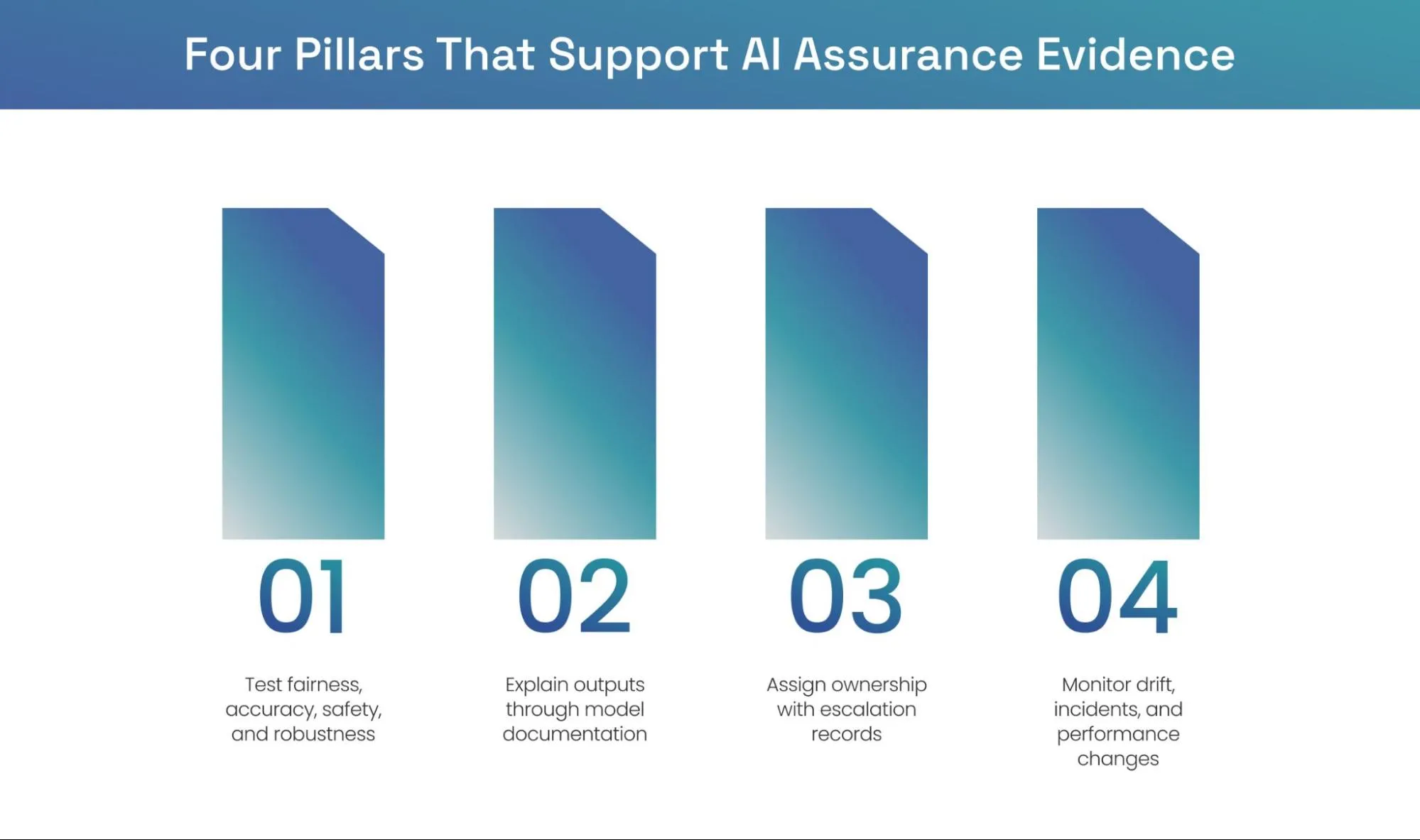
3. Accountability and Human Oversight
Accountability means teams know who owns the system, who approves changes, and who reviews exceptions. Human oversight becomes useful when reviewers have enough time, context, and authority to challenge outputs.
This pillar produces approval records, override rationales, escalation trails and reviewer logs. It also shows how governance teams handle exceptions during operations. Without these records, the organization may struggle to prove control over AI decisions.
For autonomous agents, human oversight should also work alongside runtime controls that intervene before consequential actions execute. The distinction is important because monitoring an action afterward cannot prevent a prohibited operation that has already occurred.
4. Continuous Monitoring and Evidence Generation
Continuous monitoring checks whether deployed systems continue operating within approved parameters. Monitoring can track drift and performance changes, while relevant applications may also require hallucination measurements or incident tracking.
This pillar connects assurance to current behavior rather than to old documentation. Testing shows whether the system met requirements at a stage of the AI lifecycle. Monitoring shows whether the same system still meets those requirements after conditions change.
A monitoring alert should trigger investigation when a predefined threshold is breached. Material changes may also require renewed validation before the organization accepts continued use.
Solytics Partners' AI model monitoring guide explains how operational monitoring supports ongoing assessment of production models. Together, these pillars show where assurance evidence should come from across the AI lifecycle.
What Are the Key Components of an AI Assurance Framework?
An AI assurance framework needs tools, metrics, testing workflows, and evidence records. These components turn assurance from a concept into repeatable work. They also help teams compare systems across portfolios.
- Self-assessment tools: Teams use templates and questionnaires during the design stage. These tools capture potential impacts and early control requirements. Information about data sources can help reviewers understand the intended system context.
- Evaluation metrics: Metrics translate trustworthiness goals into measurable targets. Teams may track accuracy, fairness thresholds, data quality, explainability coverage, and safety outcomes across the development process.
- Test and evaluation processes: Testing processes define when teams assess systems and which evidence they create. They may cover pre-release testing and independent validation, with reassessment procedures applying after material system changes.
- Red teaming and adversarial testing: Red teams examine how systems behave under misuse, abuse, and attack scenarios. They can identify unsafe outputs or policy weaknesses before deployment. For agentic systems, testing should also challenge unauthorized tool requests and the boundaries of execution.
- Compliance evidence generation: Evidence records bring together the results of control reviews and approval decisions. Relevant logs help teams explain how they investigated exceptions or addressed identified risks. This component supports audit readiness and traceability across governance workflows.
- Assurance case management: An assurance case organizes the requirements being assessed and the evidence supporting each conclusion. It should also identify unresolved concerns that require further review. This gives reviewers a consistent basis for evaluating a specific system.
These components should remain connected to the same governed asset. Otherwise, reviewers may spend additional time reconciling separate records before evaluating assurance findings.
How Do You Build an AI Assurance Framework?
Enterprises build an AI assurance framework by defining requirements, setting measures, testing systems, and monitoring production behavior. Each step creates records that support the next step.
Step 1: Define Assurance Requirements Per AI System
Teams should map each system to the governance requirements that apply to its purpose and risk level. A fraud model, chatbot, or credit tool may require different evidence of fairness, safety, and explainability.
The requirement set should reflect the use of AI, business outcome and stakeholder exposure. It should also reflect applicable industry standards, internal policy and external rules. This step gives assurance teams a clear target before testing starts.
Organizations should distinguish legally required controls from additional measures adopted through internal governance policies. This prevents assurance documentation from presenting voluntary practices as mandatory regulatory obligations.
Step 2: Establish Evaluation Metrics and Thresholds
Every requirement needs a measurable threshold that reviewers can test and compare over time. Accuracy, fairness, safety, and explainability targets should reflect the system's purpose and exposure.
Thresholds help teams convert expectations into reviewable outcomes. They also support AI risk management by showing when a system moves outside approved limits. This helps assurance teams evaluate results with less subjective judgment.
Thresholds should include defined response requirements when results fall outside acceptable limits. The appropriate action may involve investigation or additional validation, depending on the issue.
Step 3: Deploy Testing and Evaluation Infrastructure
Teams should bring testing into development, validation, and release workflows. This includes explainability tools, fairness tests, adversarial checks, and evaluation pipelines for relevant systems.
Testing infrastructure makes the AI assurance process repeatable across teams and business units. It also reduces dependency on manual review during release. Strong infrastructure helps teams connect test records to subsequent audit and monitoring evidence.
For autonomous systems, the testing environment should also examine whether runtime policies correctly restrict prohibited actions. A model passing output-quality checks does not demonstrate that an agent can safely operate connected tools.
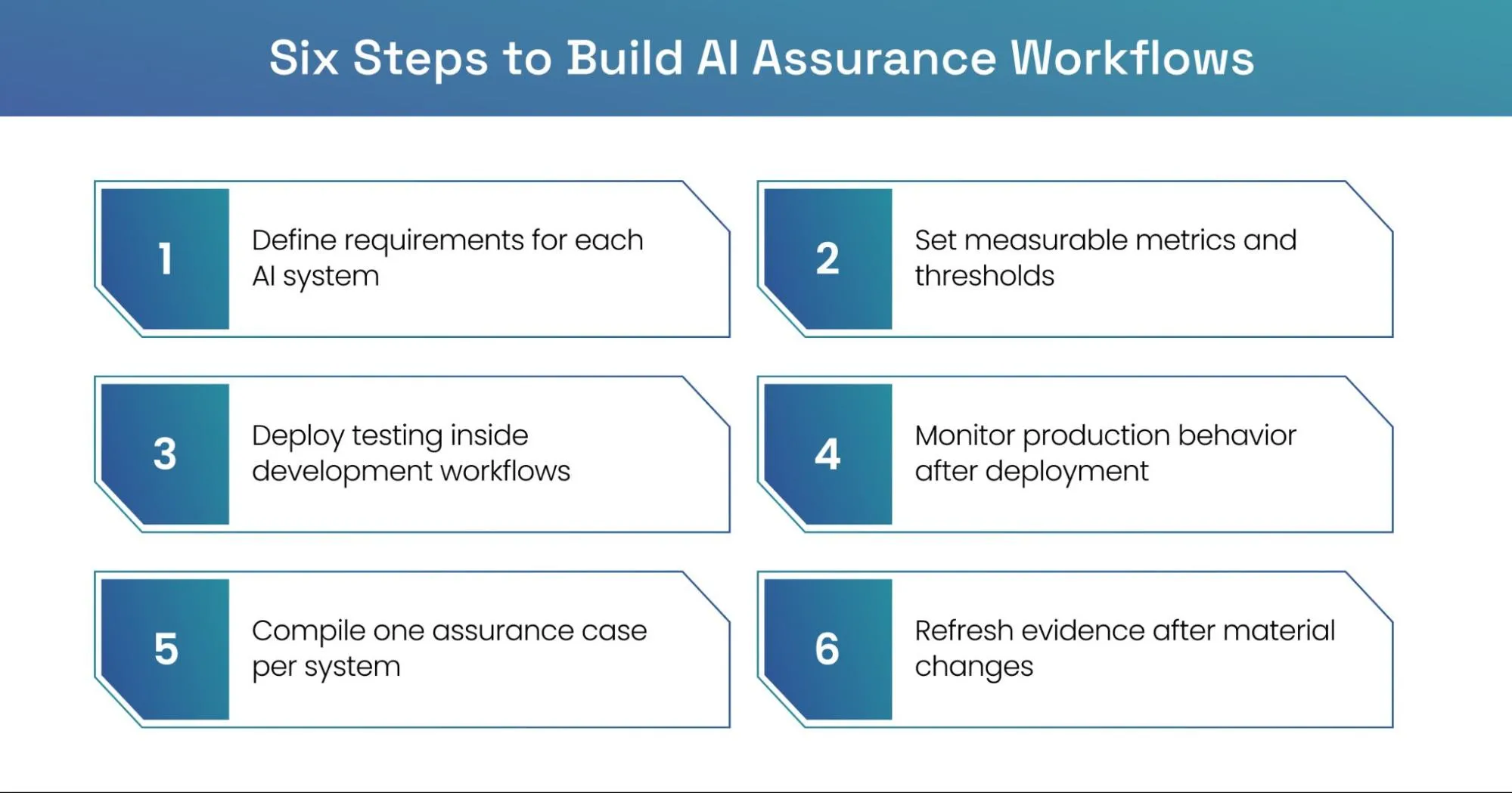
Step 4: Instrument Continuous Monitoring
Initial approval does not guarantee stable production behavior. Teams should monitor AI outputs, data shifts, incidents, overrides, and user feedback after deployment.
Monitoring should capture evidence relevant to the system's approved purpose. For traditional models, this may include performance deterioration or changes in data distributions. Generative applications may require additional measures of response quality or grounding.
Where personal data is involved, monitoring arrangements should also respect applicable data protection requirements. Under GDPR Article 35, a data protection impact assessment is required when processing is likely to result in a high risk to individuals' rights and freedoms.
The monitoring approach should link relevant findings with the responsible owner and an appropriate escalation process.
Step 5: Compile the Assurance Case Per System
The assurance case brings together requirements, test results, monitoring records and human oversight logs. It provides reviewers with a single package that explains how teams evaluated the system.
A strong assurance case also includes unresolved issues, control ownership and approval history. This package helps reviewers inspect evidence without having to reconstruct decisions from disconnected records. It can also support reassessment following operational incidents.
An assurance case should distinguish evidence supporting a requirement from findings that remain unresolved. This makes the resulting conclusion more useful for subsequent approval decisions.
Step 6: Refresh Evidence on Defined Triggers
Teams should refresh evidence when systems change or new risks appear. Triggers may include retraining or new training data. Expanded deployment and material incidents can also justify reassessment.
This step keeps assurance aligned with current AI behavior. It also supports mature AI programs that update controls as AI technology changes. Static evidence loses value when systems evolve across the lifecycle.
Teams should record the reassessment outcome and determine whether existing approvals remain valid. Significant changes may require further testing before continued operation is authorized.

What Are the Benefits of an AI Assurance Framework?
An AI assurance framework helps enterprises evaluate whether governance controls work as intended. It improves review readiness, incident response and evidence quality. It also helps teams connect AI control work with business priorities.
- Regulatory readiness: Assurance evidence helps teams respond to regulators, auditors and internal review committees. The EU AI Act establishes requirements for applicable high-risk systems, including specified conformity assessment procedures. Under the amended schedule, Annex III high-risk obligations apply from December 2, 2027, while Annex I embedded-system obligations apply from August 2, 2028.
- Faster incident response: Monitoring evidence helps teams detect drift, bias regression and safety issues earlier. Teams can route incidents to owners faster when logs and escalation paths already exist.
- Stronger stakeholder confidence: Customers, boards and procurement teams often ask how organizations control AI systems. Assurance evidence provides them with a documented basis for evaluating test outcomes and current system behavior.
- Lower audit preparation effort: Teams spend less time assembling documents when evidence already sits in a governed record. This can reduce rework before audits and internal reviews.
- Better business alignment: Assurance connects technical checks with business value and business outcomes. Teams can see whether the AI solution still supports the approved purpose.
These benefits depend on the quality of the underlying controls and records. An assurance framework cannot compensate for incomplete testing or governance decisions that lack supporting evidence.
Which Frameworks and Techniques Support AI Assurance?
An AI assurance framework works best when teams combine relevant governance guidance with applicable regulatory requirements. This helps ensure evidence remains useful for internal reviewers and affected stakeholders throughout the AI lifecycle.
- NIST AI RMF: The National Institute of Standards and Technology created this voluntary framework for organizations that design, develop, deploy, or use AI systems. Its Govern, Map, Measure and Manage functions help assurance teams decide what evidence each system needs.
- ISO/IEC 42001: ISO/IEC 42001 defines requirements for establishing, implementing, maintaining and improving an AI management system. Assurance teams can use it to align governance structures, policies, improvement cycles and control evidence during reviews.
- UK AI assurance techniques: The UK government identifies impact assessments and performance testing as techniques for evaluating AI trustworthiness. Its guidance also covers assurance activities such as compliance audits and bias assessments. Teams can select the techniques appropriate to their systems.
- Sector and ethics guidance: Enterprises should include AI ethics principles, human rights, cybersecurity, data protection, and sector-specific rules. These references help teams assess concerns that may not be captured through technical performance metrics alone.
Enterprises should avoid assuming that following a voluntary framework automatically establishes regulatory compliance. Each applicable legal requirement needs separate assessment and supporting evidence.
How Does Solytics Partners Deliver AI Assurance?
An AI system may perform well during validation but behave differently once operating conditions change. This makes ongoing assurance important for enterprises managing large AI portfolios. Solytics Partners addresses this through AI Vault and NIMBUS Uno, connecting governance decisions with technical evidence so teams can assess whether approved controls remain effective.
The process begins with AI Vault, which maintains AI asset inventories and records risk classifications. Its configurable workflows support policy approvals while keeping governance evidence accessible for subsequent reviews. Once these requirements are established, NIMBUS Uno evaluates model accuracy and robustness, helping teams identify limitations before production deployment.
However, validation alone cannot control how autonomous agents behave during execution. NIMBUS Uno addresses this through runtime assurance, checking proposed actions against approved policies before they proceed. Each action is allowed, escalated or blocked, with human review available for higher-impact decisions. Step-level traces preserve evidence of these enforcement outcomes for investigation.
This evidence becomes particularly useful after deployment, when changing system behavior can introduce new risks. NIMBUS Uno monitors production activity using more than 60 metrics, helping teams identify issues that require reassessment. AI Vault maintains the related governance records, supporting continued oversight. Solytics Partners is a Category Leader in the Chartis RiskTech Quadrant® for AI Governance Solutions, 2025.
Final Remarks
An AI assurance framework helps enterprises evaluate whether AI governance requirements are being met in practice. It connects defined requirements with testing evidence and subsequent monitoring results.
Strong assurance programs do more than create a report before launch. They keep evidence current as models change, new data arrives, and operating conditions shift. This can help organizations investigate emerging risks before weaknesses become more difficult to address.
Solytics Partners connects governance records with technical assurance through AI Vault and NIMBUS Uno. Book a demo to explore how continuous assurance can support accountable AI operations.
Frequently Asked Questions
What is an AI assurance framework?
An AI assurance framework is a structured process for evaluating whether AI systems meet approved governance requirements. It integrates testing, monitoring, reporting and human review records into a single evidence workflow. Enterprises use it to assess whether systems remain reliable and adequately controlled after deployment.
What are best practices for AI assurance?
Best practices include defined requirements, measurable thresholds, human oversight and continuous monitoring after deployment. Teams should also refresh assurance evidence after incidents, retraining and material system changes. For autonomous agents, runtime controls should enforce policy boundaries before consequential actions execute.
What processes are included in AI assurance?
AI assurance includes risk review, testing, evaluation, monitoring, evidence collection, and updates to assurance cases. Some programs also include red teaming, bias audits, model documentation, and approval tracking. The appropriate processes depend on the system's risk and intended use.
What are the most common AI frameworks?
Common AI frameworks include NIST AI RMF, ISO/IEC 42001, and the EU AI Act. They do not serve the same purpose, since one guides risk management, another defines management-system requirements, and the third establishes legal obligations for systems within its scope. Enterprises often combine them when designing assurance programs.