Solytics Partners Secures a Trifecta of Wins at the Economic Times Enterprise AI Awards 2026


Many enterprises already use AI across customer service, fraud detection, analytics and back-office decision support. Yet ownership, control evidence and approval records often remain scattered across teams. That creates gaps when auditors ask how the organization governs AI systems.
The ISO 42001 AI management system provides enterprises with a formal structure for that work. It is the world’s first international standard for an artificial intelligence management system and supports responsible development, use and oversight of AI systems. ISO says the standard specifies requirements for establishing, implementing, maintaining and improving an Artificial Intelligence Management System (AIMS).
This blog explains the standard, its clauses, Annex A controls, ISO 27001 comparison and certification process. It also examines how Solytics Partners helps enterprises connect control evidence with operational governance workflows.

What Is the ISO 42001 AI Management System Standard?
The ISO/IEC 42001 AI management system standard defines how enterprises manage AI through documented processes and controls. It applies to organizations that provide, develop, or use AI systems. This standard provides governance teams with a structure for oversight throughout the AI system lifecycle.
The ISO 42001 AI management system standard was developed by the International Organization for Standardization and the International Electrotechnical Commission. IEC describes ISO/IEC 42001:2023 as requirements and guidance for establishing, maintaining, and improving an AI management system. It applies within the context of an organization, so implementation depends on the scope and use of AI.
The standard applies within an organization's specific context. Its implementation, therefore, depends on the AI activities included within the defined management system's scope. This management system standard helps enterprises define policies, roles, risk treatment, and documented information for AI. It covers AI technology across internal tools, external AI services, and third-party components. The structure also supports alignment with existing management systems.
ISO 42001 follows the management-system pattern familiar from ISO 27001 and ISO 9001. Enterprises that already run information security management systems or quality management systems can extend existing governance structures. This may reduce duplicated processes when implementing the AI-specific requirements.
For further context, the Solytics Partners AI governance guide explains how organizations establish ownership and maintain evidence of governance throughout the lifecycle.
Why Does ISO 42001 Matter for Enterprises in 2026?
The ISO/IEC 42001 AI management system gives enterprises a structured approach to managing AI responsibilities as adoption increases. It connects defined policies with operational evidence and continual improvement. This helps organizations respond to procurement, audit, and regulatory scrutiny.
- Procurement teams want evidence: Vendor questionnaires now ask how companies manage AI systems. ISO 42001 provides service and platform providers with a recognized way to demonstrate governance maturity.
- Regulatory alignment becomes easier: ISO 42001 artificial intelligence management system does not replace legal review under the EU AI Act. It can still help teams organize evidence for regulatory requirements, global regulations, and internal AI compliance efforts.
- Independent review has value: Certification involves an independent third party that reviews the management system scope and evidence. That external review can support stakeholder expectations during procurement and oversight discussions.
- Existing programs can integrate it: ISO 27001 supports information security, while ISO 42001 covers AI management. Together, they can integrate cybersecurity compliance, data protection and AI governance into a single operating view.
- AI teams need repeatable controls: Mature programs cannot rely on slides or scattered records. ISO 42001 supports responsible AI practices through policies, owners, risk treatment and continuous improvement.
An ISO 42001 AI management system becomes particularly useful as organizations introduce applications beyond their original AI portfolio. New generative AI tools may require different controls from traditional prediction models.
Third-party services can introduce additional dependencies, making ownership and risk assessment more important. Organizations should update their management system when such changes affect its approved scope or operating controls.
What Are the 10 Clauses of ISO 42001?
| Clause | Focus Area | What It Requires | Why It Matters for Enterprises |
|---|---|---|---|
| Clause 1 | Scope | Defines the purpose and coverage of the AI management system standard. | Helps teams understand where the standard applies inside the organization. |
| Clause 2 | Normative references | Identifies any referenced documents required to apply the standard. | Gives teams the reference base for interpreting ISO 42001 requirements. |
| Clause 3 | Terms and definitions | Defines key terms used across the AI management system standard. | Creates common language across AI, risk, legal and compliance teams. |
| Clause 4 | Context of the organization | Defines AIMS scope, stakeholders, external context and internal context. | Helps teams set boundaries before designing controls and audit evidence. |
| Clause 5 | 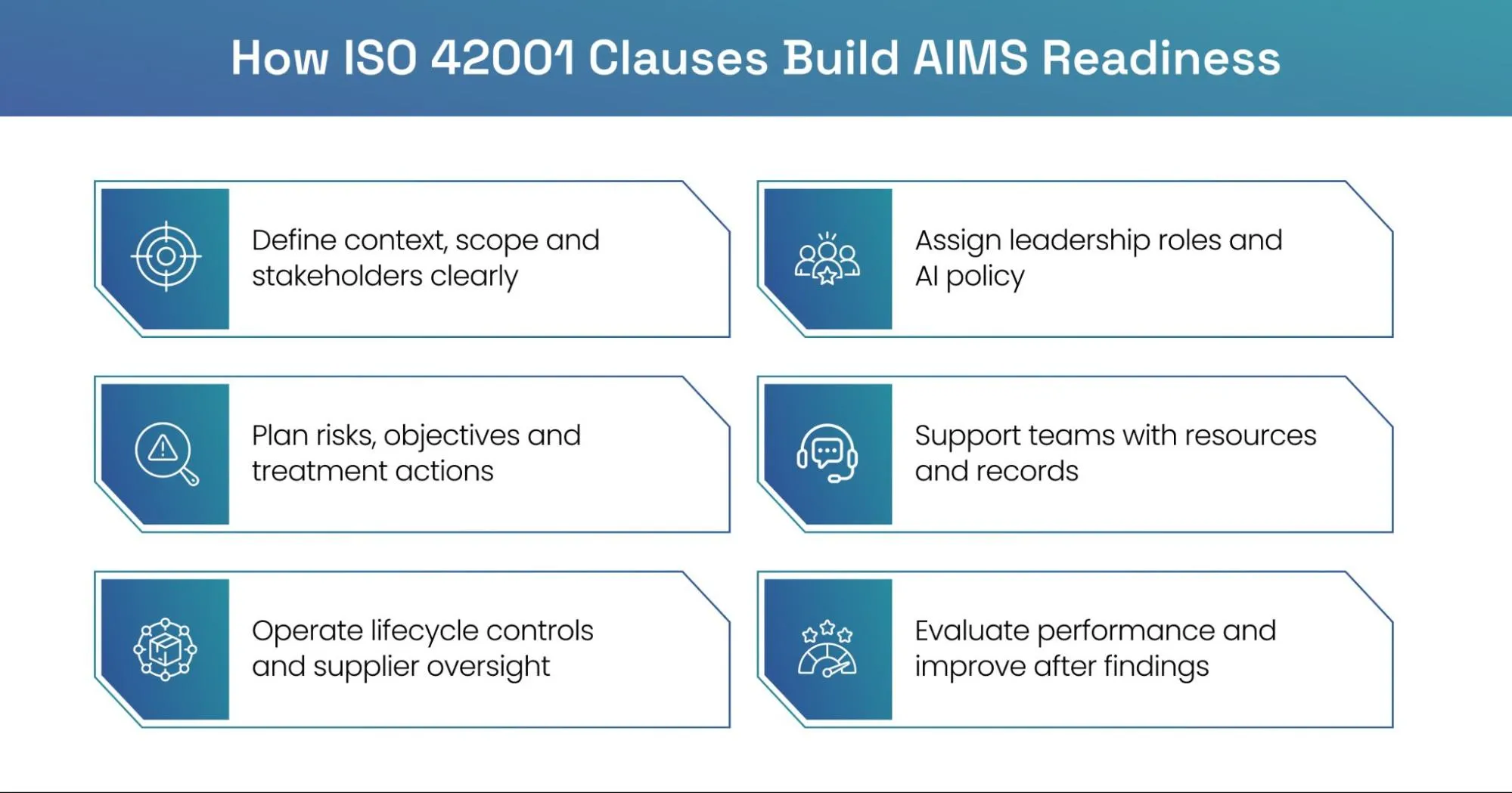 What Are the 38 Annex A Controls?Annex A turns the ISO/IEC 42001 AI management system from broad requirements into specific control areas. It includes 38 controls across nine groups, but organizations should not treat every control as automatic. Teams select controls through risk treatment, then document why each selected control fits the AIMS scope.
Once teams select Annex A controls, they still need a way to track evidence of control across portfolios. The Solytics Partners analysis of leading AI risk management tools explores how technology can support inventory management and risk assessment workflows. 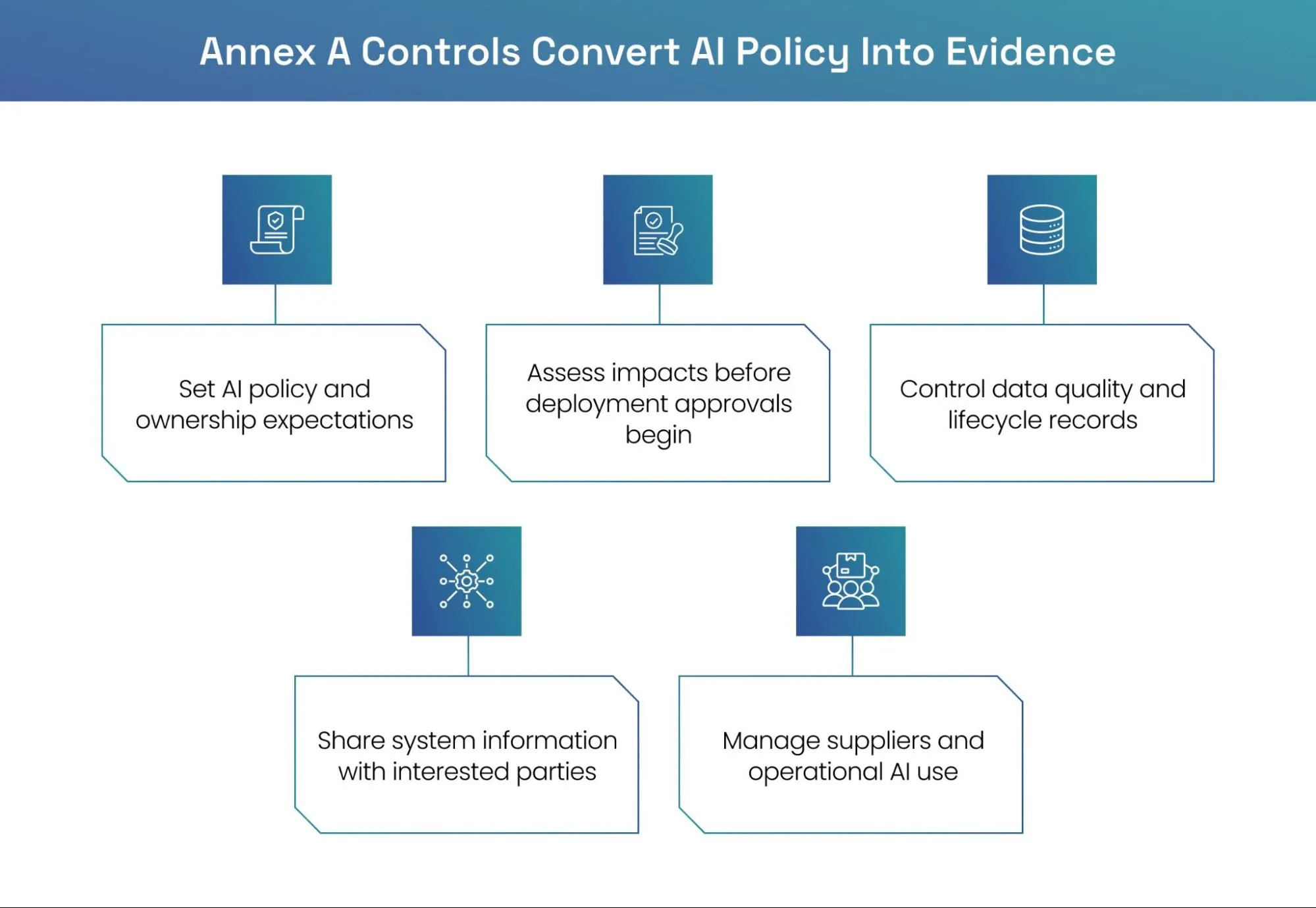 How Does ISO 42001 Differ From ISO 27001?ISO 27001 governs information security management, while ISO 42001 governs AI management. Both standards use a management-system structure but address different risks, teams, and evidence requirements. ISO 27001 can provide the security foundation for the ISO 42001 AI management system. It already supports access management, incident handling, zero-trust planning, and security governance. ISO 42001 then adds AI-specific controls around lifecycle, impact, and monitoring. This distinction becomes useful when enterprises integrate AI governance with security programs. A chatbot may need data access and incident controls. A credit model may need risk assessment, independent validation, monitoring evidence, and approval records. Teams should avoid treating security evidence as a substitute for model governance evidence. ISO 27001 can support the security baseline, while ISO 42001 adds AI lifecycle and impact controls. For regulated models, the Solytics Partners model risk management guide explains the role of independent validation and ongoing model oversight.  How Does the ISO 42001 Certification Process Work?ISO/IEC 42001 certification involves an independent assessment of an organization's defined AI management system scope. Certification bodies evaluate whether the management system meets the standard's requirements and operates effectively. ISO/IEC 42006:2025 establishes additional requirements for the bodies performing these audits. It supplements ISO/IEC 17021-1 and supports consistent assessment of AI management systems. Organizations seeking accredited certification should verify the certification body's accreditation status and the scope of its approval. ISO itself does not issue management system certificates.
Timelines depend on enterprise size, scope and documentation maturity. Organizations should confirm the certification schedule and accreditation arrangements with their selected certification body before committing to external deadlines. How Does Solytics Partners Enable ISO 42001 Compliance?ISO 42001 AI management system implementation involves more than collecting documents for a certification audit. Organizations must maintain evidence that governance processes remain active as AI systems change. Solytics Partners supports this work through AI Vault and NIMBUS Uno. These platforms connect governance decisions with technical evaluation, helping teams maintain relevant evidence throughout the AI lifecycle. Connect AIMS Governance Requirements With AI VaultAI Vault maintains an inventory of enterprise AI assets and their ownership records. It supports risk assessments and materiality scoring, while configurable workflows help teams route governance approvals. The platform also maps controls to internal policies and relevant regulatory frameworks. These functions can support evidence management activities associated with ISO/IEC 42001, particularly when teams need to document governance decisions and demonstrate ownership of controls. Support Validation and Monitoring With NIMBUS UnoA documented governance process still needs technical evidence showing how AI systems perform. NIMBUS Uno supports model evaluation before deployment, including assessments of accuracy and robustness. Once systems operate in production, its observability capabilities monitor AI behavior across prompts and responses. More than 60 metrics support the investigation of drift and other performance risks. For autonomous agents, runtime assurance evaluates proposed actions before execution. The platform allows, escalates or blocks actions under applicable policies, helping enterprises connect operational behavior with approved control boundaries. Maintain Evidence Beyond Initial ImplementationThese capabilities support an ongoing governance process rather than a one-time certification exercise. AI Vault maintains decision records, while NIMBUS Uno provides technical evidence that can inform future control reviews. This follows the Solytics Partners approach of Govern → Validate → Assure at Runtime → Monitor, connecting documented governance requirements with actual operating behavior. Solytics Partners supports organizations in aligning their governance processes with ISO/IEC 42001. This does not constitute certification, guarantee conformity or establish that Solytics Partners itself holds an ISO/IEC 42001 certificate. Book a demo with Solytics Partners to explore how connected governance and monitoring can support your organization's AI management system. Frequently Asked QuestionsWhat is the ISO/IEC 42001 standard?ISO/IEC 42001 is an international AI management system standard for organizations that develop, provide, or use AI systems. It defines how teams establish, implement, maintain, and improve AI governance processes. Enterprises use it to structure policies, controls, risk treatment, and review evidence. What is the primary purpose of ISO/IEC 42001?The primary purpose of ISO/IEC 42001 is to help organizations manage AI responsibly and consistently. It supports governance, risk treatment, lifecycle controls, and continual improvement. The standard provides teams with a structured way to document AI management and to prepare evidence for certification. What is the ISO 42001 AI management system standard?The ISO 42001 AI management system standard defines requirements for managing AI systems across an organization. It covers policies, roles, planning, operations, performance evaluation, and improvement. The standard helps enterprises make AI governance a repeatable management practice. How is ISO 42001 different from other ISO standards?ISO 42001 focuses on AI systems, while ISO 27001 focuses on information security. ISO 9001 focuses on quality management and customer requirements. ISO 42001 adds AI-specific governance, lifecycle controls, impact assessment, and monitoring evidence for organizations using AI. What is the role of ISO/IEC 42001 in AI governance?ISO/IEC 42001 provides AI governance with a formal management-system structure, including defined responsibilities and evidence of control. It supports policies, risk treatment, lifecycle management, monitoring and improvement. This helps boards, risk teams and auditors review AI governance through documented records. Does ISO 42001 apply to all types of AI?ISO 42001 can apply to organizations that develop, provide, or use AI systems across many industries. The certification scope depends on the organization’s AI activities, business context, and management system boundaries. It does not mean that every use of AI automatically requires certification. How to comply with ISO 42001?Enterprises can establish conformity by defining their AIMS scope and implementing the applicable requirements. They must conduct appropriate risk assessments and select relevant controls through risk treatment. They also need policies, documented responsibilities, internal audits, management reviews and improvement records. Accredited certification requires assessment by a suitably accredited certification body. Blogs Solytics Partners can help you transform & future-proof your business Save time and money with with our suite of accelerated services and advanced analytics solutions  Stay ahead of the curve in an evolving market, technology, and regulatory landscape  Leverage our domain knowledge, advanced analytics and cutting edge tech to build your enterprise Talk to an expert Oops! Something went wrong while submitting the form. |