Solytics Partners Secures a Trifecta of Wins at the Economic Times Enterprise AI Awards 2026


Enterprises often run AI risk reviews without a shared method behind them. Teams document findings, yet auditors still ask how they identify, analyze, treat, and monitor risks across AI systems. That gap grows once models influence regulated decisions or customer-facing workflows.
ISO/IEC 23894 AI risk management provides guidance that organizations can use to structure these activities. ISO/IEC 23894:2023 applies to enterprises that develop, produce, deploy or use AI-enabled products, systems and services. It connects familiar risk management language with AI-specific concerns such as bias, privacy, reliability and oversight.
ISO 23894 builds on ISO 31000 and adapts its principles for AI system risk processes. Teams can use the guidance to identify risks and evaluate their potential consequences. It also supports decisions about treatment and subsequent monitoring.
This process can help organizations maintain evidence relevant to ISO/IEC 42001 requirements. However, following ISO 23894 does not automatically establish conformity with a certifiable AI management system standard.
The sections ahead cover ISO/IEC 23894 AI risk management process stages, common AI risk sources, its relationship to NIST AI RMF, and how Solytics Partners supports the corresponding governance activities.

What Is ISO/IEC 23894?
The ISO/IEC 23894 AI risk management standard provides enterprises with practical guidance for managing risks across AI systems. It adapts the ISO 31000 risk principles to AI-related concerns, providing teams with a familiar method for structured review. With this base, risk teams can define consistent steps for identification, analysis, treatment, and review.
The standard provides guidance rather than certification requirements, so teams should treat it as a method reference. It differs from ISO 42001, which sets requirements for AI management systems. This distinction helps teams use each standard in the right place during audit preparation.
ISO and the International Electrotechnical Commission publish the standard under "Information technology — Artificial intelligence — Guidance on risk management." Its scope covers enterprises that develop, produce, deploy or use AI-enabled systems and services. This makes the standard relevant for financial services, healthcare, public services and autonomous system programs.
ISO 23894 supports artificial intelligence risk management by providing repeatable logic and reviewable records. It helps organizations connect established risk processes with concerns arising from AI design and operation. This structure becomes useful before teams prepare evidence for audits or certification readiness.
The official ISO/IEC 23894:2023 publication confirms that organizations can adapt the guidance to their specific context.
Why Does ISO/IEC 23894 Matter for AI Risk Programs?
The ISO/IEC 23894 AI risk management standard provides teams with a shared approach to assessing risks and selecting suitable treatments. It creates common language for evidence, escalation, treatment, and monitoring as AI enters critical business workflows.
- ISO 42001 process support: ISO 42001 requires organizations to manage AI risks inside an AI management system. ISO 23894 can support the design of risk identification and evaluation procedures. Organizations can then determine how the resulting evidence fits their AIMS requirements.
- Familiar risk language: ISO 31000 provides risk teams with a well-defined structure for organizational risk work. ISO 23894 adapts that structure for AI risk management, where data, automation, and model behavior change review needs.
- International evidence alignment: The standard provides a common reference for organizations operating across jurisdictions to structure AI risk documentation. This can support more consistent internal reviews without replacing jurisdiction-specific legal obligations.
- AI-specific risk review: AI can create privacy breaches, unfair outcomes, reliability issues, and other potential negative impacts. ISO 23894 helps teams examine these concerns before deployment and during operation.
- Regulatory work support: The EU AI Act requires risk management systems for high-risk AI systems under Article 9. ISO 23894 can inform related risk assessment practices, but its use does not independently establish compliance with Article 9.
After teams define the risk method, they need systems to store risk records across the portfolio. The Solytics Partners analysis of leading AI risk management tools provides additional context on connecting assessments with governance records.
How Does ISO 23894 Relate to ISO 31000 and ISO 42001?
These standards address related responsibilities but serve different purposes. ISO 31000 provides risk teams with a broad framework for identifying, analyzing, evaluating, and treating enterprise risk. ISO 23894 applies that method to AI-specific risks, while ISO/IEC 42001 establishes requirements for operating an AI management system.
Enterprises often use all three standards because they solve different problems:
- ISO 31000 provides general risk management principles.
- ISO 23894 adapts those principles to AI systems.
- ISO 42001 defines the management-system requirements for organizational AI governance.
This combination helps enterprises coordinate risk treatment with their broader management processes. It also gives model owners and validation teams a shared basis for discussing risk decisions.
However, organizations should distinguish using ISO/IEC 23894 as a reference from demonstrating conformity with ISO/IEC 42001. The latter requires evidence that the applicable AIMS requirements have been implemented. Solytics Partners’ AI governance work follows the same need for connected ownership and evidence.
What Are the Risk Management Principles in ISO 23894?
ISO/IEC 23894 AI risk management draws on the principles of ISO 31000 for addressing artificial intelligence systems. These principles shape process design and help organizations account for uncertainty while improving existing practices.
- Integrated: AI risk work should sit inside business activities, not outside them. Teams should connect the organization's risk management processes with model development, deployment, and monitoring workflows.
- Structured and comprehensive: A consistent process helps teams compare various risks across different AI use cases. This supports consistent decision-making when portfolios expand across business units or regions.
- Customized: Each organization should adapt the process to its purpose, sector, and control environment. The resulting methodology should reflect the organization's governance structure and acceptable risk levels.
- Inclusive: Teams should involve relevant stakeholders before accepting or treating AI risk. Clear communication helps business owners understand decisions and gives validators the context needed for independent review.
- Dynamic: AI risks can change as data, users, or operating conditions change. This principle helps teams respond to emerging threats and changes in model behavior.
- Best information available: Teams should use current evidence while recognizing uncertainty and data limits. This matters because AI systems can create unintended consequences after deployment.
- Human and cultural factors: Human judgment and organizational incentives can affect risk decisions. Teams should provide appropriate training, so reviewers understand system limitations and their control responsibilities.
- Continual improvement: The risk process should learn from incidents, findings, and monitoring results. This improvement process supports ongoing learning as teams face novel risks.
These core principles keep AI risk work practical and repeatable. They also show why traditional risk management frameworks need AI-specific interpretation.
What Are the Stages of the ISO 23894 Risk Process?
The ISO/IEC 23894 AI risk management process provides teams with a clear path for AI risk management. It starts with scope, context, and criteria, then moves into risk identification, analysis, evaluation, and treatment. The same process also requires monitoring, review, and communication throughout the AI system lifecycle.
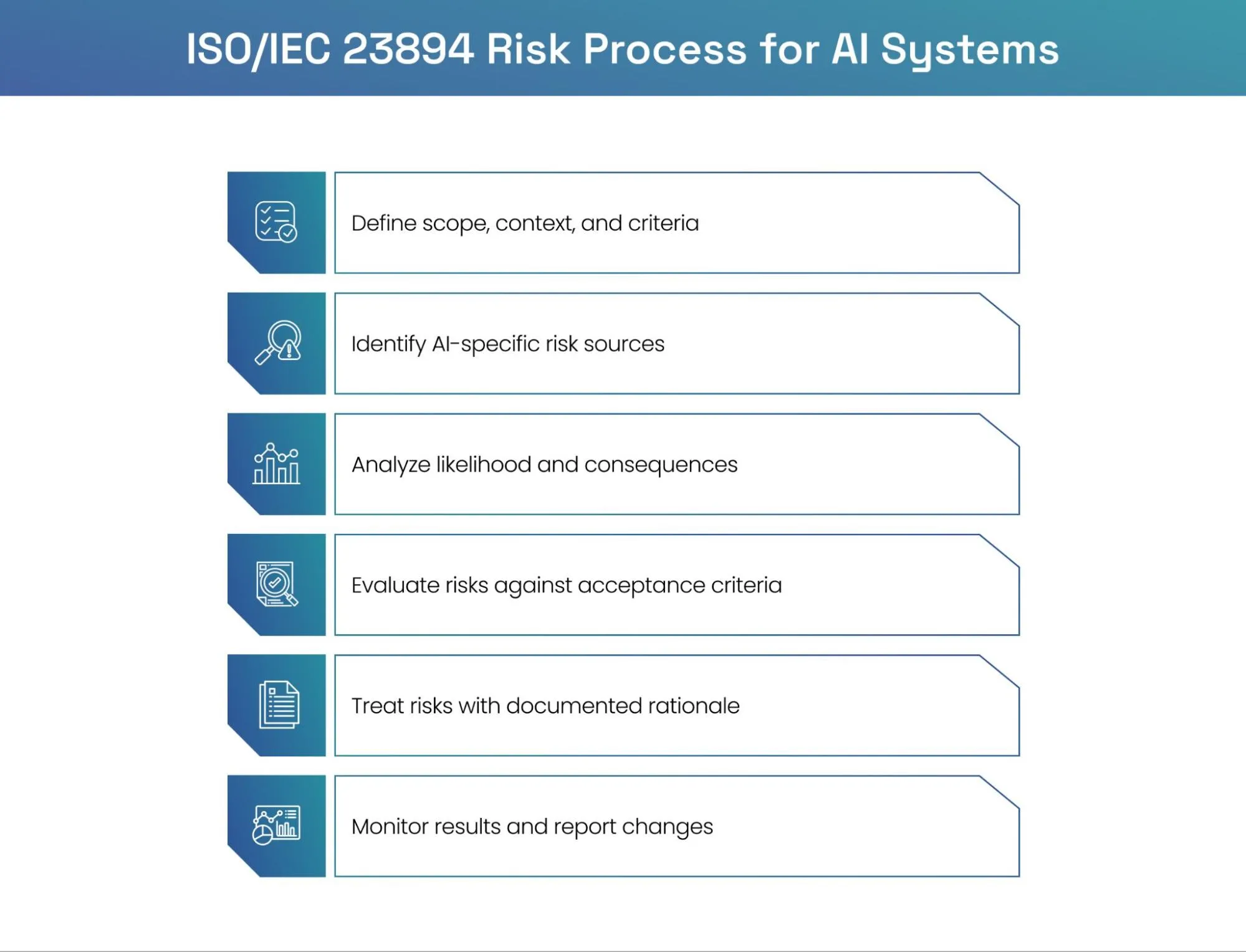
- Scope, context and criteria: Teams define system boundaries, users, data flows and business purpose. This first step also sets acceptable risk criteria for the AI system life cycle.
- Risk identification: Teams identify risk sources, affected parties and possible failure paths. The review should capture relevant sources of potential harm before teams estimate their consequences.
- Risk analysis: Teams estimate the likelihood, consequences, and uncertainty of identified AI risks. This helps them understand whether critical business functions face unacceptable exposure or weak controls.
- Risk evaluation: Teams compare the analyzed exposure with the agreed-upon risk criteria. This helps decision-makers decide which issues need treatment, escalation, monitoring, or acceptance.
- Risk treatment: Teams select risk treatment strategies and document why each one fits the system. Treatment may include control changes, deployment limits, risk mitigation steps, or stronger human review.
- Monitoring and review: Teams track key risk indicators, incidents, drift, and control performance after deployment. This keeps risk management systems connected to current behavior rather than older design assumptions.
- Communication and reporting: Teams keep relevant stakeholders informed during every stage. This provides evidence for oversight, audit review, and regulatory inquiries throughout the entire AI system lifecycle.
Each stage should create records that reviewers can inspect later. Scope records explain boundaries and stakeholders, while analysis records show how teams judged exposure. Treatment records then connect risks with mitigation strategies, control owners, and follow-up actions.
Communication should continue throughout the risk process rather than operate as an isolated final stage. Monitoring findings can also return the system to earlier assessment activities when its exposure changes.

What AI-Specific Risk Sources Does ISO 23894 Identify?
ISO 23894 helps teams examine AI-specific risk sources across data, models, automation, and infrastructure. These sources can appear during development or production. Teams should review them across the lifecycle.
- Complexity and opacity: Some systems can make outputs difficult to explain or verify. This complicates risk assessment when reviewers cannot establish how an AI system reached a consequential decision.
- Data quality and provenance: Weak data lineage can affect performance, fairness, and accountability. Reviewers should examine whether the available training records support the intended use and whether data limitations introduce material risks.
- System reliability: AI systems can behave differently across environments, users and data changes. Testing should reflect the operating conditions in which the system will be used, including foreseeable changes.
- Machine learning behavior: Machine learning models can drift, overfit or respond poorly to new conditions. These risks often require monitoring throughout the lifecycle.
- Generative AI exposure: Generative systems introduce hallucination and grounding concerns. Prompt injection and misuse can create additional risks requiring targeted evaluation after deployment.
- Infrastructure and security: Infrastructure gaps can affect availability, resilience and model behavior. Teams should review access, dependency mapping and security paths for AI-enabled workflows.
- Automation level: Greater autonomy can allow systems to execute consequential actions without routine human approval. Organizations should assess whether intervention controls are appropriate for the system's authority and operating risk.
- Environmental and operational impact: Large AI workloads can affect cost, energy use and operational capacity. Teams should include these factors when risk decisions affect enterprise planning.
Risk sources define what teams examine during review. Frameworks then help teams organize that review into repeatable practices. The Solytics Partners guide to AI model monitoring explains why production evidence remains important after validation.
How Does ISO 23894 Compare to the NIST AI RMF?
ISO 23894 and NIST AI RMF both support AI risk management. They use different structures but can inform the same organization's governance approach. Enterprises can combine both standards when they need international documentation and operating functions.
Here is a comparative analysis of these risk management standards:
NIST AI RMF gives enterprises another way to organize AI risk work. NIST describes it as voluntary guidance for organizations that design, develop, deploy, or use AI systems. Its Govern, Map, Measure, and Manage functions help teams turn risk review into operating activities.
This is where ISO 23894 and NIST AI RMF can work together. ISO 23894 provides teams with a clear risk management process, while NIST AI RMF helps structure day-to-day governance activities. Both can support AI governance when teams map evidence across frameworks.
For regulated teams, that evidence often needs to extend into model ownership, validation, and monitoring. Solytics’ model risk management analysis explains how model governance connects risk evidence with oversight, issue tracking, and ongoing review.
What Are the Key Components of ISO 23894 Implementation?
Implementation of the ISO/IEC 23894 AI risk management standard needs governance, process design, evidence management and monitoring discipline. These components make the guidance operational and help teams avoid fragmented risk records.
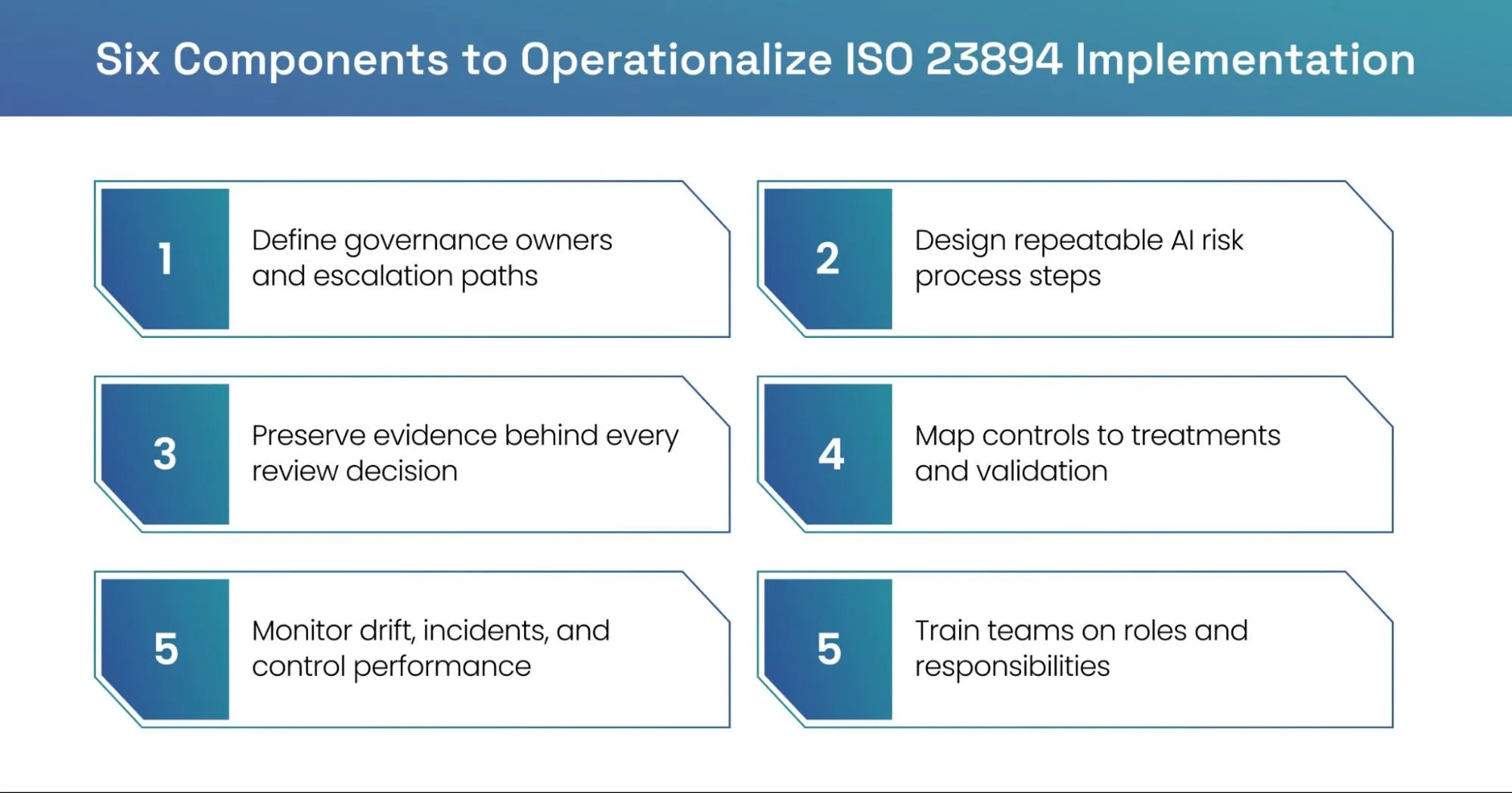
- Governance structure: Teams need owners, committees, escalation paths and review responsibilities. These arrangements help connect existing organizational risk processes with decisions concerning AI systems.
- Risk process design: The process should define scope, criteria, identification, analysis, treatment and monitoring. This gives teams a repeatable methodology that can be adapted to different AI applications.
- Evidence model: Teams need records showing who reviewed the system and what evidence supported the decisions. This prevents last-minute evidence gathering before audits or regulatory reviews.
- Control mapping: Teams should map treatments to policies, validation results, and monitoring signals. This helps reviewers determine whether selected measures address the risks identified during assessment.
- Monitoring layer: Teams need current signals for drift, incidents, model behavior, and control performance. These signals help teams review treatment effectiveness after deployment.
- Training and awareness: Personnel should understand the organization's risk process and their specific responsibilities. Training can help reviewers recognize limitations that affect the quality of their decisions.
These key components help teams move from ISO 23894 guidance to daily risk work. They also address the implementation challenges by linking each requirement with owners, evidence, and review actions.
The next step is to embed that process within a workflow that keeps risk records, validation outputs, and monitoring signals connected.
How Does Solytics Partners Operationalize ISO 23894?
Risk management guidance becomes useful when assessment findings influence what organizations approve and how systems operate afterward. A risk treatment recorded during development should remain available to reviewers after deployment. Solytics Partners connects these activities through AI Vault and NIMBUS Uno, helping teams maintain oversight as risk conditions change.
AI Vault provides the governance foundation by registering AI assets and their owners. Its workflows support risk tiering and approval decisions, while evidence trails retain the rationale behind governance activities. These capabilities can help organizations structure records relevant to ISO/IEC 23894 without implying that the standard prescribes a particular technology platform.
Once risks are assessed, NIMBUS Uno contributes evidence through technical evaluation and model validation. It supports accuracy testing and robustness assessment, with additional capabilities for relevant bias or safety risks. NIMBUS AI Mate can help generate model documentation from available technical evidence, supporting more consistent records for review.
Monitoring then helps teams determine whether accepted risk assumptions remain appropriate. NIMBUS Uno tracks production behavior through more than 60 metrics, including relevant drift and performance signals. AI Vault retains the associated governance information, allowing findings to inform further review. This connects risk assessment with ongoing control evaluation across the AI lifecycle.
Organizations should treat framework mapping as a support for risk management rather than proof of regulatory conformity. ISO 23894 can inform processes relevant to ISO 42001 and the EU AI Act, but it does not, on its own, establish compliance.
Solytics Partners is a Category Leader in the Chartis RiskTech Quadrant® for AI Governance Solutions, 2025.
Book a demo with Solytics Partners to explore how connected governance and model monitoring can strengthen enterprise AI risk management.
Frequently Asked Questions
What is the ISO standard for AI risk management?
ISO/IEC 23894 is the ISO standard that gives AI-specific risk management guidance. It applies to organizations developing or using AI-enabled systems and services. Enterprises use it to shape AI risk management strategies across development, deployment and monitoring. The guidance can be adapted to the organization's context.
What is the new ISO standard for AI?
ISO/IEC 42001 defines a certifiable AI management system, while ISO/IEC 23894 guides AI risk management. Together, they help teams move from policy intent to structured evidence. Organizations should choose the relevant standard according to whether they need management-system requirements or guidance for risk assessment activities.
What is the difference between ISO 23894 and ISO 42001?
ISO 23894 guides AI risk management methodology, while ISO 42001 defines a certifiable AI management system. ISO 23894 helps teams build risk management processes that support the requirements of ISO 42001. The two standards work together, but they do not serve the same purpose.
Is ISO/IEC 23894 a certifiable standard?
ISO/IEC 23894 provides guidance rather than certification requirements for organizations. It does not establish a scheme for certifying an organization's AI risk management system. Individual training certificates do not change that distinction. ISO/IEC 42001 separately specifies the requirements against which an AI management system can be certified.
How does ISO/IEC 23894 support ISO 42001 readiness?
ISO 42001 expects organizations to manage AI risks within the AI management system. ISO 23894 provides guidance for identifying risks and analyzing their potential consequences. It also helps teams plan treatments and review their effectiveness. This creates clearer evidence for auditors during readiness reviews.
How does ISO/IEC 23894 compare with the NIST AI RMF?
ISO/IEC 23894 follows ISO-style risk process stages for AI risk work. NIST AI RMF organizes activities through Govern, Map, Measure, and Manage functions. ISO 23894 also extends traditional risk management approaches toward AI-specific evidence, monitoring, and review needs.