Solytics Partners Secures a Trifecta of Wins at the Economic Times Enterprise AI Awards 2026


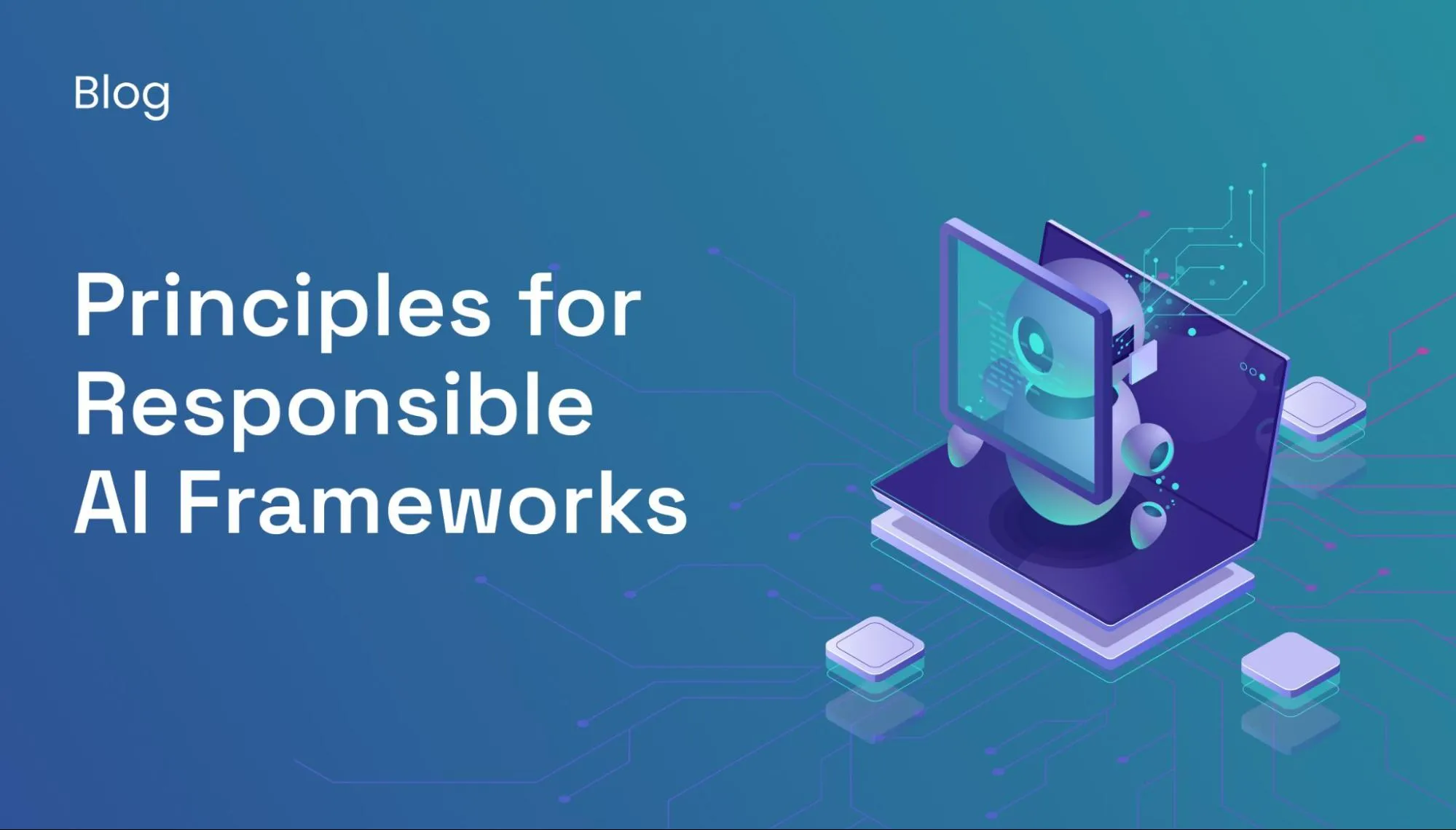
AI systems now influence credit approvals, healthcare triage, hiring shortlists, and fraud detection at enterprise scale. When teams deploy them without clear controls, small design gaps can quickly affect many people. A biased credit model may reject qualified applicants, while a hallucinating assistant may distort clinical review queues.
These risks become harder to manage when algorithms produce outputs that reviewers cannot explain. Business leaders need more than ethical statements or committee approvals. They need named owners and measurable controls that establish accountability. Supporting evidence should show how teams assess fairness and respond when model behavior creates potential harm.
A responsible AI framework turns those expectations into AI governance practices that teams can audit and defend. This article explains seven core principles and the controls organizations can use to implement them. It also examines relevant regulatory frameworks and practical implementation requirements.

What is a Responsible AI Framework?
A responsible AI framework is a structured set of principles, policies and controls that guide how enterprises build and use AI. It translates ethical AI practices into measurable operational actions across the model lifecycle. The framework connects fairness and transparency requirements with named owners, measurable controls and documented evidence.
The framework sits between enterprise principles and day-to-day engineering decisions, especially where model risk management already governs validation and monitoring. It gives engineering teams defined thresholds and review requirements for applying responsible AI principles during development. These requirements continue through validation and deployment.
Enterprises often confuse AI ethics, AI governance, and responsible AI frameworks even though each plays a distinct role. AI ethics defines the values that guide decisions, while AI governance establishes ownership and decision authority. A responsible AI framework translates both into controls that organizations can measure and verify.
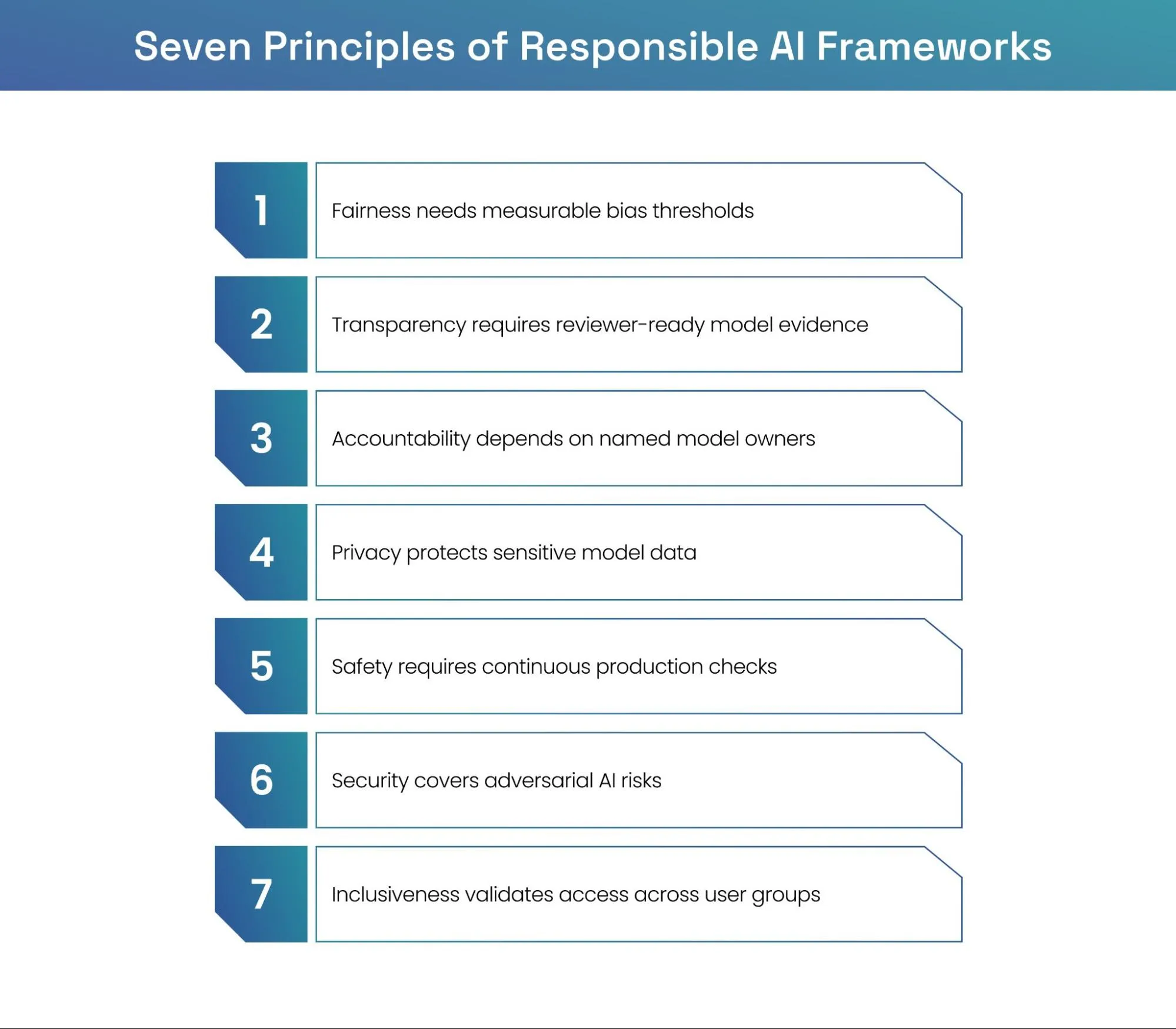
What Are the 7 Key Principles of a Responsible AI Framework?
The seven principles create a practical operating model for responsible AI across enterprise programs. Each principle should have measurable requirements and a named owner responsible for demonstrating compliance with internal policies. This shifts the framework from abstract principles into measurable best practices that teams can execute.
1. Fairness and non-discrimination
AI systems should avoid discriminatory outcomes across protected groups and affected user segments during scoring and ranking. Fairness requires bias testing during development and disparity measurements across relevant population groups. Representative training data helps teams assess whether models perform consistently across their intended users.
For a credit scoring model, fairness means measuring approval rates and default predictions across different groups. Reviewers should document acceptable disparity thresholds and investigate material differences before deployment. They must also record unresolved limitations and any necessary remediation measures.
Teams should repeat fairness testing after retraining or significant changes to features. Shifts in the affected population may also require reassessment.
2. Transparency and interpretability
Stakeholders should be able to understand what the AI system is meant to do, how it produces outputs, and where its limits are. They should also be able to trace the evidence behind important decisions.
Teams can make this practical through model cards, dataset documentation, explainability reports, and reviewer-friendly decision notes. These records help validators understand system behavior and identify limitations that may affect business decisions.
EU AI Act Article 13 establishes transparency requirements for high-risk AI systems, including information that enables deployers to interpret outputs and use the system appropriately. Organizations should distinguish these obligations from the separate transparency and documentation requirements that apply to general-purpose AI models.
For systems that use foundation models, documentation may also need to explain subsequent fine-tuning and known limitations. The scope depends on the organization's role and applicable regulatory obligations.
3. Accountability and human oversight
Named people should own AI outcomes across development, validation, monitoring, and retirement through a clear three lines of defense structure. Accountability requires model owners, risk committees, approval workflows, and defined oversight controls that reviewers can trigger during production incidents.
EU AI Act Article 14 introduces human oversight requirements for high-risk AI systems, including the ability to intervene or halt operations. Shared committee ownership rarely replaces named accountability when incidents demand fast decisions from a single owner.
Enterprises should define who can approve consequential actions and who can stop unsafe system behavior. They should also record interventions so reviewers can reconstruct decisions during later investigations.
4. Privacy and data protection
AI systems should protect personal and sensitive data through access controls, data minimization, consent handling, and lineage tracking. Privacy controls should detect unauthorized disclosure of sensitive information, including personal identifiers or protected business data.
Data lineage should trace inputs from the source system through the algorithm to the model output. Organizations should also document how they retain data and determine which personnel can access it.
Healthcare AI deployments that handle diagnostic recommendations must comply with applicable laws such as HIPAA and GDPR where those laws apply. Financial services teams apply similar controls to customer data flowing through fraud and credit ML models.
The responsible AI framework should connect these privacy obligations with operational controls rather than treating data protection as a separate compliance activity.
5. Safety and reliability
AI systems should perform as expected under normal and stressed operating conditions across their intended use cases. Safety controls can include validation and drift monitoring, supported by incident response procedures. Generative applications may also require hallucination testing and defined fallback measures.
The NIST AI RMF classifies validity and reliability as core characteristics of trustworthy AI.
Production monitoring serves as the practical bridge between safety principles and daily operational evidence. Teams compare observed performance with approved thresholds and investigate deviations. Material breaches may trigger corrective action, retraining, or rollback depending on the operating risk.
6. Security and resilience
AI systems should resist adversarial attacks, prompt injection, data poisoning and unauthorized access to model weights or training pipelines. Security controls should include adversarial testing and appropriate access restrictions. Organizations should also establish recovery procedures for incidents affecting production systems.
EU AI Act Article 15 covers accuracy, robustness and cybersecurity for high-risk AI systems. Generative AI introduces new attack surfaces through prompt manipulation and grounding failures inside retrieval pipelines. Enterprises should extend their existing cybersecurity practices to cover model-specific threats and usage patterns.
The responsible AI framework should also establish how teams report security incidents and identify the personnel authorized to intervene.
7. Inclusiveness and accessibility
AI systems should work across diverse populations, languages, abilities and operating contexts served by the enterprise. Inclusiveness requires testing with representative user groups and accessibility checks that reflect the system's intended operating environment.
Teams should verify that users with disabilities can interact with relevant AI features through accessible interfaces and supported assistive technologies. Testing should address barriers that aggregate performance scores may conceal.
Focus on whether the system serves all intended users without excluding groups from benefits or support pathways. Coverage gaps often surface only through targeted testing across underrepresented segments.
How Do Leading Organizations Apply These Principles?
Leading technology companies use different labels, but their published approaches address overlapping concerns around responsible AI development and governance. Reviewing peer frameworks helps enterprises benchmark their own approach without adopting other companies' terminology. The exercise clarifies which principles carry sector-specific weight.
The comparison below reflects the official frameworks published by each organization.
Google updated its AI Principles on February 4, 2025, replacing the earlier seven-principle structure with three overarching principles. Its current approach addresses responsible development alongside innovation and collaboration.
Microsoft continues to organize its approach around six responsible AI principles, supported by internal governance requirements. Cisco also identifies six principles within its Responsible AI Framework, while IBM uses five pillars of trustworthy AI.
These frameworks demonstrate that organizations can group similar responsibilities under different structures. Enterprises should evaluate how each approach translates principles into practical controls before adopting its terminology.
How Does a Responsible AI Framework Connect to Regulation?
A responsible AI framework can support mapping to relevant laws and voluntary standards, helping organizations identify overlapping governance requirements. This mapping can reduce duplicate documentation when teams address obligations through existing controls. However, alignment with a framework does not establish legal compliance without evidence that the applicable requirements are met.
The following references provide useful starting points:
- EU AI Act: High-risk system requirements address risk management and data governance. They also cover transparency, human oversight and other technical obligations. Organizations should map applicable controls to the relevant provisions rather than treating every AI system as high-risk. Following the 2026 amendments, obligations for standalone Annex III high-risk systems apply from December 2, 2027. The corresponding date for Annex I embedded high-risk systems is August 2, 2028.
- NIST AI RMF: The National Institute of Standards and Technology provides a voluntary framework for managing AI risks throughout the lifecycle. Its Govern, Map, Measure, and Manage functions help organizations structure risk activities and assess trustworthy AI characteristics.
- ISO/IEC 42001: This AI management system standard establishes requirements for policies and organizational responsibilities. It also addresses risk management and continual improvement. Organizations can use it to develop a certifiable management system that is subject to conformity assessment requirements.
- OECD AI Principles: The OECD AI Principles provide values-based guidance for trustworthy artificial intelligence. They address inclusive growth, respect for human rights, and transparency and accountability. The OECD's official list of adherents identifies the governments and institutions committed to these principles.
The OECD's 2025 government AI report lists 48 countries and the European Union as adherents. Because published OECD pages use different reporting bases, the official adherent list should remain the reference for future updates.
A responsible AI framework can help teams map a single governance control to multiple requirements. However, reviewers must still verify each obligation against its governing legal text or standard.

How do You Operationalize a Responsible AI Framework?
Operationalization means assigning measurable controls and clear ownership to every principle within a responsible AI framework. Supporting evidence should demonstrate how teams apply those controls during development and operation.
Each step should produce audit-ready output that engineers, validators and reviewers can trace.
- Define each principle in operational terms: Fairness requires measurable testing thresholds, while transparency depends on accessible documentation. Accountability requires named owners who can explain decisions and initiate corrective action. Convert each principle into evidence that reviewers can assess during validation.
- Map principles to applicable regulations: Map controls against relevant provisions of the EU AI Act and other applicable requirements. NIST AI RMF and ISO/IEC 42001 provide additional reference structures. A control can support several requirements when the organization documents the corresponding evidence.
- Embed controls into AI lifecycle workflows: Integrate governance checks into development and release processes rather than relying on disconnected reviews. Risk-based approval gates can prevent deployment when required testing remains incomplete. Teams should preserve the associated documentation for subsequent audit.
- Track responsible AI metrics continuously: Monitor fairness and safety indicators alongside model performance. Explainability evidence and human oversight records can help reviewers understand operational decisions. Combine this information with drift monitoring for traditional models and generative applications.
- Refresh the framework regularly: Update controls when regulatory requirements change or organizations introduce new AI applications. Significant model changes may also trigger a review. Establish a defined reassessment process that assigns responsibility for updating the governance framework.
A responsible AI framework becomes more useful when teams connect these activities to existing risk management processes. This allows governance requirements to influence operational decisions before issues reach production.
What are Common Mistakes in Responsible AI Programs?
Responsible AI programs can develop gaps when organizations publish principles without integrating them into everyday operations. The most common issues involve weak measurement and unclear accountability. Recognizing these mistakes early helps enterprises strengthen their governance approach.
- Principles without metrics: Fairness statements need measurable criteria that support objective review. Transparency requirements also need evidence that reviewers can inspect. Without defined measures, teams cannot determine whether the intended control operates effectively.
- Framework published and never operationalized: A documented framework does not establish governance maturity unless teams apply its requirements. Organizations should connect policies with testing procedures and approval decisions. Auditors need evidence that controls operated during the relevant period.
- Fairness tested once and assumed stable: Bias can change when input data or population characteristics shift. Teams should reassess fairness after significant retraining or model changes. Monitoring helps identify emerging disparities that require investigation.
- Accountability shared across committees: Committees can establish policy direction, but operational decisions still require clear ownership. Named model owners should address incidents and respond to monitoring findings. Defined escalation routes help prevent delays when corrective action becomes necessary.
- GenAI treated as traditional machine learning: Generative AI introduces risks involving hallucinations and prompt injection. Retrieval-grounding failures can create additional concerns. Organizations should extend their GenAI observability practices to assess these risks during production use.
Addressing these issues helps enterprises move from published principles toward a responsible AI framework supported by repeatable evidence.
How Does Solytics Partners Enable Responsible AI?
Solytics Partners supports responsible AI through AI Vault and NIMBUS Uno, connecting enterprise governance with technical assurance. AI Vault manages governance processes, while NIMBUS Uno supports evaluation and monitoring across AI systems.
These platforms help organizations translate framework principles into controls that teams can apply in both development and production.
AI Vault: Governance and Accountability
AI Vault provides a centralized inventory for AI systems and their ownership records. It supports risk assessments and tiering through configurable workflows.
The platform also supports policy mapping and approval management, while maintaining evidence trails for governance decisions. These capabilities help organizations connect accountable ownership with documented oversight activities.
NIMBUS Uno: Validation and Continuous Assurance
NIMBUS Uno evaluates AI systems against defined performance and safety requirements. Its capabilities cover accuracy testing and robustness evaluation, along with checks for bias or hallucination risks.
The platform also supports observability across prompts and responses. Retrieval activity and tool calls form part of its monitoring coverage, supported by more than 60 metrics.
For autonomous agents, runtime governance checks actions before execution and then allows, escalates, or blocks them according to applicable policies. High-impact actions can require human review, while step-level traces preserve evidence of the enforcement decision.
Connected Responsible AI Governance
AI Vault maintains governance records, while NIMBUS Uno provides validation results and evidence of runtime monitoring. Together, the platforms support a responsible AI framework that connects documented requirements with operational behavior.
This approach follows the Solytics Partners model of Govern → Validate → Assure at Runtime → Monitor. It helps organizations maintain oversight as AI systems move from development into production.
Solytics Partners is a Category Leader in the Chartis RiskTech Quadrant® for AI Governance Solutions, 2025.
Book a demo with Solytics Partners to explore how connected AI governance and continuous assurance can strengthen your responsible AI program.
FAQs
What is a responsible AI framework?
A responsible AI framework defines principles and operational controls that guide responsible AI development across an organization. It covers fairness, transparency, accountability, privacy, and safety through measurable requirements. The framework connects these expectations with evidence that engineering and risk teams can review during the AI lifecycle.
What are the pillars of a responsible AI framework?
The seven principles in this enterprise framework cover fairness, transparency, accountability, privacy, safety, security and inclusiveness. Enterprises should convert each pillar into controls with named owners and measurable requirements. This turns principle statements into governance practices that reviewers can verify.
What is the framework for responsible AI?
A responsible AI framework connects ethical expectations with governance decisions and technical controls. It defines how principles translate into daily engineering and risk decisions. The framework also establishes evidence requirements that support ongoing review across the AI lifecycle.
What are the key principles of responsible AI?
Key principles across enterprise AI systems include fairness, transparency, accountability, privacy, safety, security and inclusiveness. Leading frameworks may use different labels for similar underlying ideas and controls. Organizations should select measurable requirements that reflect their intended AI use cases and associated risks.
What are the key components of a responsible AI framework?
A responsible AI framework includes governance policies and risk classification processes. Model documentation and validation support technical assurance, while monitoring provides ongoing evidence. Each component should have clear ownership and measurable expectations. Together, these elements connect system behavior with accountable governance decisions.
What are the top AI frameworks?
Recognized AI governance references include NIST AI RMF and ISO/IEC 42001. The OECD AI Principles and EU AI Act provide additional guidance or legal requirements within their respective scopes. Organizations should select relevant references according to their operating environment and regulatory obligations.