Solytics Partners Secures a Trifecta of Wins at the Economic Times Enterprise AI Awards 2026


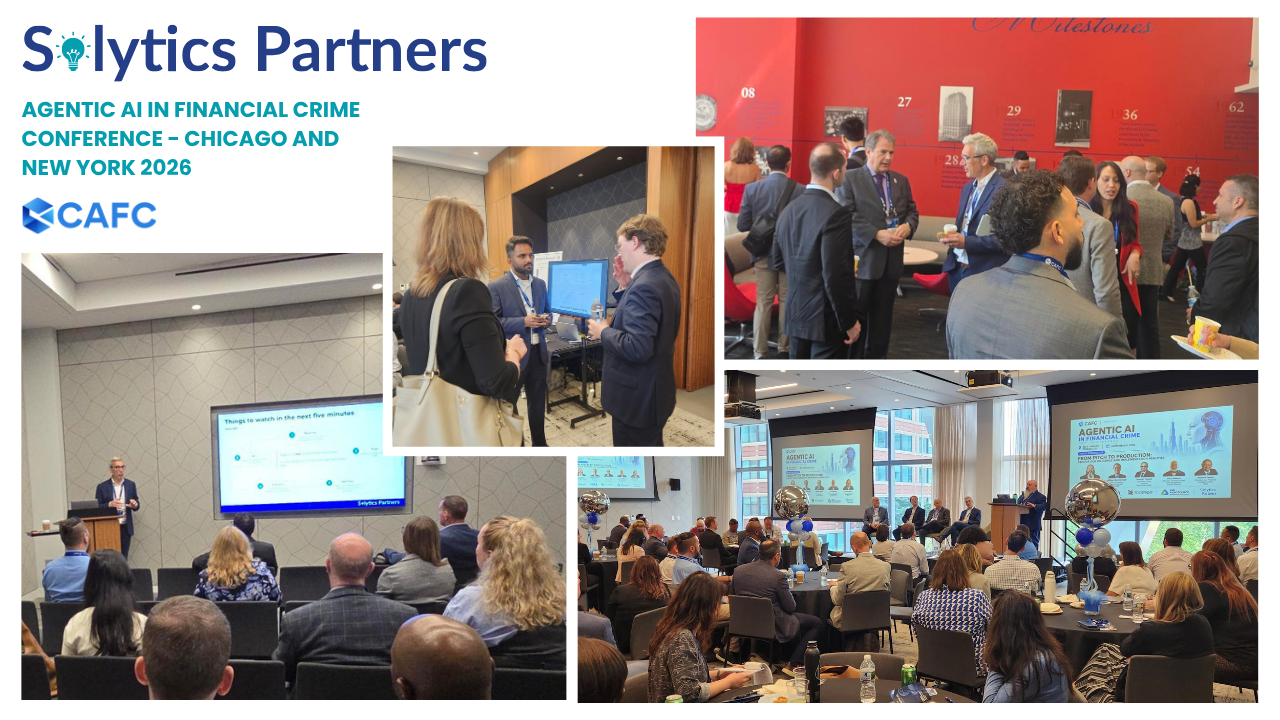
Recap: Solytics Partners at the CAFC Agentic AI in Financial Crime Conferences– Chicago & New York 2026

Key insights from the CAFC Agentic AI in Financial CrimeConferences in Chicago and New York on accountability, validation, AIinventory, and vendor scrutiny.
From Capability to Control: GoverningAgentic AI in Financial Crime
Solytics Partners participated as a Sponsorat the Coalition Against Financial Crime (CAFC) Agentic AI in FinancialCrime Conferences, held in Chicago on 8 September 2026 at BMO Towerand in New York on 10 September 2026 at St. John's University. The twoeditions convened practitioners, technology providers, and compliance leadersfrom across the financial crime community to examine the practical applicationof Agentic AI in financial crime and compliance operations. Solytics Partnerswas represented across both editions by Sunvik Chandan,Director – Business Development, and Patrick Bowe,Product Head – AML/FCC, and in New York by AnjanaDadlani, Director – Client Engagement.
A clear shift in emphasis characterisedboth editions. Discussion has moved beyond the capabilities of Agentic AItoward the question of governance: how should these systems be owned,validated, and controlled once they operate within production environments?
Session:Governed Agentic AI for AML Investigations
In Chicago, Patrick Bowe led a SolyticsPartners session on the application of Agentic AI to AML investigations,covering governed workflows and intelligence enrichment. The session examinedthe points at which AI agents are most likely to fail when introduced intofinancial crime workflows.
A live demonstration formed the centrepieceof the session. The agent failed during the demonstration, illustrating howquietly and unobtrusively failure can arise in agentic systems. Thedemonstration made a practical case that verification and control mechanismsmust be embedded in the deployment approach from the outset.

Prove It: AI Explainability, Auditability,and Defensibility (Chicago)
This panel, with Patrick Bowe as aparticipant, considered the documentation, controls, and evidence thatinstitutions require to support transparent and defensible AI-driven decisions.
From Pitch to Production: Vendor DueDiligence and Implementation Realities (New York)
In New York, Patrick Bowe contributed to apanel examining how institutions select, validate, and implement AI solutions,with particular attention to vendor risk and integration challenges.

Four themes emerged consistently across thetwo editions:
- Accountability. Institutions with differing governance structures reached a common position on ownership. The business process owner is accountable for the outcome, technology supports the process, and AML teams retain responsibility for regulatory compliance.
- AI inventory. Effective oversight depends on visibility into the AI already operating within an organisation, including capabilities that enter the environment through vendor platforms and product releases. The first regulatory challenge in many institutions may concern not a model, but the absence of a reliable inventory of the AI tools in use.
- Validation. A system that produces inconsistent responses to identical inputs cannot be adequately assured through an annual review. Consistency testing, edge-case analysis, and trigger-based review are emerging as baseline expectations for AI in production.
- Vendor scrutiny. Financial technology providers reported that their sponsor banks increasingly expect bank-grade model validation of the tools they procure. Buyers now ask which data sources underpin a solution, whose data it is, how current it is, and whether it can be evidenced.

- Establish ownership before deployment. Clear accountability for outcomes is the foundation for any AI use in financial crime operations.
- Maintain a complete AI inventory. This should include capabilities embedded within vendor platforms, as visibility underpins every other control.
- Move from periodic to continuous validation. Consistency testing and change-triggered review support defensible use in production.
- Design controls into the workflow. As agentic failure can be subtle, verification and human oversight should be integral to deployment rather than added afterwards.
- Prepare evidence for scrutiny. Institutions and vendors alike should be able to demonstrate data provenance, validation results, and the controls that support AI-enabled solutions.

The more rigorous questions now put tovendors are a constructive development, not an obstacle. They are what willallow AI in financial crime to be deployed at scale rather than shelved. Theeditions reinforced a principle central to the approach of Solytics Partners:Agentic AI in financial crime requires Governed Workflows, Verification,Human Oversight, and Decision Traceability.
Solytics Partners extends its thanks to theCoalition Against Financial Crime, the speakers, panelists, and participantsacross both editions, and to Sunvik Chandan, Patrick Bowe, and Anjana Dadlanifor representing the company.
.svg)


