Solytics Partners Secures a Trifecta of Wins at the Economic Times Enterprise AI Awards 2026


Building Intelligent Financial Crime Defence with GenAI and Agentic AI
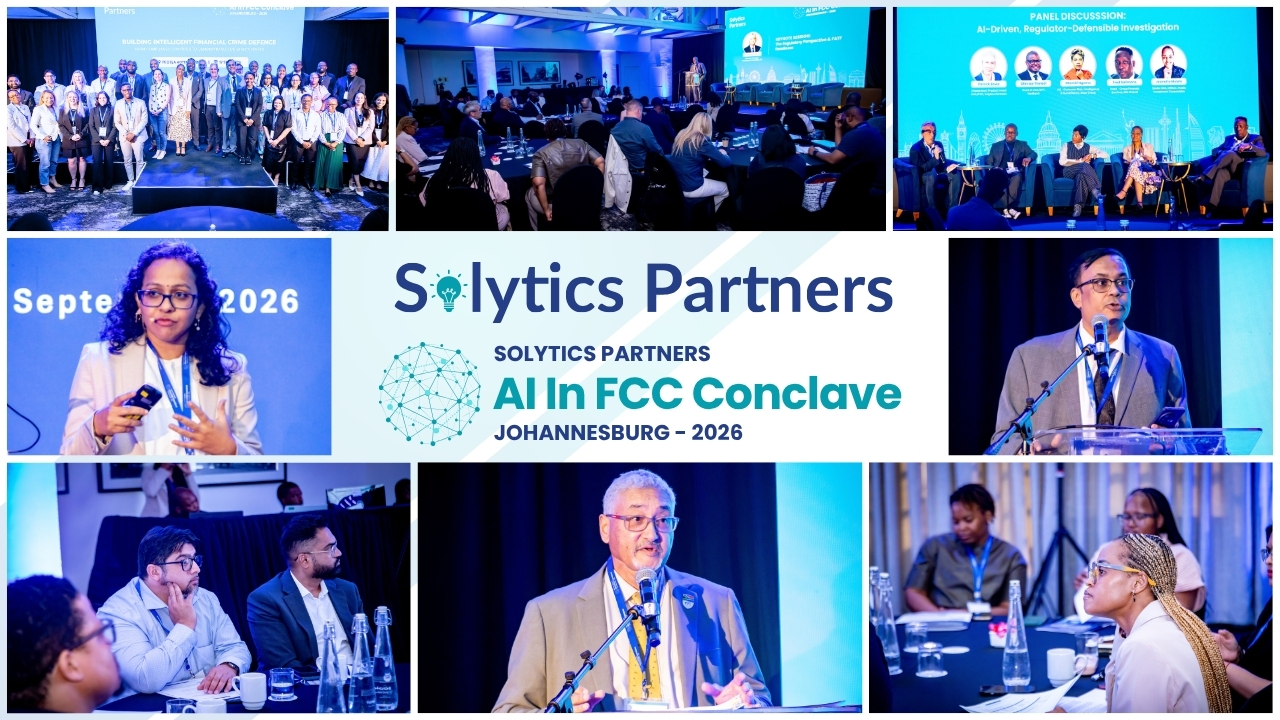
Solytics Partners hosted the AI in FCC Conclave – Johannesburg 2026, bringing together senior leaders across financial crime, fraud, compliance, risk, analytics, and technology. The goal was to examine how financial institutions can strengthen Financial Crime Compliance (FCC) while AI capabilities and regulatory expectations keep evolving. The theme was Building Intelligent Financial Crime Defence with GenAI and Agentic AI.


The conclave opened with welcome remarks from Dr. Manish Kumar, Co-Founder and Chief Analytics Officer at Solytics Partners. He set the context for the changing FCC landscape and described the industry's progression from rules-based detection, to GenAI-assisted investigations, and now to Agentic AI.
This led to the central question of the day: how can GenAI and Agentic AI be deployed across financial crime operations while keeping the governance, human oversight, auditability, and regulatory defensibility that a highly controlled environment demands?
The afternoon's discussions covered FATF Mutual Evaluation readiness, risk-based FCC effectiveness, transaction monitoring, AI-driven investigations, fraud-AML convergence, customer risk intelligence, case management, and the practical use of GenAI and Agentic AI across the financial crime operating model.

Topic: From compliance controls to demonstrable FCC effectiveness

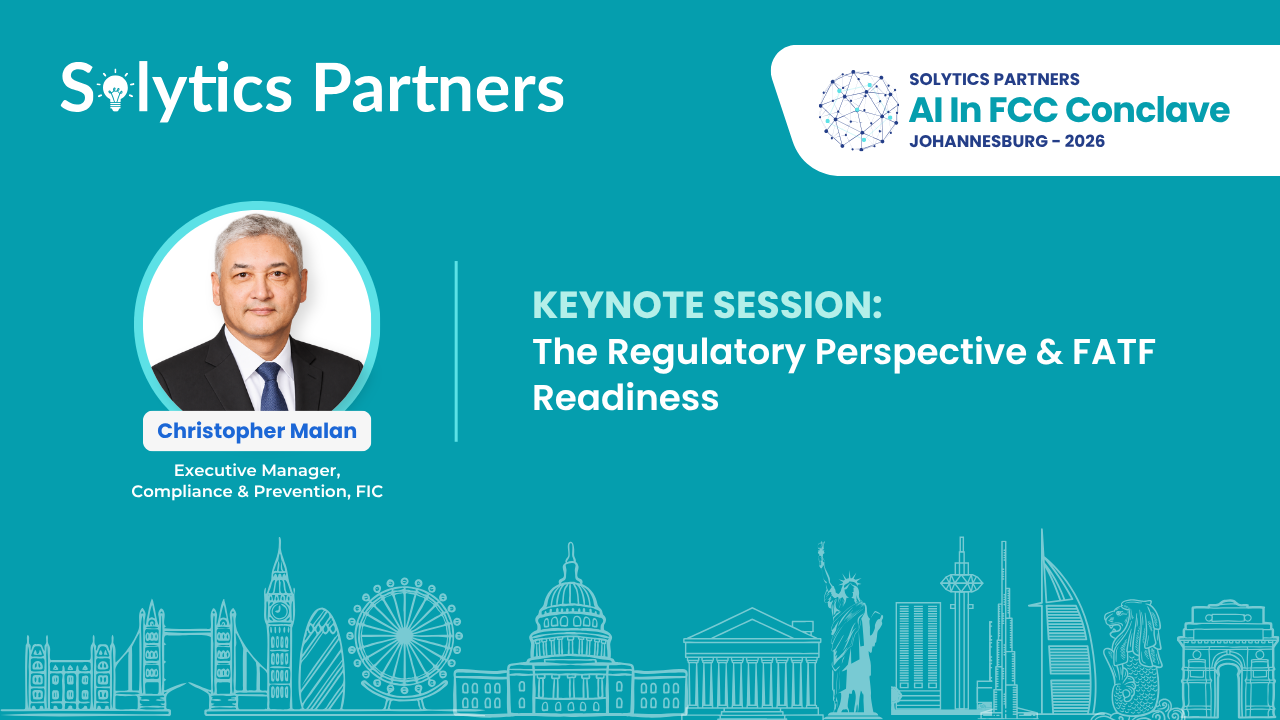
The regulator's view came from Christopher Malan, Executive Manager: Compliance and Prevention at the Financial Intelligence Centre (FIC), South Africa. His session focused on FCC effectiveness and FATF Mutual Evaluation readiness. He examined:
- what is expected in implementing and executing the risk-based approach
- how compliance behaviour has changed
- what has improved since the previous Mutual Evaluation
- how effective transaction monitoring systems are at achieving positive outcomes

Topic: AI-Driven, Regulator-Defensible Investigations

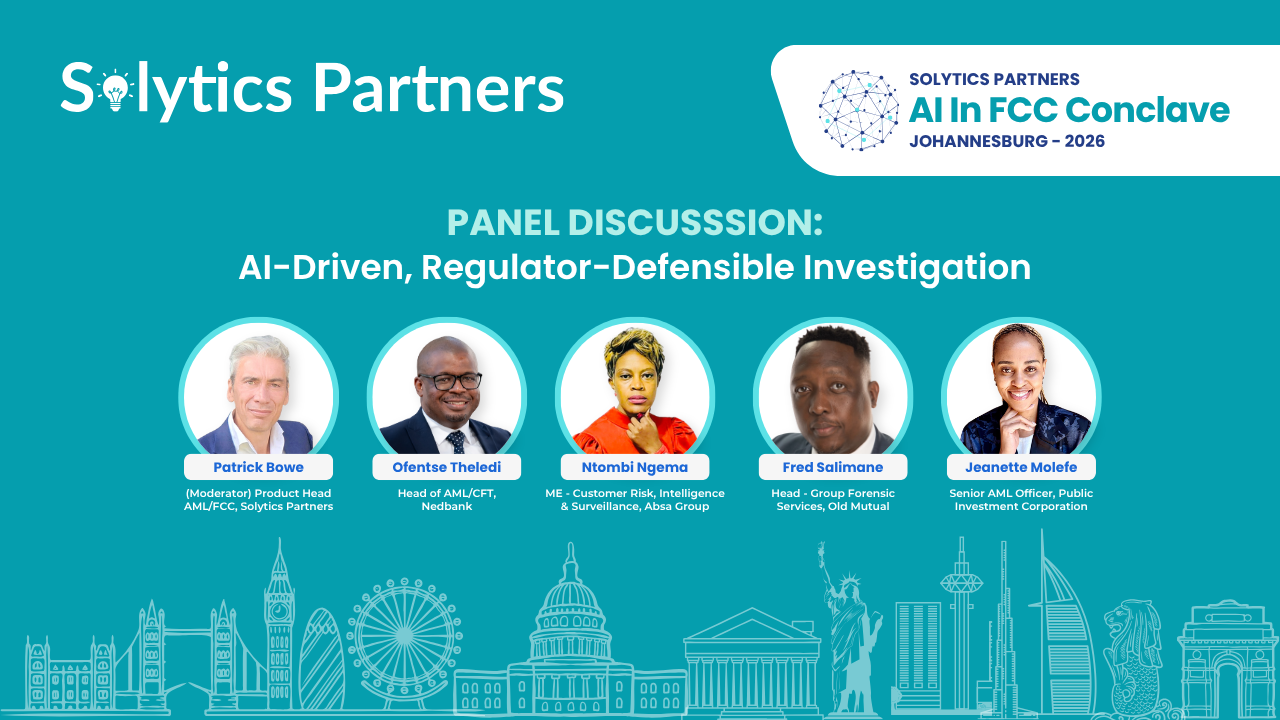
It was moderated by Patrick Bowe, Product Head – AML/FCC at Solytics Partners.
The panel explored how AI can be used across AML/CFT risk management, including risk assessment, transaction monitoring, sanctions screening, investigations, and case management, while keeping the oversight and controls that responsible adoption requires. The panelists also shared practitioner views on emerging financial crime typologies and on the practical realities of applying AI in day-to-day operations.
A key point was the need to move beyond conceptual AI adoption toward implementation frameworks that address model validation, ongoing monitoring, false-positive management, human oversight, governance, and auditability. The panel also made a point about people. As AI becomes part of investigative workflows, analysts need to be able to interpret, challenge, and contextualise AI-generated outputs rather than simply consume them.

Topic: Applying GenAI and Agentic AI across FCC operations

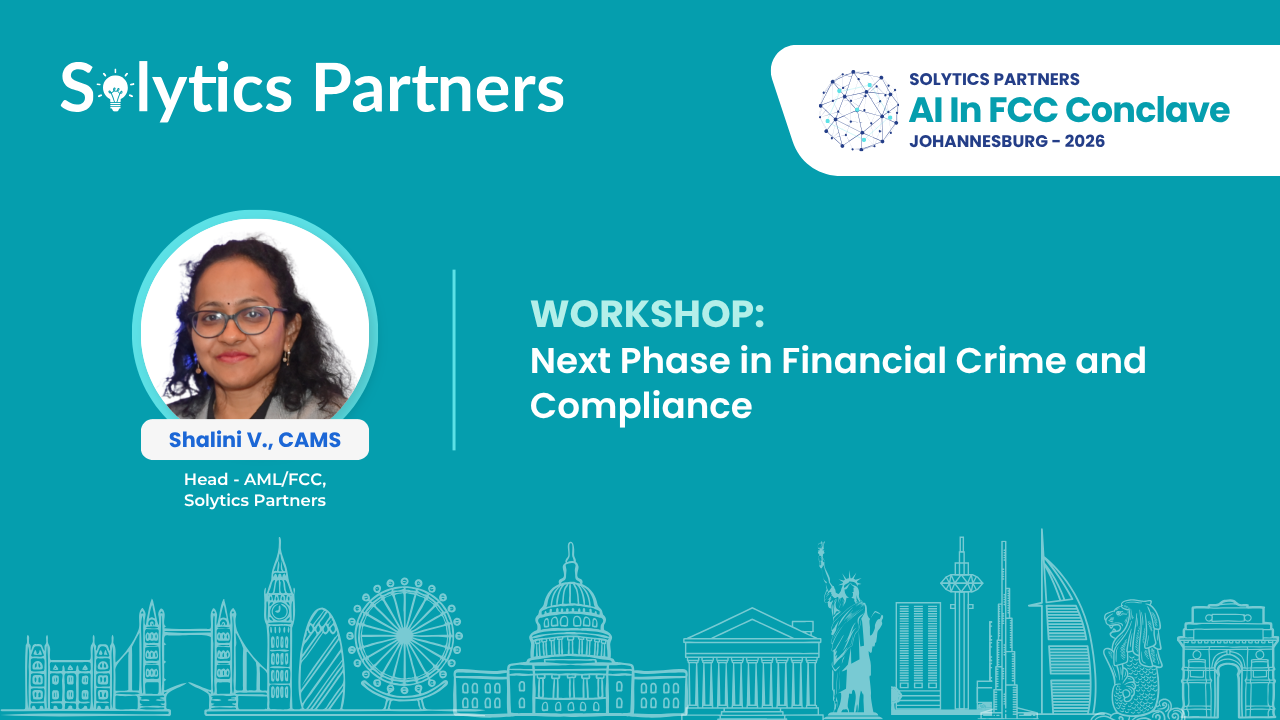
The workshop was led by Shalini V., Head of FCC at Solytics Partners, and moved the conversation from strategy into practice. It explored how GenAI and Agentic AI can be built into existing ML/TF/PF risk management processes and operating models. Participants looked at nine areas where intelligent technologies can support FCC operations:
- AI-powered adverse news screening, focused on identifying and escalating genuine risk rather than generating noise.
- Entity-centric CDD and EDD, bringing together relevant customer and entity intelligence in one place.
- End-to-end risk assessment, with configurable risk drivers, automated assessments, and integrated insights.
- Agentic AI for investigations, including autonomous L1 alert triage and disposition, with human-in-the-loop escalation.
- Transaction monitoring optimisation, using behavioural analytics and scenario tuning to improve detection and reduce false positives.
- Unified case management, combining investigation workflows, customer 360° views, AI-drafted STRs, and e-filing in a common environment.
- Dynamic customer risk intelligence, enabling continuous, behaviour-driven risk assessment instead of periodic snapshots.
- Fraud and AML intelligence fusion, giving a more connected view of criminal activity and networks.
- FCC effectiveness measurement and governance, covering management information, model validation, ownership, and evidence that can withstand regulatory scrutiny.
The workshop's main message was that the value of AI in FCC is not limited to automating individual tasks. Its greater potential lies in connecting fragmented processes and intelligence across the entire financial crime lifecycle, while keeping appropriate human decision points and governance controls.

- Identifying use cases is different from deploying them in a regulated setting.
- Production deployment needs: model validation, monitoring, false-positive management, explainability, human oversight, auditability.
- As AI moves into operational workflows (alert triage, investigation prep, information gathering, case disposition), it needs clear boundaries, escalation paths, ownership, and controls.
- Challenge for FCC leaders: Find where AI delivers measurable improvement while keeping controls transparent, reviewable, and regulator-defensible.

The conclave included a live Agentic AI demonstration showing how agentic capabilities can operate within an end-to-end financial crime investigation workflow.
The demo gave a practical view of how AI agents can support investigative processes rather than working as isolated analytical tools. It tied the day's themes of automation, investigation efficiency, human oversight, and governance to a tangible FCC workflow. The focus was on smarter detection and stronger investigations, backed by measurable evidence of FCC effectiveness.

The recap closes with six considerations for institutions evaluating the next phase of AI adoption in FCC:
- Regulatory effectiveness must remain central. AI adoption should contribute to demonstrable improvements in FCC outcomes, rather than becoming an objective in itself.
- AI needs to operate within a defined control framework. Human oversight, governance, audit trails, ownership, and appropriate escalation remain critical as AI becomes embedded in investigations and monitoring.
- Transaction monitoring requires more than model deployment. Behavioural analytics, scenario optimisation, false-positive reduction, validation, and continuous monitoring are all part of the implementation challenge.
- Agentic AI introduces a new operating model. Autonomous L1 triage, investigation support, and workflow orchestration create opportunities for greater efficiency, but they also require clear boundaries between automated actions and human decisions.
- Fraud and AML intelligence can be better connected. Combining signals across financial crime domains gives a more complete view of networks, behaviours, and emerging threats.
- FCC effectiveness needs to be measurable. Board and regulatory stakeholders increasingly want evidence that controls are operating effectively and producing meaningful outcomes.

The Johannesburg Conclave reinforced that the next phase of AI in financial crime is moving beyond experimentation. For financial institutions, the focus is increasingly on how GenAI and Agentic AI can be implemented responsibly, governed effectively, and connected to measurable improvements in financial crime effectiveness.