Solytics Partners Secures a Trifecta of Wins at the Economic Times Enterprise AI Awards 2026


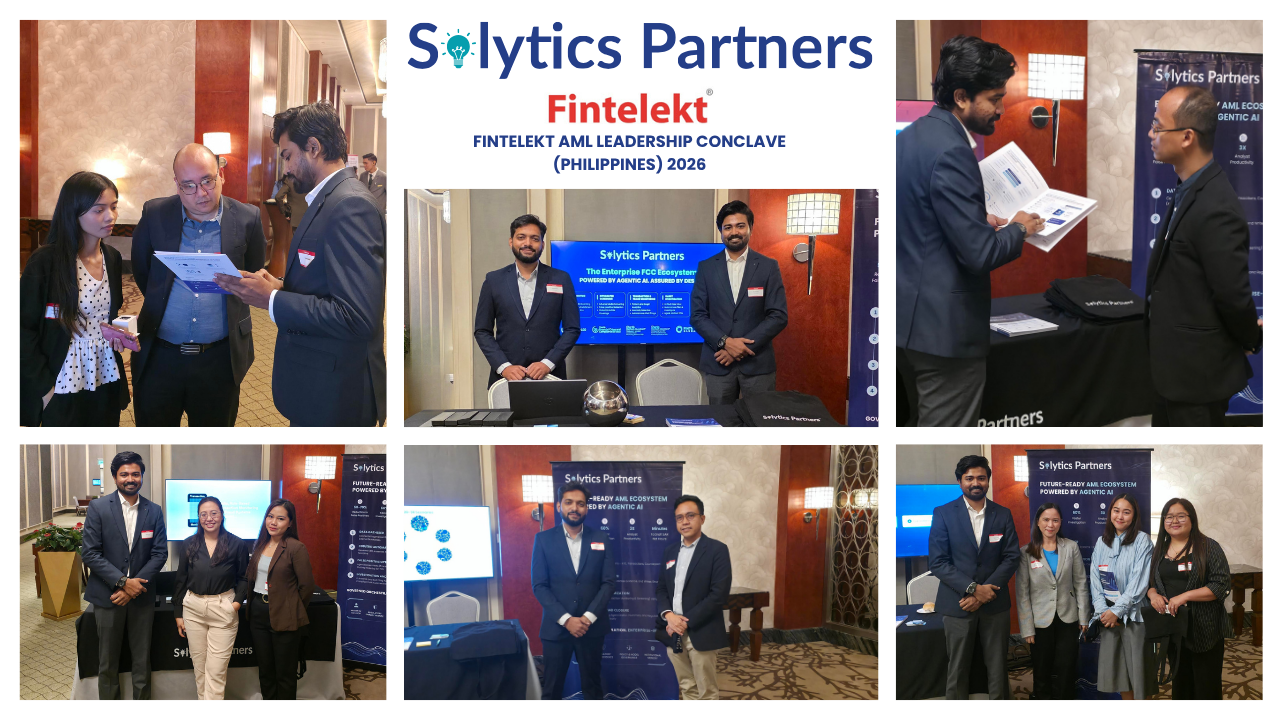
Fintelekt AML Leadership Conclave Philippines 2026: Key Takeaways on AML Effectiveness, AFASA, and GoTRACS Readiness
Strengthening AML Effectiveness in an Evolving Financial Crime Landscape
As a proud Sponsor of the Fintelekt AML Leadership Conclave (Philippines) 2026, Solytics Partners was delighted to engage with regulators, compliance leaders, banks, fintechs, and financial crime professionals to discuss the evolving AML landscape in the Philippines. The conclave provided a valuable platform for exchanging perspectives on regulatory priorities, emerging financial crime risks, and practical approaches to strengthening AML effectiveness.
The discussions reflected a clear industry shift from compliance-focused reporting toward demonstrable AML effectiveness. From AFASA implementation and GoTRACS readiness to digital banking risks, mule account detection, Fraud-AML convergence, and preparation for the 2027 APG Mutual Evaluation, institutions are increasingly focused on building stronger controls, improving risk visibility, and delivering measurable compliance outcomes.
AFASA, Digital Banking, and the Changing Risk Environment
A key area of discussion was the impact of the Anti-Financial Account Scamming Act (AFASA) and its implications for banks, digital banks, payment providers, and financial institutions operating in the Philippines.
As digital banking adoption continues to accelerate, institutions are facing new challenges associated with account misuse, fraud networks, scam-related transactions, and increasingly sophisticated money mule activity. Participants discussed the need for stronger fraud prevention strategies, better intelligence sharing, and enhanced monitoring capabilities to identify emerging threats earlier in the financial crime lifecycle.
Another recurring theme was the growing convergence of Fraud and AML. Criminal activity rarely operates in silos, and institutions increasingly recognize the value of connecting fraud signals, customer intelligence, transaction data, and AML investigations to create a more comprehensive view of financial crime risk.
From Manual Reporting to GoTRACS and Compliance Automation
One of the most insightful takeaways from our conversations was the continued reliance on manual processes for CTR and STR preparation and reporting across many financial institutions.
While manual reporting processes remain common, there is clear momentum towards modernization and automation. Organizations are actively exploring solutions that can streamline reporting workflows, improve data quality, reduce operational effort, and strengthen regulatory readiness.
Particular interest was seen around GoTRACS adoption, with institutions looking for more efficient ways to manage reporting obligations while maintaining accuracy, consistency, and auditability.
The transition toward automated reporting is not simply about efficiency. It is also about enabling compliance teams to focus on higher-value investigative activities while improving the overall effectiveness of financial crime programmes.
Preparing for the 2027 APG Mutual Evaluation
The upcoming 2027 APG Mutual Evaluation was another important area of discussion throughout the event.
As regulatory expectations continue to evolve, institutions are increasingly being evaluated not only on the existence of controls but on their ability to demonstrate measurable outcomes. This shift places greater emphasis on risk-based approaches, effective transaction monitoring, meaningful investigations, and the ability to evidence the impact of financial crime controls.
Discussions highlighted the importance of building integrated AML frameworks that can support regulatory expectations while remaining scalable and operationally efficient.
Enabling End-to-End Financial Crime Compliance
Throughout the conclave, the Solytics Partners team engaged with industry leaders on how technology can help strengthen AML effectiveness across the financial crime lifecycle.
We shared how our end-to-end FCC ecosystem brings together:
- Customer Screening
- Transaction Monitoring
- Fraud Monitoring
- Unified Case Management
- Mule Account Detection
- Unified Fraud and AML Controls
- Automated CTR/STR Reporting
- AI/ML-powered Risk Intelligence
By connecting traditionally fragmented processes and adopting a risk-based approach, financial institutions can improve operational efficiency, strengthen AML controls, enhance investigation quality, and identify financial crime risks earlier.
Looking Ahead
The Fintelekt AML Leadership Conclave (Philippines) 2026 reinforced a clear industry direction: institutions are prioritizing AML effectiveness, regulatory readiness, Fraud-AML convergence, and operational modernization.
As a Sponsor, Solytics Partners was proud to contribute to these discussions and engage with industry leaders navigating the next phase of financial crime compliance transformation. As AFASA implementation progresses, GoTRACS adoption increases, and preparations for the 2027 APG Mutual Evaluation continue, integrated and outcome-focused FCC programs will become increasingly important.
We thank Fintelekt, the speakers, and all participants for the valuable conversations and insights shared throughout the event. We look forward to continuing these discussions and supporting financial institutions across the Philippines and the broader APAC region in building effective, scalable, and future-ready AML programs.
.svg)


