Solytics Partners Secures a Trifecta of Wins at the Economic Times Enterprise AI Awards 2026


From AML Alerts to Assured Investigations: Agentic AI in Action
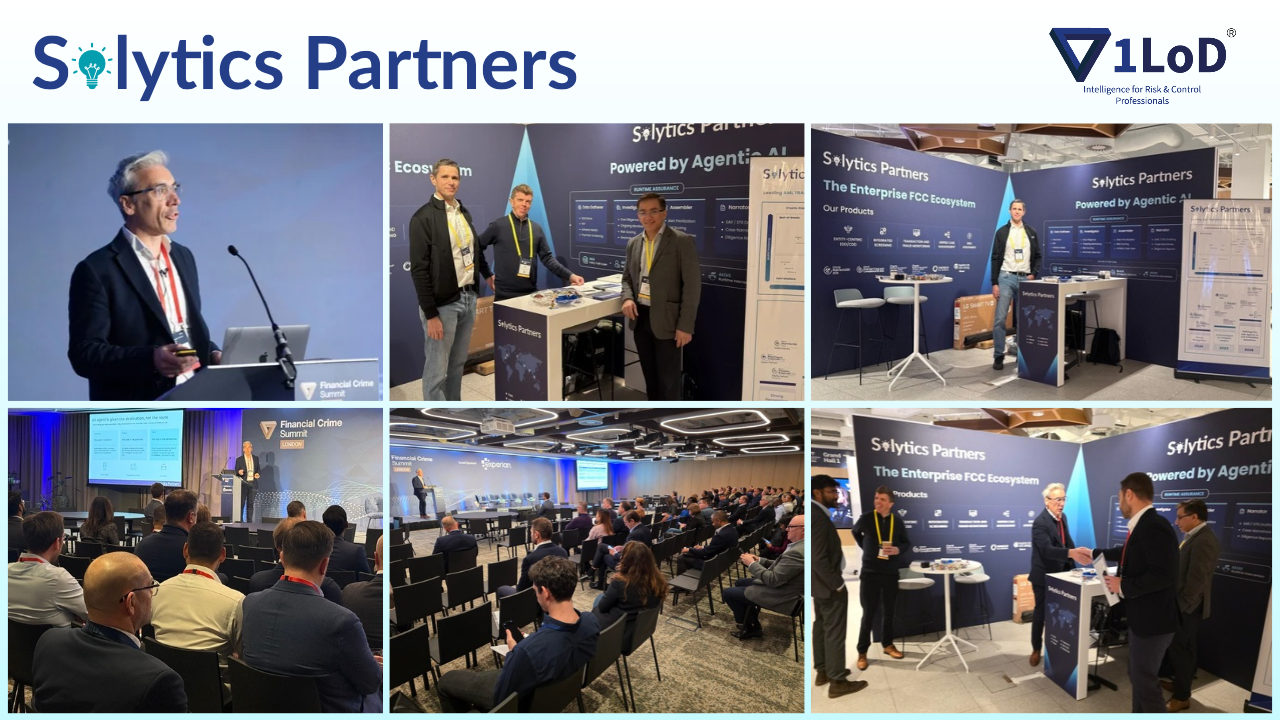
Financial institutions are being asked to detect more, investigate faster and demonstrate regulatory confidence, all while managing cost and operational complexity. These expectations were at the centre of the conversation at the 1LoD Financial Crime Summit London 2026, where Solytics Partners participated as a sponsor.
The summit was held on Thursday, 12 November 2026 at Convene Sancroft, St Paul’s, London. It brought together financial crime, compliance and risk professionals to discuss how automation and AI can strengthen financial crime controls with greater efficiency and oversight.
Case Study Session
Topic: From AML Alerts to Assured Investigations: Agentic AI in Action
Solytics Partners presented a case study in Grand Hall 2. It was delivered by Patrick Bowe, Product Head of AML/FCC at Solytics Partners, and examined how AI agents can support financial crime investigations without compromising control or accountability.
The session began by distinguishing three approaches often grouped together under the term “AI”:
- Automation follows a fixed route. Each step runs in the same order every time and cannot respond to the unexpected.
- A copilot answers questions, summarises and drafts, while the investigator decides every next step.
- An agent is given the destination rather than the route. It selects its sources, decides when the work is complete and documents the evidence, working within a defined set of limits.
The central point was that an agent’s value depends on the harness that surrounds it.
Live Demonstration: Agentic AI in an EDD Investigation
The session included a live demonstration of an AI agent working through an Enterprise Due Diligence (EDD) investigation in real time. Gathering and assembling evidence typically takes up the largest share of an investigator’s working day. When this is delegated to an agent, the analyst can concentrate on the judgement that only a human can provide: determining whether the investigation points to genuine financial crime risk.
The demonstration also showed that the agent’s capabilities are only part of the question. A harness defines what an agent is permitted to do, but it cannot, on its own, confirm that the agent was properly tested, has not drifted, or is acting within policy.
Three Tests for Any AI Agent
The session proposed three practical tests that institutions can apply to any agent, from any vendor:
- Is the conclusion supported? Findings should be traceable to the evidence gathered.
- Did context survive each step? Information should be carried accurately through every stage of the investigation.
- Could the investigation be re-created six months later under audit? This should be possible without relying on the analyst who first handled the case.
An agent deployed for productivity gains, without an evidence package that can be reconstructed later, creates a form of regulatory debt that grows over time.
Conversations at Booth 6
At Booth 6, the Solytics Partners team presented the Enterprise Financial Crime Compliance Ecosystem, powered by Agentic AI, and met banks, financial institutions and compliance professionals throughout the day.
The discussions reflected a clear direction across the industry. Organisations are actively seeking automation, operational efficiency and AI-driven compliance solutions, provided these remain governed, transparent and defensible before regulators.
Key Considerations for Financial Crime Leaders
The summit reinforced several priorities for institutions evaluating AI in financial crime compliance:
- Define the role of AI clearly. Automation, copilots and agents carry different levels of autonomy and call for different controls.
- Keep human judgement where it matters most. Agents can take on evidence gathering, leaving analysts to assess genuine financial crime risk.
- Build evidence that endures. Investigations should remain reproducible, explainable and audit-ready long after the decision is made.
- Test and monitor agents continuously. Proper testing, drift monitoring and adherence to policy are prerequisites for responsible deployment.
Looking Ahead
The London summit reaffirmed that the next stage of AI in financial crime compliance depends on practical, governed deployment that delivers measurable efficiency while preserving a defensible evidence trail.
If your institution is exploring AI-driven approaches to AML, investigations or financial crime compliance, we would welcome the opportunity to continue the conversation. Please contact the Solytics Partners team to discuss how the Enterprise Financial Crime Compliance Ecosystem can support your objectives.