We have been recognized in RegTech100 2026 - Strengthening leadership across AI governance, MRM and FCC


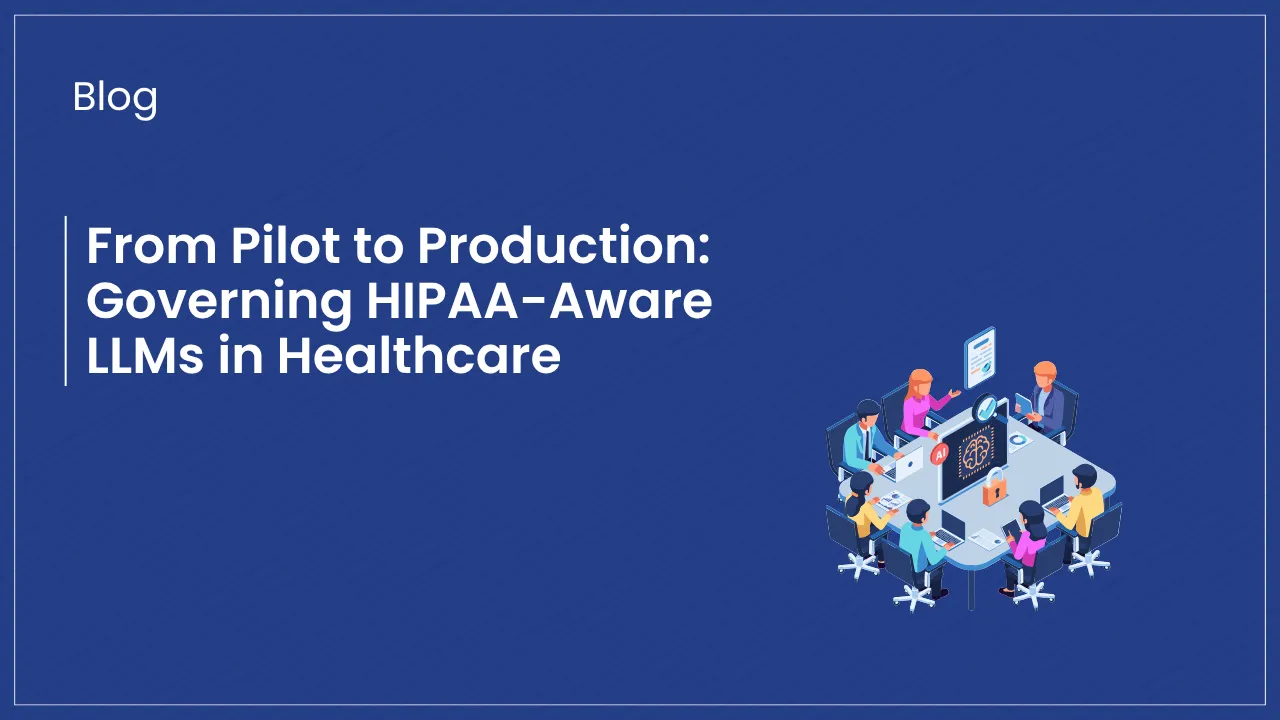
Introduction
Most healthcare AI initiatives succeed at the pilot stage, but fail when they try to scale.
Large Language Models (LLMs) are already transforming clinical documentation, patient engagement, internal knowledge access, and administrative workflows. In controlled environments, these systems often perform well. But production introduces a different set of challenges — ones that are less about model capability and more about robust controls and governance.
The Healthcare sector is under strict scrutiny from an AI/GenAI risk perspective since it deals with critical and confidential patient data. Any LLMs or GenAI use cases must operate within strict boundaries: protecting Protected Health Information (PHI), maintaining reliability in sensitive workflows, and remaining sustainable in terms of cost and performance.
Deploying LLMs is simple, but having a regulatory-aligned assurance layer is the key problem.
The Three Pillars of Healthcare LLM Governance
Healthcare organizations need to think about LLM deployment through three simultaneous lenses: 1) privacy and security, 2) clinical reliability, and 3) operational sustainability. If any one of these is weak, the overall program becomes difficult to scale.
PHI Exposure and Privacy Risk
Every interaction with an LLM — prompt, retrieval call, generated output, and log — can become a potential exposure point. PHI risk is not just confined to storage but exists across the entire runtime lifecycle.
Effective systems enforce:
- Minimum-necessary data access aligned with HIPAA expectations
- Prompt and response redaction layers
- Retrieval controls within RAG pipelines
- Vendor and API-level safeguards
- Audit-ready logging and traceability
Hence, it is imperative that PHI protection is built into the core architecture from the very start.
Clinical Reliability and Output Risk
In healthcare, weak or incorrect outputs are not just inconvenient — they can introduce massive downstream operational or clinical risk.
Even in non-diagnostic use cases, organizations must ensure:
- Outputs are grounded in approved knowledge sources
- Responses remain within defined scope and policy
- Hallucinations and outdated reasoning are detected early
- Model and prompt changes are traceable
Cost and Operational Sustainability
LLM deployments do not stay small for long.
A use case that appears efficient during a pilot can become expensive in production due to:
- Increased query volume
- Inefficient prompt design
- Redundant or excessive retrieval calls
- Lack of usage controls
Latency is equally critical. In clinician-facing or operational workflows, delays can erode trust and disrupt decision-making.
What Good HIPAA-Aware LLM Governance Looks Like
Strong healthcare LLM governance doesn't mean restricting access to PHI, but creating a governed system that can continuously observe privacy risk, runtime behavior, cost, and performance together. This includes implementing controls such as LLM guardrails to manage sensitive data exposure, enforce usage policies, and improve the reliability of AI-generated responses.
Mature implementations usually share a few common characteristics:
PHI-Scoped Architecture
Good implementations treat PHI protection as an architectural requirement instead of a policy add-on. Prompts should be checked for unnecessary identifiers before submission. Retrieval layers should enforce access and scope boundaries. Outputs should be reviewed for leakage risk, and logs should be retained in a way that supports traceability and auditability.
Explainability and Traceability
Healthcare teams need to understand how a response was generated, what model or prompt version was active, what documents were retrieved, and what controls were applied. Without this level of visibility, governance becomes difficult to defend internally or externally.
Real-Time Monitoring
Periodic review is not enough. Teams need real-time visibility into PHI-sensitive interactions, model behavior, latency drift, and cost anomalies. Combined with safety evaluation for LLMs, continuous monitoring helps healthcare organizations detect unsafe outputs, emerging risks, and compliance issues before they affect clinical workflows.
Response and Remediation Workflows
Monitoring alone is not enough. Once a risk signal is identified, there should be a structured process around escalation, investigation, remediation, and documentation. In healthcare, the difference between a monitoring event and a governed control response is significant.
Where Healthcare Organizations Typically Struggle
The core challenge facing healthcare organizations is fragmented, siloed existence of data, analytics, metrics, and controls. This can make LLM evaluation difficult to manage consistently across different systems and workflows.
PHI detection may exist in one system, model metrics in another, cloud cost dashboards elsewhere, and approvals managed through manual workflows. Documentation is often scattered across teams.
Compliance teams spend time stitching together evidence. Technology teams identify operational issues too late. Finance sees cost surprises after the billing cycle. Governance remains reactive rather than continuous.
That is why healthcare organizations need more than individual controls. They need a centralized assurance model with a connected governance layer around it.
Solytics Partners: A Connected Approach to Healthcare LLM Governance
Solytics Partners addresses this through a connected architecture:
- Nimbus Uno acts as the runtime control layer — enabling evaluation, observability, PHI-aware monitoring, latency tracking, benchmarking, and policy-aligned oversight across GenAI workflows.
- MRM Vault provides the governance layer — supporting centralized use-case inventory, approval workflows, lifecycle tracking, findings management, and audit-ready documentation.
Together, they create a system where:
- PHI exposure, cost, latency, and model behavior are continuously monitored
- Governance decisions are recorded, traceable, and defensible
- Risk signals are linked directly to remediation workflows
Conclusion
HIPAA-aware LLM governance is ultimately about discipline and foresight. It is about ensuring that healthcare AI systems, apart from being useful, are also bounded, traceable, and manageable at scale.
That requires a combination of runtime observability, structured evaluation, human oversight where needed, lifecycle governance, and documentation that can support internal review as well as external scrutiny.
Healthcare organizations already understand the potential of LLMs. The real differentiator now is not whether they can launch an AI use case, but whether they can govern it once it becomes part of day-to-day operations.
The institutions that scale healthcare AI successfully will not be the ones experimenting the fastest. They will be the ones that build the strongest foundation for monitoring PHI exposure, controlling cost, managing runtime reliability, and maintaining a clear governance record from pilot to production.
Explore the Solytics Ecosystem
Explore Nimbus Uno for LLM/GenAI evaluation, observability, monitoring, and continuous assurance.
Explore MRM Vault for GenAI inventory, approvals, lifecycle governance, findings, and documentation.
Explore MoDeVa for deeper model validation, interpretability, and broader model assurance needs.
References
- ADHERENCE – Maintaining HIPAA Compliance in Healthcare: Developing an Internal LLM for Data Privacy – https://www.moriskyscale.com/adherence-blog/maintaining-hipaa-compliance-in-healthcare-developing-an-internal-llm-for-data-privacy
- QuickBlox – HIPAA Compliance and AI Assistants: Telehealth Guide – https://quickblox.com/blog/hipaa-compliance-and-ai-assistants-telehealth-guide/
- TopFlight Apps – Build a HIPAA Compliant App – https://topflightapps.com/ideas/build-a-hipaa-compliant-app/
- HIPAA Journal – When AI Technology and HIPAA Collide – https://www.hipaajournal.com/when-ai-technology-and-hipaa-collide/
- TechTarget – AI and HIPAA Compliance: How to Navigate Major Risks – https://www.techtarget.com/healthtechanalytics/feature/AI-and-HIPAA-compliance-How-to-navigate-major-risks
- National Institute of Standards and Technology (NIST) – AI Risk Management Framework – https://www.nist.gov/itl/ai-risk-management-framework
- Securiti – AI Governance in Healthcare – https://securiti.ai/ai-governance-in-healthcare/
- PubMed Central (PMC) – AI in Healthcare – https://pmc.ncbi.nlm.nih.gov/articles/PMC12075486/
- National Center for Biotechnology Information (NCBI) – NCBI Bookshelf – https://www.ncbi.nlm.nih.gov/books/NBK613808/
- PubMed Central (PMC) – AI in Healthcare – https://pmc.ncbi.nlm.nih.gov/articles/PMC12460403/
- ScienceDirect – AI Governance in Healthcare – https://www.sciencedirect.com/science/article/pii/S2667102625001044
- NeuralTrust – Gen AI Security in Healthcare – https://neuraltrust.ai/blog/gen-ai-security-healthcare
- ClearDATA – LLMs in Healthcare – https://cspm.cleardata.com/cleardata-blog/blog/llms-in-healthcare/
- arXiv – AI Governance and Healthcare Systems – https://arxiv.org/html/2511.11347v2
- Noggin – The Future of Healthcare Incident Management: AI & Machine Learning in Software Solutions – https://www.noggin.io/blog/the-future-of-healthcare-incident-management-ai-machine-learning-in-software-solutions
.webp)
.svg)


