We have been recognized in RegTech100 2026 - Strengthening leadership across AI governance, MRM and FCC


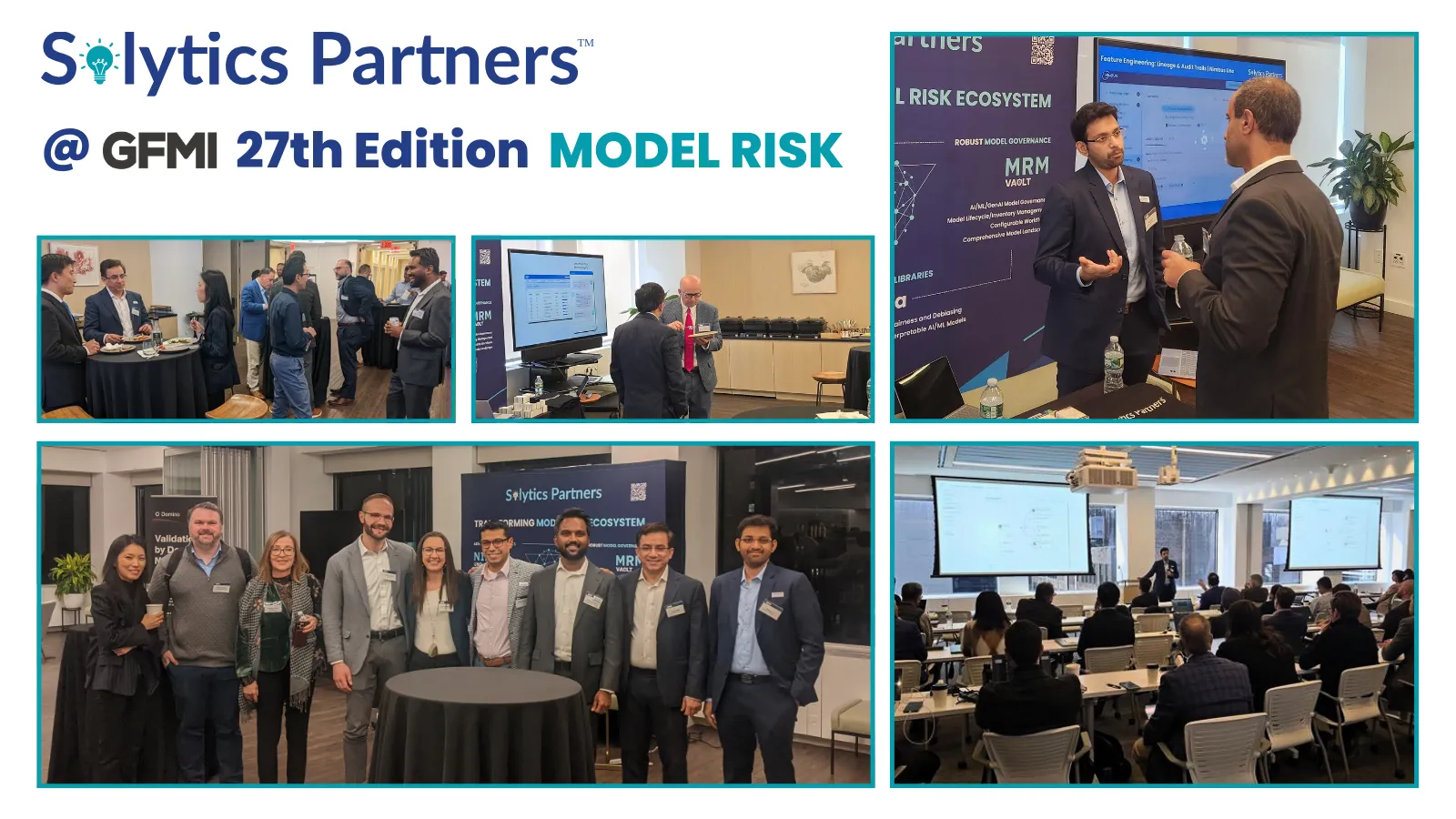
Solytics Partners at the 27th GFMI AI Governance Conference, New York: Driving Scalable, Responsible, and Enterprise-Wide AI Governance
Solytics Partners participated as a sponsor and speaker at the 27th Edition of the GFMI AI Governance Conference in New York, a premier gathering that brought together banks, asset managers, insurers, FinTechs, and regulators for three days of in-depth dialogues on AI risk, governance, validation, and the next generation of intelligent systems, including agentic AI.
The event provided a platform for industry leaders to exchange practical strategies for building scalable AI governance frameworks, strengthening model oversight, and operationalizing responsible AI adoption across complex enterprise environments.
Solytics Partners contributed actively through expert sessions, platform demonstrations, and discussions on the future of AI governance aligned with global regulatory expectations.
Key Themes Shaping the Future of AI Governance
1. Governance Must Scale with AI Complexity
A recurring message across keynotes and panel sessions was the need for governance frameworks that evolve with the sophistication of AI systems. Institutions emphasized:
- Robust model classification and tiering
- Proportional governance based on materiality and risk
- Extending SR 11-7 style controls to GenAI and agentic workflows
Speakers reinforced that tiering not only supports automation and traceability but also helps organizations allocate validation and monitoring resources more effectively.
2. Transitioning from Traditional MRM to Enterprise AI Governance
As financial institutions rapidly adopt ML, GenAI, and autonomous systems, model risk management is expanding into a broader discipline of enterprise AI governance. Discussions highlighted:
- Increased transparency and explainability challenges in GenAI
- Regulatory focus on fairness, accountability, resilience, and bias
- The need for demonstrable control over continuous learning systems
Representatives from the Federal Reserve reiterated that “responsible AI use requires clear frameworks, appropriate controls, and complete documentation.”
3. High-Quality Inventory Is the Foundation
Nearly every session underscored the importance of a complete and accurate AI inventory. Institutions shared best practices including:
- Standardized definitions that distinguish models, tools, and applications
- Automated inventory solutions that support lineage tracking and dependency mapping
- Strong collaboration between developers, governance teams, and business users
This aligns closely with Solytics Partners’ capabilities in building unified, automated model inventories across AI ecosystems.
4. Validation and Audit Must Evolve
With the increasing volume and complexity of AI systems, institutions are rethinking their approaches to assurance. Priority areas included:
- Risk-segmented validation processes
- Automation for testing, evaluation, and monitoring
- Closer integration between audit, validation, and MRM functions
Workshops emphasized the importance of continuous monitoring for high-risk models and emerging GenAI use cases.
Solytics Partners’ Contribution: Enterprise AI Governance in Practice
At the conference, Alberto Ramirez (Partner, Risk Analytics) and Kannan Venkataramanan (Lead, MRM & GenAI Governance) delivered a specialized session titled: “Comprehensive AI Governance Across Traditional, ML & GenAI Systems.” The session covered:
- A unified and structured lifecycle: registration, validation, monitoring, and change management
- Enterprise-wide governance frameworks that support Traditional Models, ML Models, GenAI systems, and agentic workflows
- Practical adoption of AI Vault and Nimbus Uno within an AI governance platform to enable scalable, consistent governance
Key Implementation Insights Shared:
- Standardized control frameworks accelerate safe AI adoption
- Full lineage, documentation, and traceability improve audit readiness and regulator confidence
- Centralized governance strengthens reliability, fairness, and continuous assurance
The presenters also shared examples of deployments with large banks, insurers, and digital enterprises establishing their AI governance programs.
Regulatory and Industry Priorities Highlighted
Across sessions, regulators and practitioners aligned on several emerging supervisory expectations:
- SR 11-7 remains foundational, but now explicitly extends to GenAI and Agentic AI
- Greater emphasis on model tiering methodologies
- Documentation rigor and audit trails for all AI systems
- Heightened scrutiny of bias, fairness, drift, and resilience
The Federal Reserve panel underscored responsible AI use, the need for transparent control frameworks, and adopting risk-based oversight for modern AI portfolios.
Workshops: High-Risk Use Cases and Third-Party AI Governance
The final day of the conference featured hands-on workshops on practical assurance techniques for complex and high-risk AI applications. Institutions explored:
- Validation strategies for high-stakes GenAI and ML models
- Bias and fairness testing
- Continuous monitoring frameworks
- Governance approaches for third-party and vendor AI systems, including:
- Supplier risk assessments
- Transparency and documentation challenges
- Re-validation cycles
Participants gained actionable methodologies to embed into their operating models.
Solytics Partners: Supporting the Industry's AI Governance Transformation
The conference reinforced that scalable governance, lifecycle automation, and specialized talent are now essential for responsible AI adoption in financial institutions.
Solytics Partners continues to support this evolution through:
- Enterprise AI Governance Frameworks
- MRM and Compliance Automation Solutions
- AI Ecosystem Platforms: AI Vault and Nimbus Uno
- Implementation Support for Banks, Insurers, and Digital Enterprises
Our work ensures institutions can adopt AI confidently, transparently, and in full alignment with regulatory expectations, positioning them for long-term success in an AI-driven landscape.
.svg)


